


Warehouse robot maker Vecna Robotics has raised $31 million in venture backing, saying that it plans to boost its commercial sales and to accelerate the development of new capabilities as demand for American-made warehouse automation technology soars in the wake of a recent White House policy prohibiting the purchase of certain robots from foreign companies.
Waltham, Massachusetts-based Vecna said the funding will support growing demand and strengthen its “increasingly strategic role in North American robotics amid a shifting regulatory landscape.”
The U.S. Federal Communications Commission (FCC) in July banned many imported robots from sale in the U.S. in a move intended to close national security risks and to encourage domestic robot production. Details were scarce in the brief announcement, but industry analysts said the policy could evidently stop U.S. companies from purchasing many of the foreign-made mobile robot models frequently used in logistics, such as AMRs and AGVs for goods-to-person, sortation, and picking applications.
With foreign robotics vendors excluded from the arena, attention has quickly turned to U.S.-based producers. That is one reason for the timing of Vecna’s new funding. The “series D” round was led by Unless, with participation from existing investors Drive Capital, Tiger Global, Highland Capital Partners, and Tectonic Ventures.
In addition to the fast-changing regulatory landscape, longer-term market forces are also driving demand for Vecna’s products, Vecna CEO Karl Iagnemma said. The company said that demand for flexible automation continues to grow as warehouse and manufacturing operators look to increase productivity, reduce non-value-added travel, and automate material movement without the constraints of fixed infrastructure.
The potential market is huge, Iagnemma said, with an estimated 15 billion square feet of warehouse space in North America alone and market penetration that is “still relatively modest” since the vast majority of warehouses in the U.S. don’t have material handling automation.
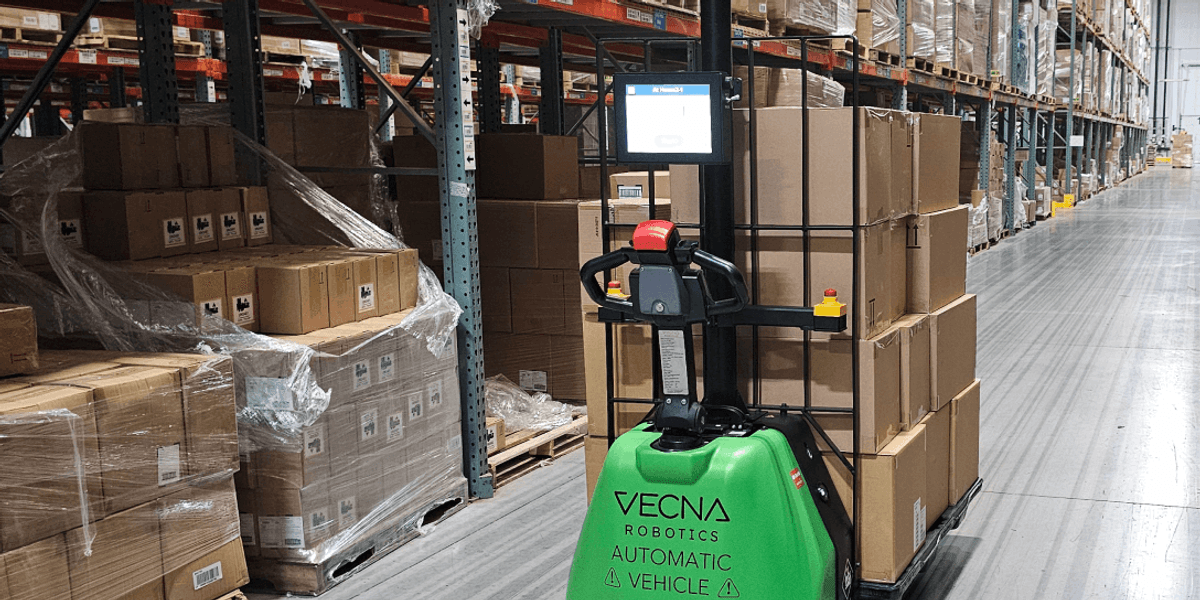
Vecna currently meets that demand with its portfolio of autonomous forklifts, tuggers, and pallet jacks, and with its newest product, the CaseFlow platform that automates the labor-intensive work of case picking. The company is now also developing two new product families, saying it is “close to delivering” a system for pallet stacking and de-stacking, and a system for autonomous trailer loading and unloading.
The new FCC policy will likely accelerate demand for those products, although its brevity has raised questions about exactly how it will be applied. “You can’t overstate the importance of that ruling. It was a very short announcement with a potentially broad impact,” Iagnemma said. “Within 72 hours of the FCC announcement, we had a surge of inquiries from customers, both asking about our products and also looking in part how to understand the policy change.”
