

Dumka, Jharkhand: Villagers Halt Neyveli Uttar Pradesh Power Coal Mine Work Over Compensation – Indian PSU

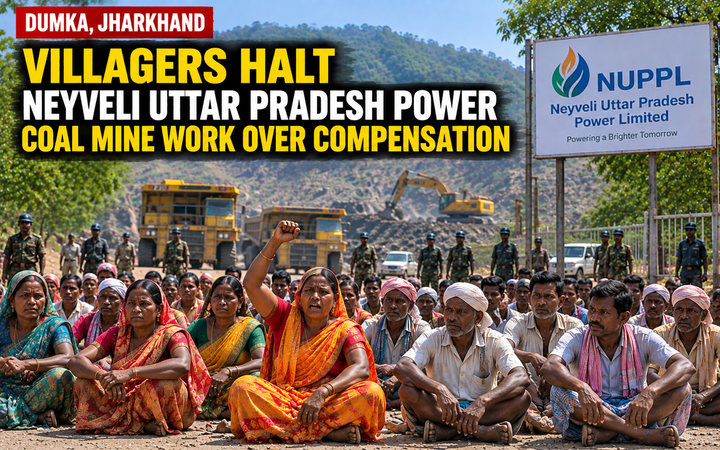
Villagers have halted mining-related activities at the Pachwara South coal project in Dumka, Jharkhand, protesting over compensation, rehabilitation and public-hearing issues linked to the project being developed for Neyveli Uttar Pradesh Power Limited (NUPPL).
The protest has disrupted the movement of coal and mining vehicles in the affected area, with villagers demanding that their concerns be addressed before mining activities resume.
The agitation comes after villagers announced that they would stop mining-related work and vehicle movement from September 14 over what they describe as unresolved issues concerning compensation, public consultation, rehabilitation and employment.
Compensation at the Centre of the Dispute
Compensation has emerged as one of the key points of contention between affected villagers and the project authorities.
Villagers are demanding greater clarity and transparency in the assessment of compensation for land, houses and other assets affected by the coal project. They have also raised concerns about whether the compensation being offered adequately reflects the losses suffered by families whose land and livelihoods are affected.
For rural families, the issue is particularly significant because agricultural land is often the primary source of income and livelihood.
The protesters are seeking a transparent assessment of their losses and timely payment of compensation before further disruption to their land and livelihoods takes place.
Demand for Public Hearing
The villagers are also demanding a proper and transparent public hearing covering the communities affected by the project.
They allege that the concerns of local residents have not been adequately addressed and want affected families to be given an opportunity to raise questions and objections concerning land acquisition, compensation, rehabilitation, employment and the project’s environmental and social impact.
The demand is therefore not limited to financial compensation. Villagers are seeking greater participation in decisions that could fundamentally alter their communities and livelihoods.
Employment and Rehabilitation Concerns
Employment is another major issue raised by the protesting communities.
Villagers want local residents, particularly families directly affected by land acquisition, to receive employment opportunities arising from the mining project.
They have also sought clarity on rehabilitation and resettlement measures for affected families and the benefits that local communities will receive from development and corporate social responsibility initiatives.
The protesters have raised concerns over the possible impact of mining on agriculture, water resources, health, the environment and traditional livelihoods.
What Is NUPPL?
Neyveli Uttar Pradesh Power Limited (NUPPL) is a joint venture between NLC India Limited and Uttar Pradesh Rajya Vidyut Utpadan Nigam Limited (UPRVUNL).
The company is involved in power generation and coal-related activities, including the development of coal resources required for its operations.
Its Pachwara South Coal Block is located in Dumka district of Jharkhand and is intended to provide captive coal for the company’s power-generation requirements.
According to the Ministry of Coal’s Annual Report 2025-26, the Pachwara South Coal Block has a capacity of 9 million tonnes per annum. Environmental clearance for the project was granted on September 23, 2024.
Why the Dumka Protest Matters
The latest blockade highlights the difficulties that can arise when large-scale coal mining projects intersect with the land and livelihoods of rural communities.
For the villagers, the dispute is about more than the immediate payment of compensation. They are demanding assurances over their future after mining affects their land, employment prospects and traditional sources of livelihood.
For the project authorities, resolving these issues is crucial to ensuring that mining operations can proceed without prolonged local resistance.
The developments also highlight a wider challenge facing India’s coal sector: increasing domestic coal production while ensuring that communities affected by mining receive fair compensation, rehabilitation and a meaningful opportunity to participate in the decision-making process.
Mining Work Faces Roadblock
With villagers blocking the movement of mining and coal vehicles, operations connected with the project have faced disruption.
The protesters have made it clear that they want their demands addressed through a transparent process before normal operations resume.
The immediate focus is now on whether the authorities and project stakeholders can bring the affected communities to the negotiating table and resolve the outstanding issues concerning compensation, public hearing, rehabilitation, employment and community development.
The Dumka standoff is therefore shaping up as an important test of how a major captive coal project balances operational requirements with the concerns and rights of the communities living around the mine.
