


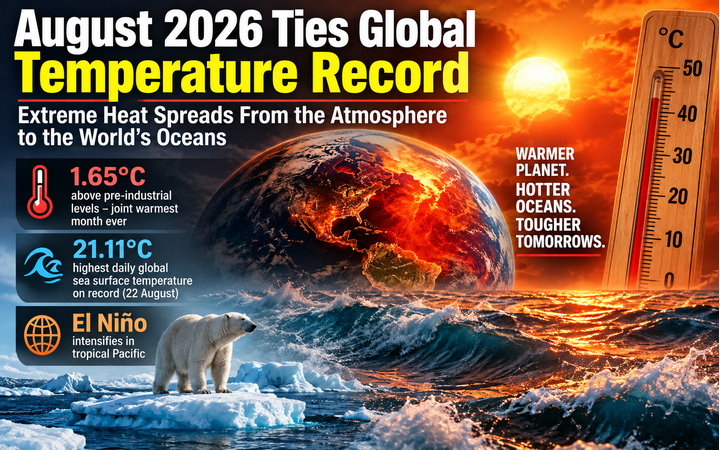
August 2026 was the joint warmest month ever recorded, tied with July 2023. Last month also saw the average sea surface temperature (SST) over the extra-polar ocean reach a record high, due to global heating from burning fossil fuels and rapidly increasing SSTs in the equatorial Pacific associated with strong El Niño conditions – as reported by the Copernicus Climate Change Service (C3S), implemented by the European Centre for Medium-Range Weather Forecasts (ECMWF).
With a global average surface air temperature 1.65°C higher than the estimated pre-industrial baseline, this August was the first month to exceed 1.5°C since November 2025. Samantha Burgess, Strategic Lead for Climate at ECMWF said that : “August 2026 was a remarkable month in the global climate record. It was both the warmest August and the warmest month ever recorded, with global temperatures reaching 1.65°C above pre-industrial levels, marking the return of global temperatures above 1.5°C. Combined with record global sea surface temperatures and the warmest summer on record for Western Europe, these observations show how climate change is driving extremes across both the atmosphere and the oceans. The impacts of these conditions are increasingly being felt by communities, economies and ecosystems across the world.”
The month saw the joint highest monthly average SST ever recorded across the extra-polar ocean, tied with March 2024, and the highest daily global SST over the extra-polar ocean ever recorded, at 21.11ºC.The daily global average sea surface temperature (SST) has reached its highest level on record, exceeding the previous record set in March 2024. The Copernicus Climate Change Service (C3S) confirmed the record, with a temperature of 21.1°C on 22 August, exceeding the previous record of 21.09°C. The dataset extends back to 1979. Global ocean temperatures are typically highest in March and April, following the austral summer, yet this record has been reached in August. It also exceeds the previous highest August value, recorded in 2023 at 20.98°C.
UN Climate Change Executive Secretary Simon Stiell: “Until humanity stops burning colossal amount of coal, oil and gas, the pollution this causes will keep baking our planet, and extreme heat will keep smashing all-time records, killing millions and costing trillions, hitting transport and health systems, and pushing up prices for household basics like food. The evidence is irrefutable: this is the spiraling price of humanity’s fossil fuel addiction, and the global climate crisis it is fueling. But the solutions are equally clear: a faster shift to clean energy – which is now cheaper than fossil fuels, protecting our forests and the ocean, and building climate resilience.”
Meanwhile, record high SSTs were seen across the tropical Pacific, an area where a potentially extreme El Niño event continues to intensify. While daily records should always be interpreted within a broader climate context, this milestone is consistent with the continued long-term warming of the global ocean and the emergence of an extreme El Niño event in the tropical Pacific. The impacts of this event are already being felt over land, with conditions favouring the intensification of seasonal wildfires across Indonesia, as reported by the Copernicus Atmosphere Monitoring Service (CAMS).
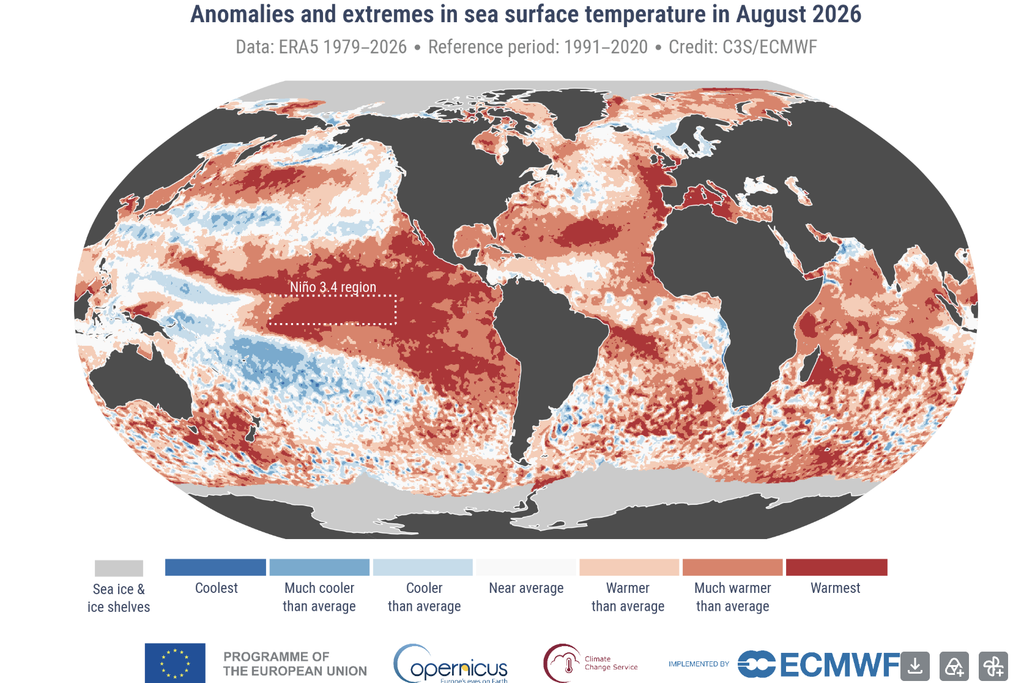
Anomalies and extremes in sea surface temperature for August 2026. Colour categories refer to the percentiles of the temperature distributions for the 1991–2020 reference period. The extreme (“coolest” and “warmest”) categories are based on August rankings for the period 1979–2026. Values are calculated only for the ice-free oceans. Areas covered with sea ice and ice shelves in August 2026 are shown in light grey. The map outlines the Niño 3.4 region used to monitor El Niño conditions.
Data source: ERA5. Credit: C3S/ECMWF.
The month marked the end of western Europe’s warmest summer on record, surpassing the previous record set in 2003.
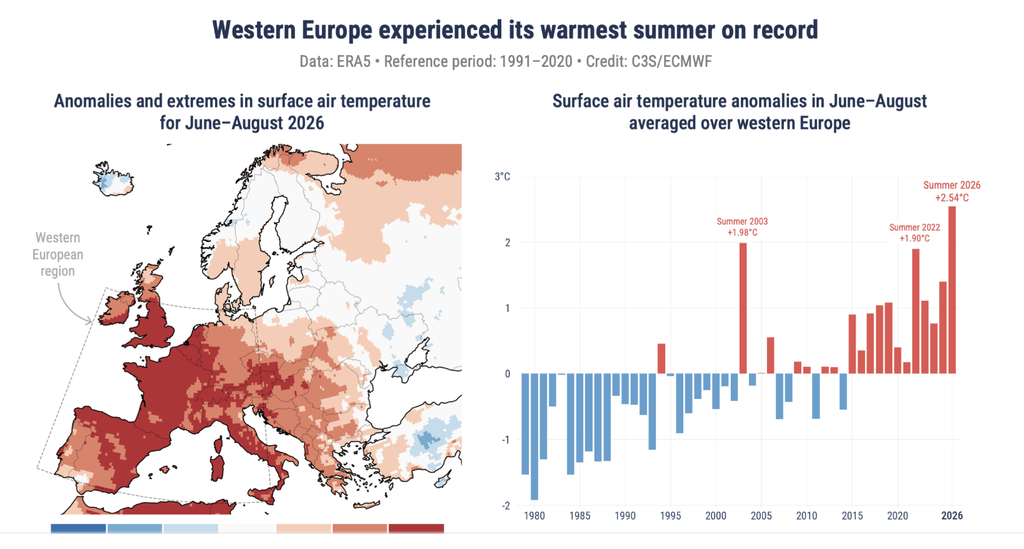
The region also saw further heatwaves in August, continuing an exceptional run of extreme heat that began in May. Much of the region and large parts of central and eastern Europe also saw widespread dryness in August, in some cases persisting since May, with severe drought conditions reported in France, the UK, Hungary, Romania and Serbia. Across the dry regions, major European river flows were exceptionally low, including – from west to east – the Rhine, Danube, Southern Bug and Dnieper experiencing exceptionally low flows.
The writer of this article is Dr. Seema Javed, an environmentalist & a communications professional in the field of climate and energy
