


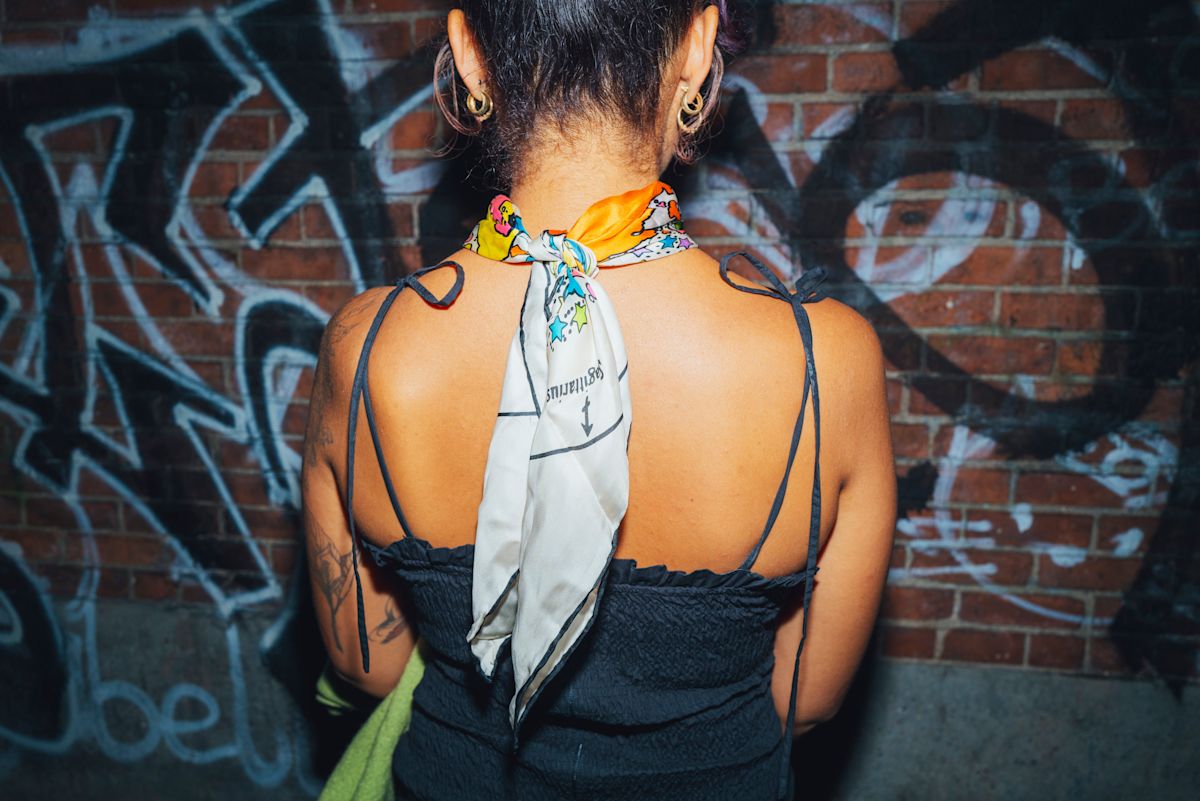
If any artist was responsible for defining the visual vocabulary of the 1960s, it was Peter Max, whose vividly fluorescent paintings, posters and graphic imagery were ubiquitous during the era of flower children and the Age of Aquarius.
Countless college dorm rooms of the late ’60s and early ’70s had a Peter Max poster on the wall, next to the burning incense. Through savvy marketing, his pulsating colors and images adorned hundreds of objects — from buses and subways to pantyhose and the soles of sneakers that imprinted his name in the earth and sand.
Mr. Max’s color-saturated, almost hallucinatory depictions of stars, sun rays and people in profile showed up on walls and coffee mugs, on clothing, clocks, stationery, and even airplanes and cruise ships. In some ways, Mr. Max created the graphic equivalent of the rock-and-roll revolution in music.
Get The 7 newsletter
The day’s top stories, curated by Washington Post editors. Sign up for free
A New York Fashion Week attendee wears a Peter Max scarf to the LaQuan Smith show in 2024. – (Sara Konradi/For The Washington Post)
Although never a critical favorite, he proved a genius at self-promotion. He became one of the country’s best-known painters, a counterculture mogul who had his choice of three chauffeur-driven Rolls-Royces, all decorated with his bold designs.
“I occupy my own space in art,” he told People magazine. “I’ve achieved at least as much as Picasso, Matisse and Braque when they were my age.”
Mr. Max died Wednesday at 88, according to a statement shared by his son and Park West Gallery. He had dementia, according to a 2019 report in the New York Times about how relatives and business associates had come under legal scrutiny because of suspicions that the artist had been exploited as his health and mental faculties declined.
Mr. Max was a virtual painting factory. He created dozens of works a day, returning to favorite images that included butterflies, rainbows, planets, men with umbrellas or colorful patterns resembling arrangements from a kaleidoscope.
A national celebrity by the time he was 30, Mr. Max redesigned the set of Johnny Carson’s “Tonight Show” for his appearance in 1968. The next year, he was featured on the cover of Life magazine with the headline “Portrait of the Artist as a Very Rich Man.”
Before he helped give the hippie generation its signature style, Mr. Max had trained as a painter in the classic, realistic style of John Singer Sargent. He ran a graphic design firm in the competitive world of Madison Avenue advertising before stepping away in 1965 to focus on painting.
He emerged two years later with a completely new artistic and personal style, geared to the peace-and-love spirit in the air. He had long hair and a drooping mustache, practiced yoga, and meditated with the Indian spiritual guru Maharishi Mahesh Yogi.
His posters, including one in vibrant colors with the word “Love” in psychedelic script, sold in the millions at $2 apiece. He employed a large staff that took up a five-floor office building, and at one time, more than 70 product lines bore his name.
Mr. Max hobnobbed with movie stars and rock musicians, painting their portraits and album covers. His style inspired the Beatles’ 1968 animated movie, “Yellow Submarine,” but beyond some initial talks with John Lennon, he had no role in creating the film’s look.
Early in his career, Mr. Max was sometimes grouped with pop art figures such as Roy Lichtenstein and Andy Warhol. He had a one-man show at a San Francisco museum, but as his work became ubiquitous and increasingly commercial, his reputation began to suffer. Critics complained that his art didn’t extend below its glossy surface, that it had neither the irony of Warhol nor the humor of cartoonist R. Crumb.
“He’s the producer of a product that many people confuse for art,” critic Hilton Kramer told Newsday in 1990. “I suppose there are lots of gullible people who believe Peter Max is a real artist. But he’s primarily responsible for making a name for himself and for cashing in on the taste of the Sixties. I don’t know a single person in the art world who considers him to be a real factor.”
Nonetheless, by 1971, Mr. Max’s various artistic efforts had brought in $1.5 billion. But just as suddenly as he became a cultural touchstone, he withdrew, dissolving his secondary businesses and largely retreating from public life.
“I was a culture hero,” he told People in 1986, but something was missing. “My life revolved around corporations, itineraries and nonartistic responsibilities. I just wasn’t painting anymore.”
After carrying the banner of the counterculture — or designing it — Mr. Max later emerged as something of a court painter of the establishment. In 1981, he was invited to the White House by President Ronald Reagan and first lady Nancy Reagan. Setting up easels on the White House lawn, Mr. Max made six paintings of the Statue of Liberty in a single day. In the mid-1980s, he helped automotive executive Lee Iacocca lead an effort to restore the then-century-old statue in New York Harbor.
Mr. Max soon remade himself as an artist for the masses. With a sharp commercial eye, he opened boutiques, galleries and restaurants, and he had scores of product-licensing arrangements while feverishly painting 12 to 14 hours a day in his studio.
“It’s 3:40, and I’ve done, like, 95 paintings today,” he told The Washington Post in 2000.
He went on the QVC home-shopping network, typically selling, in two hours, more than $1 million worth of items.
“Look, if I was a musician, when I was 25, I would have had record companies with all their public relations machinery working to create a buzz around my name,” Mr. Max told the Newark Star-Ledger about his rise. “But I’m an artist. Nobody does that for artists. So I had to do it myself.”
His later style became looser and more facile, as he often returned to familiar subjects, including sailboats, sunsets and the Statue of Liberty. He made multiple portraits, a la Warhol, of world leaders such Mikhail S. Gorbachev, the former president of the Soviet Union, and of U.S. presidents from Gerald Ford to Barack Obama.
Mr. Max was the official artist for several Super Bowls, the World Series, the U.S. Open in tennis, the New Orleans Jazz & Heritage Festival and world’s fairs. He painted a jumbo jet, created covers for the New York telephone directory and decorated a piano for former Beatle Ringo Starr.
Peter Max Finkelstein was born Oct. 19, 1937, to German Jews in Berlin. The next year, his family fled Nazi persecution, moving to Shanghai, where his father was a businessman. His mother, a onetime fashion designer, encouraged her son’s artistic interests.
Most Read From The Washington Post
During the family’s 10 years in Shanghai, Mr. Max attended an English-language school and was drawn to the bright colors of a nearby Buddhist monastery and the artistic calligraphy of the monks. He also became an avid reader of American comic books, with their bold drawings in vivid primary colors.
In 1948, his family moved to Haifa, Israel. Mr. Max took painting lessons and studied astronomy and eventually combined the two interests in his richly hued canvases of planets, flying saucers and interstellar vistas.
His family later lived in Paris before settling in Brooklyn, where Mr. Max completed high school in the 1950s. He studied at the Art Students League and dropped his last name before becoming a commercial artist and graphic designer. He and a partner had an award-winning advertising and design agency before Mr. Max left the business to develop his new style.
“All I did was design,” he told the New York Times in 1968. “About 4,500 different patterns for surface decoration were done in two years. Then I started submitting things to manufacturers, made some deals and opened my own corporations.”
When people said his starburst-style paintings looked like something inspired by an LSD trip, Mr. Max said he had not used drugs or alcohol since 1966, when he became a vegetarian disciple of yoga.
His first marriage, to Elizabeth Nance, ended in divorce. They had two children, Adam Cosmo Max and Libra Astro Max. Mr. Max also had long relationships with the model Rosie Vela and the actress Tina Louise, who played the movie star Ginger on “Gilligan’s Island.” In 1996, he approached Mary Balkin, a young woman he saw on the street, and said her profile resembled that of a female figure in many of his paintings. They were married the following year, in a ceremony officiated by New York Mayor Rudy Giuliani.
After a long sabbatical in the 1970s and ’80s, Mr. Max returned to the spotlight because of renewed demand for his paintings from celebrities and commercial galleries. He worked obsessively, turning out thousands of paintings and commercial designs a year.
“Even before my shower I do something, anything, just to know that I’ve already painted,” he told People magazine in 1986. “There’s nothing else in life that attracts me as much.”
In 1997, Mr. Max pleaded guilty to concealing more than $1 million in income from federal authorities. In later years, he increased his artistic output, and dozens of artists were hired to work in his studio. He sold many new works through an arrangement with Park West Gallery, based in Southfield, Michigan. As he went into a noticeable decline in his mid-70s, new artworks continued to be offered for sale at galleries and on cruise ships.
The Times reported in May 2019 on a serious rift in Mr. Max’s family, including accusations that his son and financial advisers had seized control of his studio. According to the report, witnesses said Mr. Max spent hours a day scrawling his name on canvases painted by others.
Family members filed lawsuits against Park West and Mr. Max’s managers and accountants, alleging financial mismanagement and exploitation. Other lurid allegations included charges that the artist had been kidnapped by his son, Adam. Adam Max declared that Mr. Max’s wife, Mary, had physically abused her husband and had threatened further bodily harm.
A guardian was appointed to manage Mr. Max’s personal and professional affairs, and he was placed in the care of his wife. In June 2019, Mary Max died in an apparent suicide at 52.
As his artworks and his name were peddled, the early comparisons to Picasso, Matisse and Warhol faded away. He may not have been seen as a major creative force, but he was nonetheless a genuine phenomenon and, beyond question, one of the most successful artists of his time.
“I always wanted the universe to be a more beautiful place than it is,” he said in 2002, “and I sort of merged that idea, that ideology, those concepts, with my love for the universe. Then the ’60s came around, and I was the guy with the art.”
