


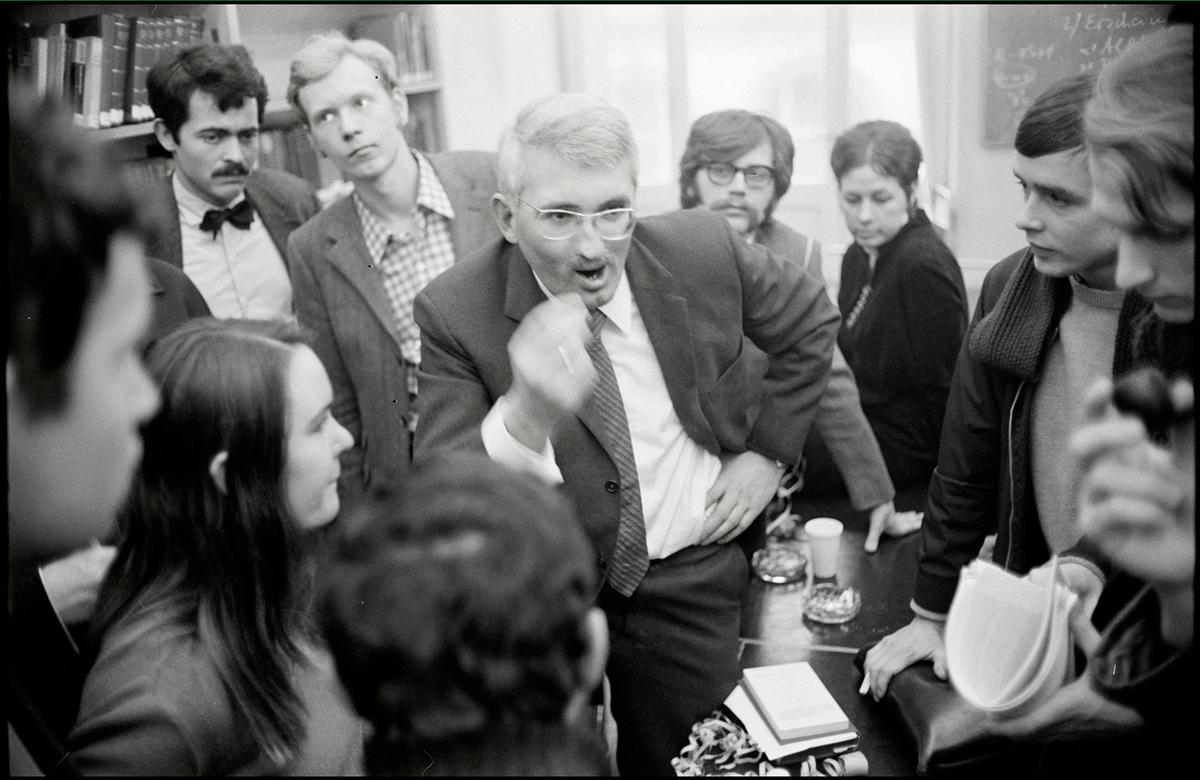
Jürgen Habermas died on 14 March 2026, in the German town of Starnberg, aged 96. Every fall, from the mid-1990s into the late-2000s, he would come to Northwestern University in Evanston, Illinois to teach and give talks, a visit that a dedicated group of students looked forward to every fall term. The year that has stayed with me is 2004, when he taught what he’d spelled out in Between Facts and Norms (1992), his opus applying his theory to democratic politics. Law, philosophy, history, political science: students spanned many disciplines to come watch the famous German scholar every week, dressed in Wrangler jeans and a tweed jacket, expose his theory of deliberative politics in his unmistakable nasal voice, thick German accent, and impeccable English. Max Weber and the Frankfurt School, which were intimate to him, since he’d been Theodor Adorno’s research assistant in the 1950s, came to life in his speech and then in schemas and figures in chalk as he theorised about them.
I understood almost none of it at first: words I’d read were coming to life in the room, spoken by their author, and still not resolving into sense. After several lectures, the shape came into focus: this wasn’t just Between Facts and Norms being rebuilt in public, but decades of work arriving at a single place. Since The Theory of Communicative Action (1981), Habermas had been arguing that reason survives in modern life only as something people do together, that is, by giving each other reasons and staying open to being moved by them, rather than by force, money or tradition. Between Facts and Norms was that idea turned toward law and democracy directly: a state counts as legitimate only when its laws could in principle be justified to everyone bound by them, through exactly that kind of open exchange. I’d watched that argument take root in a decades-long intellectual history. Thinking is a practice, it involves owing each other explanations, questions, answers. It is not a fast process, and doing it in public, out loud, in front of a room, is what makes it worthwhile.
I attended all of Habermas’s seminars during my time at Northwestern with great interest and, to be honest, a sense of awe. One day, the topic of the weekly seminar was inclusion, and I had argued, with the timid conviction of a green graduate student, that deliberative publics ought to be designed for inclusion, and that entry into these publics required that members accept the terms of deliberation themselves. ‘Well, we can tell that Ms Prattico really is a Catholic in the strict, universalist sense,’ was not the answer I expected – and what took me by surprise wasn’t that he’d made a joke of my religion, but that he’d seen me as a person with a history and a set of unexamined beliefs, something he’d noticed only by teaching me.
After the seminars, the class would sometimes go out for drinks. It was on one of these occasions that I understood where the joke had come from. I’d asked him what it had been like arriving in the US as a visiting professor for the first time, at the New School for Social Research in the autumn of 1967, which decades earlier had served as a refuge for scholars fleeing the same Germany in which he’d grown up. It was the start of a long habit of crossing the Atlantic: Princeton four years later, for the Gauss Lectures where he first tried out the turn toward language that would eventually become his theory of communicative action; then, decades on, Northwestern, where I got to sit in the room.
Habermas answered my question by going back further than any of that. He’d been raised Lutheran. Visiting the US in the 1960s and ’70s, he’d been introduced to the Quakers, and something in their small meetings had stayed with him, specifically the way they sought unity with everyone present. When he came to describe the conditions under which people could reason together as equals, he said he heard an echo of those meetings: conditions that hold only when everyone who could be affected by a norm isn’t just included but has a voice, can object, and speaks with sincerity. In those conditions, which go far beyond mere inclusion, the only constraint left on discourse is ‘the unforced force of the better argument’, as he put it in Justification and Application (1993). It didn’t feel like something he’d have said at the podium.
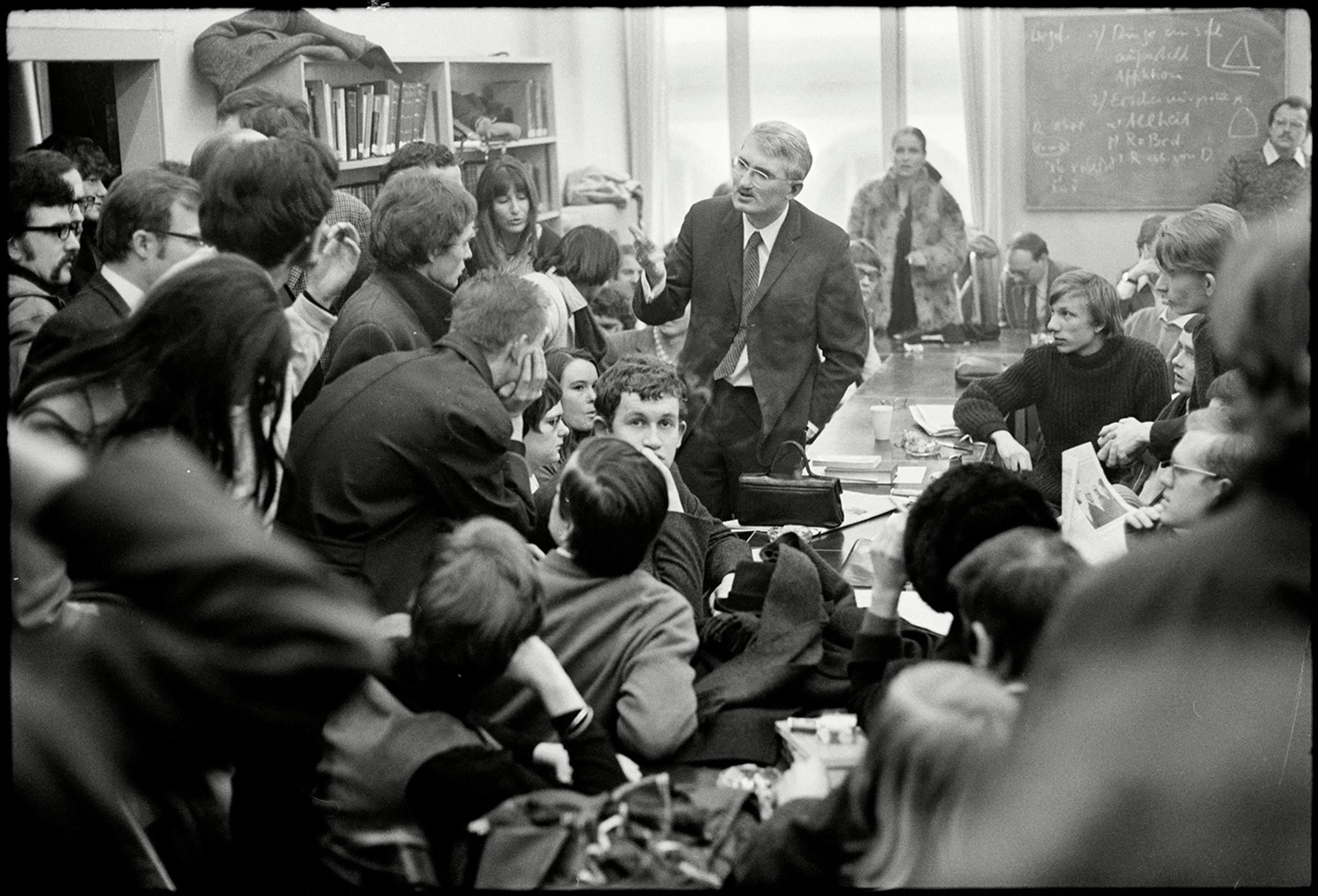
The Structural Transformation of the Public Sphere (1962), his seminal work originally published in German, made an argument about something concrete: 18th-century coffeehouses, salons and journals, where private citizens began treating the affairs of state as something they had standing to publicly discuss and judge, rather than simply obey. That habit, Habermas argued, was where modern democratic legitimacy first took root. The book also identified tendencies that would weaken it, too. He thought that the public sphere had already started to decay, folded back into spectacle by advertising and mass media, the public reduced from participants to an audience. It took almost 30 years for an English translation to appear. By the time it did, in 1989, Habermas had gotten a great deal of mileage out of the book in its original language; indeed, it had already made him a name outside Germany. When Craig Calhoun finally gathered the English-language response into a single volume, Habermas and the Public Sphere (1992), bringing together historians and theorists who challenged the argument, closing with a long response from Habermas himself, he could have easily spent the occasion defending a book that had already proved itself. Instead, he very openly contended with these critiques.
He came to think he’d been too sceptical about one piece of that story. But the warning itself never went away
Two critics stand out. Nancy Fraser argued that the public sphere was never actually open to everyone since it had excluded women and other groups from the start. She proposed replacing one public with many, arguing with each other, including publics formed by the very groups shut out of the first one. Geoff Eley made a related point from history: working-class and plebeian public spheres had existed alongside the bourgeois one all along, not before or after it. Both were extending an argument that Oskar Negt and Alexander Kluge had made back in 1972, that a whole proletarian public sphere existed, which Habermas’s book never accounted for.
Habermas answered these criticisms directly, in an essay called ‘Further Reflections on the Public Sphere’, printed as the closing chapter of Calhoun’s book. Habermas conceded that the exclusion of women was not incidental but built into how the bourgeois public sphere had worked from the start. Unlike the exclusion of underprivileged men, which was a problem of class, and in principle correctable, the exclusion of women, he now wrote, ‘has been constitutive for the political public sphere not merely in that the latter has been dominated by men as a matter of contingency but also in that its structure and relation to the private sphere has been determined in a gender-specific fashion.’ Habermas conceded that other public spheres had existed alongside the one he had taken as foundational. And he softened the warning, without abandoning it. He came to think he’d been too sceptical about one piece of that story, the early stirrings of consumer society. But the warning itself never went away. Sixty years on, he was still diagnosing a public sphere being distorted by commercial and structural forces, only now the culprit was platforms and algorithms rather than advertising and mass circulation.
He did not give up everything. He still wanted to keep the public sphere as something to measure democracies against, even if the history behind it was messier than he’d first made it look. The criticism and his answer to it sit in the same book, printed one after the other. Habermas’s views were open to being challenged, and open for us all to witness his thought in process.
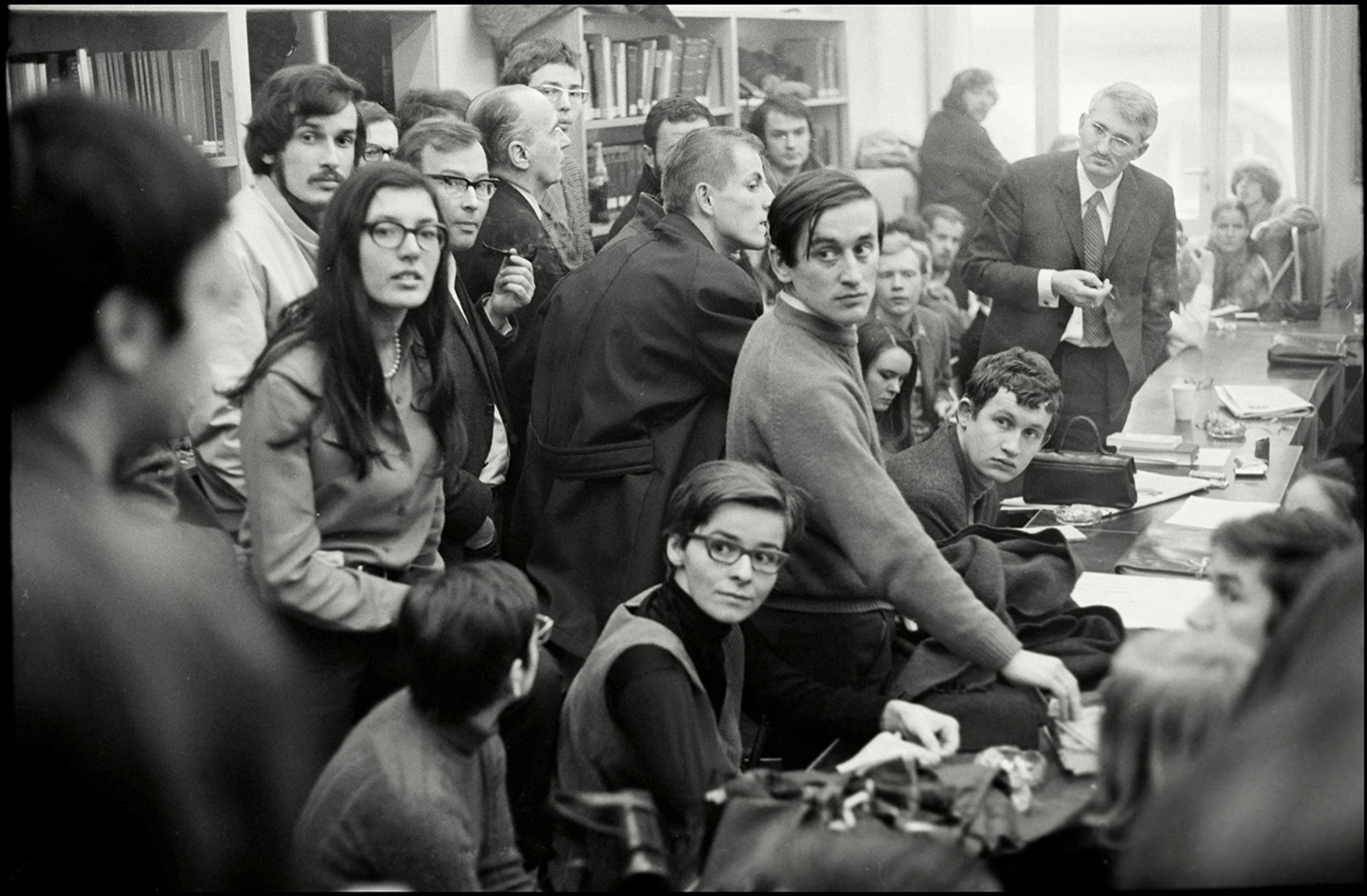
Early in my dissertation work, I wanted to explore the role of experts in democracies through Habermas’s theory of deliberative politics, though I didn’t yet know how – I was, by any measure, stuck. My advisor, Cristina Lafont, one of his most trusted students, arranged a meeting anyway, at the hotel where he stayed during his visits to Northwestern’s campus in Evanston. He didn’t seem to mind that I arrived without a fully formed argument. Over almost two hours at what was then the Homestead Hotel, he had me lay out the problem as it stood, half-formed, and began working through it himself, out loud, testing it against his own theory as he went. He explained the three types of discourse that characterise deliberation – moral, ethical, and pragmatic – and was clear that when it comes to the moral, there are no experts: only individuals working out, together, what’s right in a given context.
Followed to its conclusion, that seemed to leave no room for expertise anywhere in deliberative politics. But he then turned to pragmatic discourse, where expertise does real work: finding the most empirically sound way to reach a goal already agreed on. Experts have no authority over what’s right, fair or worth valuing – only over facts. This was, in miniature, an argument he’d been making since his early work on science and politics: that treating value-laden political questions as though they were merely technical ones corrodes democracy. Decades later, in Justification and Application, he’d given the same worry he’d laid out in the trichotomy that morning sharper philosophical shape.
In later meetings in his office, more routine than that first one, I pushed the distinction further: what did it mean for climate change – a problem almost always treated, in his terms, as a matter of pragmatic discourse, all graphs and targets and carbon budgets, and almost never as a moral one. Who pays? What do we owe the people who pay? How should the resources that caused the damage be used? He didn’t have a ready answer. He asked question after question, testing the case against his own framework as though it genuinely hadn’t occurred to him before.
Justification answers only to the standards we happen to hold now: those standards can be shown wrong later
I’ll never know for sure if he was being generous or if I had shown him something he had not yet thought of in applying his own distinction. What stayed with me wasn’t the answer but the manner of it: a philosopher in his 70s, decades into a settled framework, still willing to test that framework against a case he hadn’t considered, in real time, out loud, in front of a student.
By 1999, Habermas gave up a position he’d held since 1973, the year he’d argued that truth is simply whatever people would agree on if they argued it out under fair-enough conditions. By the end of the century, he’d decided this was a mistake: it confused truth with justification. A claim can meet every test we have for it, survive every objection anyone raises, be about as justified as a claim can be, and still turn out false. That’s because justification answers only to the standards we happen to hold right now, and those standards can later be shown wrong. Truth doesn’t move when our standards do. Moral claims were different, he still thought: what’s right can only ever be what a fair conversation would settle on. There’s nothing else for rightness to answer to. But facts about the world answer to the world itself, not just to our best current agreement about it.
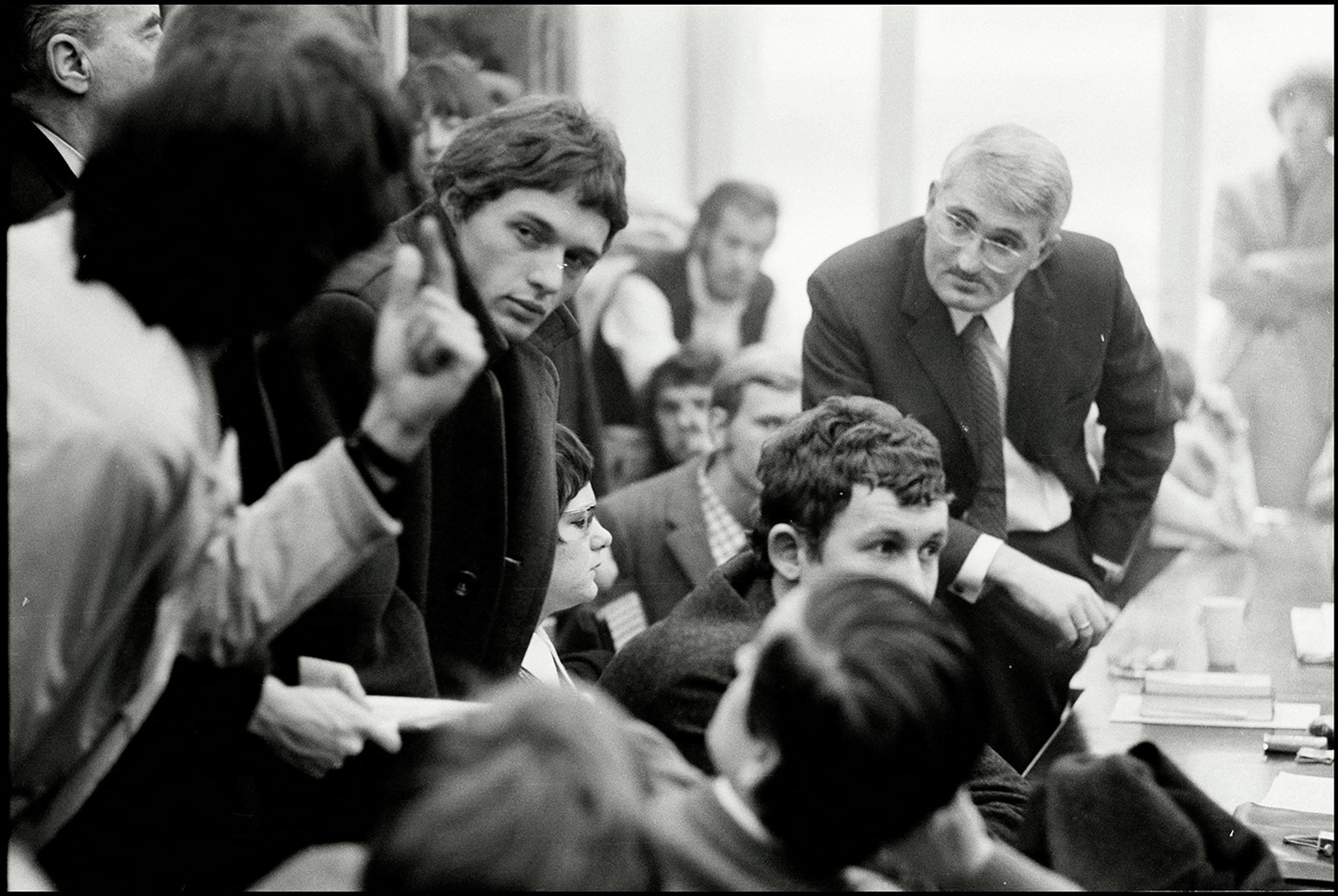
Several people had been pushing him toward this change. The US philosopher Richard Rorty pushed from the side from which Habermas was now backing away: for Rorty, there was no need for truth to answer to anything beyond what an audience could be talked into agreeing on, and he’d been making that case to Habermas for years. Lafont, my advisor, who’d arranged the hotel meeting, pushed from the other side, drawing on the US philosopher Hilary Putnam, who had spent much of his career arguing against exactly the kind of view that made truth depend entirely on human agreement. Lafont had argued since 1994 that Habermas’s own philosophical tradition, in its turn toward language, had drifted into a position where it couldn’t say the world holds firm no matter how we talk about it. When Habermas changed his mind, he moved toward Lafont’s position, not Rorty’s.
What Habermas never spelled out is what this does to moral and political claims once people stop being able to agree at all. Truth, on his revised view, still has somewhere to go even if everyone stops talking: the world doesn’t care whether anyone’s listening. His philosophy of Rightness never had that option. So, when the people who’d need to agree on something splinter into groups that no longer talk to each other, a factual claim can still be true or false regardless. A moral claim has nothing left holding it up, once nobody’s left in the room to agree on it.
Habermas gave up a position he’d held for almost 30 years because the people around him showed him it didn’t hold. He’d spent decades arguing that claims get redeemed when someone can compel you to answer, and then was compelled himself, and answered, in print, aged 70. Those critiques were not meant to be damning objections: they were precisely what his theory called for and was built on, ultimately.
Habermas returned to the subject in ‘Reflections and Hypotheses on a Further Structural Transformation of the Political Public Sphere’ (2022). His starting point is a particular relationship between beliefs and reality. Constitutional democracy runs on citizens holding certain assumptions about their own disagreements, namely that the disagreements are real, that they’re about something, that better reasons could in principle settle them. The system holds together only as long as those assumptions stay reasonably close to how politics actually works. His argument is that a public sphere, run through social media, threatens that relationship and widens that gap.
For Habermas, there are two forces at play in this widening. Platforms drop the editorial filtering that newspapers and broadcasters used to perform, and they turn every user into someone who publishes. For Habermas the deeper problem isn’t the resulting noise; it’s that heavy platform use produces something smaller than a public: semi-public spheres, self-enclosed, silos whose members can no longer perceive the wider public sphere as inclusive at all – claims to universality beyond their own horizon become, in his words, ‘suspect of hypocrisy’. That perception is itself the damage, on his account, as much as anything actually happening out in the general public sphere. He ends by insisting that ‘maintaining a media structure that ensures the inclusive character of the public sphere and the deliberative character of the formation of public opinion and political will is not a matter of political preference but a constitutional imperative.’
A factual claim still has to get the world right, whether or not anyone’s around to check it. Moral claims never did: they answer only to discourse. And discourse is exactly what he’s just described coming apart. He doesn’t draw the conclusion for moral and political claims himself, but it follows from putting his two books next to each other: the very thing a claim about what we owe each other had to answer to is the thing he says is disappearing, in an age dominated by exchanges on social media.
People retreat into whichever group agrees with them and lose their grip on a shared standard of true and false
Around that time, I reached out to my advisor for help asking Habermas for a foreword to a collection I was editing on Habermas and democracy. He was known for guarding his time closely – very few people had his email address, and he accepted only a handful of the hundreds of such requests he received each year. A couple of months later, an email came from an address I didn’t recognise: he had accepted, and written to say so himself. Amid the logistics, he added one condition: ‘You should send me at least a substantive part of the book before I can and would sit down and settle a few ideas.’ At 92, he wanted the material in hand before he’d commit to anything.
What came back was not a review of the interviews that make up the book one by one. He says so himself in the opening lines: it isn’t his task to comment on the conversations directly. Instead, he used the occasion to answer the standing objections to his view of deliberative democracy, and to close with the digital transformation that turned out to run through nearly every interview in the book – a theme he noticed himself, and named as central to the collection. One section was on experts, common sense, and the chain of translation that carries specialised knowledge into public reasoning: the same distinction he’d first sketched over a hotel breakfast, worked out now in far more detail, at the very end of his working life.
At one point, he writes that what’s been lost, in the democracies now regressing, is ‘a conflict of opinions that remains recognisable as a dispute about which position is backed by the better reasons.’ That’s as close as he ever came, in anything he wrote for me directly, to stating my own premise in his own words. He names the same loss again later in the foreword, describing people who retreat into whichever group already agrees with them and lose their grip not just on the public sphere’s inclusiveness but on the idea of a shared standard of true and false. What he doesn’t do here, any more than he did in 1999, is follow that loss when it concerns a moral claim once the discourse behind it comes apart. And that is what I tried to explore in my philosophical work since my dissertation.
He still believed the gap between expert and layperson could always, in principle, be closed by the right chain of translation. It was the one thing he never revised: he revised his theory of the public sphere, his theory of truth, but never the conviction that under the right conditions people can still reach each other. I am not persuaded that these conditions are as anywhere close to being met today – but that’s a disagreement I never got to have with him.
