


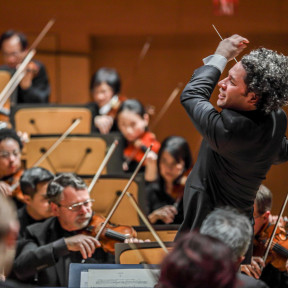
Having attended all eight programs Gustavo Dudamel conducted last season as the New York Philharmonic’s Music Director Designate (in order to turn them into a piece for The New York Review of Books pondering the perilous state of American orchestras), I had some idea what to expect from his Mahler Fifth these past two weeks. And the performance last Tuesday night ran true to form. There was a lot to think about – not all of it Mahlerian.
I own an unusual score of this particular Mahler symphony. It is densely annotated. That’s because 46 years ago it sat in my lap during a New York Philharmonic rehearsal led by Klaus Tennstedt. Tennstedt was certainly one of the major Mahler conductors of his generation. Onstage (and also offstage, I am told), he looked a nervous wreck. His guest appearances with the Philharmonic furnished a rare oasis during the long desert years of Zubin Mehta’s music directorship. Tennstedt’s music-making trembled with feeling, and never moreso than when Mahler was the composer. I would call his Mahler readings “Mahlerian.”
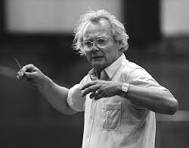
So listening to Dudamel’s Mahler 5 with Tennstedt’s Mahler 5 before my eyes was a schizoid experience. What I was hearing was mellifluous. What I was reading was fractured and eruptive.
A typically Tennstedt instruction, repeated many times: “Please, it’s so difficult. Play more softly but with more vibrato!”
Rehearsing the first movement’s march tattoo: “The triplets must always be late.” He wanted a sharper rhythmic contour (which he could only fitfully obtain).
Rehearsing the opening of the second movement, marked by Mahler fortissimo “with greatest vehemence” – “Come on. Three times more! [i.e., three times louder].”
Rehearsing the Adagietto: “More intensity, please! But not so loud! One line!” “Relax your right arm. With the left (i.e., the vibrato): the most intensity you have.” He urged the strings to forgo convention and attempt “free bowing.” “All long notes – change bow! Change! Change so you don’t get caught with too little bow left! You have to get used to it. In the middle of the note you can change.” “Change the bow! Free bowing! Don’t bother to write it in your parts!!!”
His general instructions, imparted at the start, included: “The Fifth Symphony is the most exciting [Mahler] symphony with dynamics – the dynamics are always exaggerated. In this symphony. Not the Seventh! Not the Ninth! The whole symphony!”
Random urgings: “Excuse me. That’s a big problem with this symphony. Everybody must give the greatest fortissimo.” “Too loud but not enough expression.” “Look: Mahler has written ’molto crescendo.’” “It’s very tiring – but don’t forget any of the accents, please.”
The orchestra did not respond communally. Some individuals were rebellious. Philip Myers, the principal horn, requested that Tennstedt permit him to ignore Mahler’s subito forte [suddenly loud] in a third movement solo. Tennstedt insisted. When the horns were asked to use mutes, they shot back: “What mutes do you want?” “You know your instruments,” Tennstedt curtly replied. Rehearsing a passage for pianissimo cellos, Tennstedt heard piano cellos. He expressed incredulity that the section could not play more softly. And so it went.
Though I did not attend any of Dudamel’s Philharmonic rehearsals of Mahler’s Fifth, I am sure that nothing remotely comparable occurred. For one thing, his concept of the piece is far less tortured than Klaus Tennstedt’s. For another: he and the players are one. And the audience can sense this.
Certainly Dudamel’s arrival in New York has been hyped by the Philharmonic and hyped in the press. But a performance like his Mahler 5 makes the hype seem tolerable (almost). Not because it’s a paramount reading, but because Dudamel fastens on the exuberance of the work, its ultimate gusts of positive energy, and makes them his own.
***
After writing all that, I went to AI to find the date of Tennstedt’s performance – and discovered that it could be revisited on youtube. In fact, one reason I attended this particular rehearsal is that I couldn’t make the concert – so I have just listened to Klaus Tennstedt’s June 18, 1980, New York Philharmonic performance of Mahler’s Fifth for the first time. You can, too – it’s sitting right here and here.
And it is colossal. Everything Tennstedt begged for somehow transpired. Phil Smith nails those delayed triplets in the trumpet tattoo. Philip Myers dutifully plays his subito forte. The previous resistance of the players is forgotten – they are transformed.
Experiencing the physical and spiritual fatigue of the symphony’s opening march – an existential trek only Mahler could have composed – I discover myself glimpsing Christ bearing his heavy cross up the Calvary slope. A representative detail: at measure 306, where Mahler asks flutes and oboes to instantaneously sink from forte to pianissimo, the Philharmonic administers a jab of sorrow..
The symphony’s central scherzo (there are five movements), in which Dudamel charms, is for Tennstedt heavy-footed; it lapses organically into moments of rumination or calamity. In the famous Larghetto for strings (coming fourth), with its harp aroma, Tennstedt instantly attains a worshipful gravitas (a plausible rendering of Mahler’s adoration of his wife).
The plan of this symphony is necessarily controversial. It begins tragically, with funeral strains and (in movement two) seismic eruptions. The scherzo is longer but lighter. The Larghetto can be streaked with perfume or with anguish. The finale builds to an exuberant chorale chased by a giddy coda. A singularly plausible reading is offered by Karol Berger in his indispensable Mahler’s Symphonic World (2025), which I have elsewhere extolled. Berger writes:
“The symphony’s last word is ironic, mocking even, certainly not pompously triumphant. What I mocked here is a whole tradition of victorious symphonic scenarioes epitomized by Beethoven’s Fifth . . Mahler pokes this tradition in the ribs.
“The finale as a whole, however, does more than undermine a hallowed symphonic tradition. It puts into question Mahler’s own past. For the first time, the composer writes a symphony that does not aim at transcendence and sublimity but that accepts and embraces the comic immanence of the earthly existence. . . . The formal complexity and motivic density of the Rondo-Finale is more than sufficient to match those of parts 1 and 2 (i.e., movements 1, 2, and 3). The movement is not lightweight, but it does undermine the ponderousness of the pesante apotheosis. This is not its shortcoming; it is, rather, its point. . . . the failure of transcendence becomes the aesthetic experience. . . . In his Fifth Symphony Mahler withdrew for the first time his earlier bet on transcendent hope without forgetting the suffering that such hope was meant to answer.”
And this is the reading that Tennstedt clinches. The heavy moments yield intimations of serenity. The bucolic moments retain weight. The trajectory of every movement is tidal. As for the free bowing he begged for in that rehearsal: I cannot glimpse this towering performance with my eyes, but what my dazzled ears perceive – especially in the climaxes of the Larghetto – is a seamless parabola of sound mounting from pianissimo to fortissimo and back again. And I hear string players digging in with heedless abandon. (For the past three months in this space I have yearned to see and hear the young violinists in today’s American orchestras “feel it.” )
A conductor of my acquaintance (who was not at Dudamel’s Mahler performances, but heard about them) comments: “Celebrity is the ultimate currency. It’s not always a bad thing.” He is rooting for Dudamel because he is rooting for the future of classical music in competition with screens, cell phones, and AI. I attended last Tuesday’s concert with my daughter. She is no newcomer to concerts, but was hearing Mahler’s Fifth for the first time. Not only was she enthralled; I am sure this was a Dudamel experience she will urge upon her friends. And they will love it.
