

From Classroom to Business Excellence: Jitesh Kumar shares insights on the Future of Supply Chain Management at IIMM Vadodara

VADODARA: Bridging the gap between academic knowledge and real-world business challenges is becoming increasingly important for the next generation of supply chain professionals, as the sector undergoes rapid transformation driven by technology, geopolitical uncertainties, sustainability imperatives and changing customer expectations.
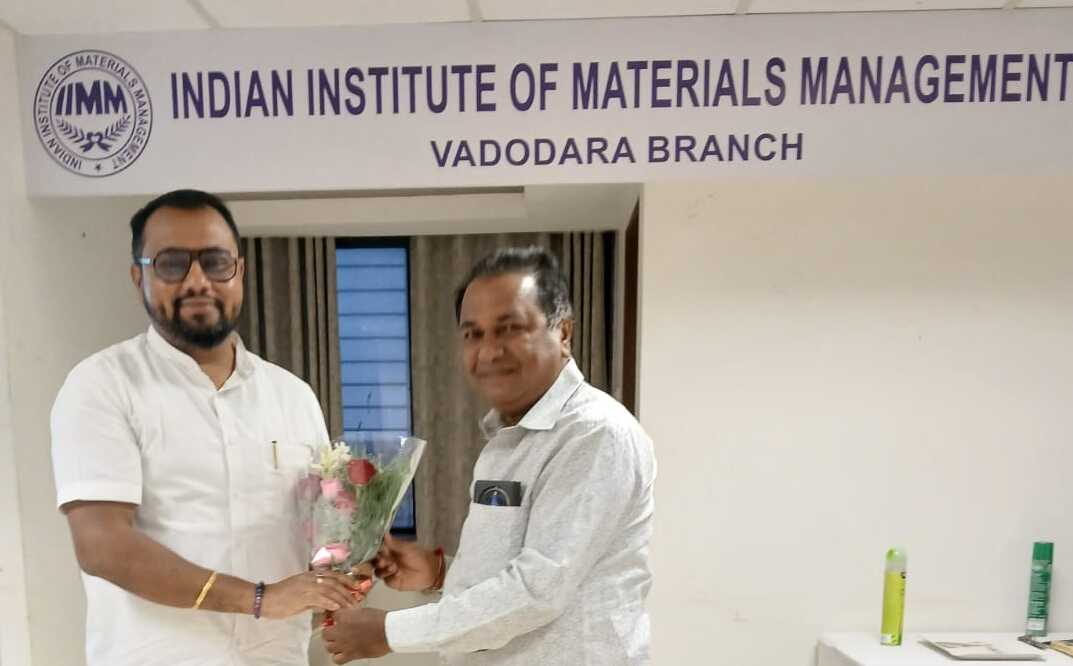
Against this backdrop, Jitesh Kumar, Director, Kamya Shipping Pvt. Ltd., Supply Chain Consultant and Knowledge Partner at ThinkPeepal Consulting, shared valuable industry insights during a session held on 19 September 2026 at the Indian Institute of Materials Management (IIMM), Vadodara.
Titled around the theme of moving “From Classroom to Real Business Excellence,” the session focused on how supply chain professionals can transform academic knowledge into practical business outcomes by combining education with experience, continuous learning and strategic thinking.
Drawing upon nearly three decades of hands-on experience across shipping, logistics, port operations, sourcing, vessel management, commercial negotiations and supply chain leadership in India and overseas, Kumar used practical examples and real-world case studies to explain the widening gap between theoretical concepts and the complexities of modern business.
From Theory to Practical Application
While academic education provides an important foundation in areas such as procurement, inventory management, logistics, forecasting, risk management and supply chain strategy, Kumar emphasised that professional success requires the ability to apply these concepts in dynamic and often unpredictable business environments.
Today’s supply chain professionals are required to make decisions amid multiple challenges, including global market volatility, supplier risks, geopolitical disruptions, sustainability requirements, artificial intelligence-led transformation, rising customer expectations and shortages of skilled talent.
Consequently, technical knowledge alone is no longer sufficient. Supply chain leaders must increasingly combine functional expertise with commercial acumen, strategic thinking, problem-solving capabilities, effective communication and leadership skills.
Resilience Emerges as a Critical Supply Chain Capability
The session also reflected on lessons from major global disruptions, particularly the COVID-19 pandemic, which exposed vulnerabilities across international supply chains.
Kumar highlighted the importance of building resilient and agile supply chain networks capable of responding quickly to unexpected disruptions. Key areas include supplier diversification, improved digital visibility, risk preparedness and agile decision-making.
The experience of recent disruptions has reinforced the changing role of Supply Chain Management. What was traditionally viewed largely as an operational function is increasingly being recognised as a strategic business enabler and a potential source of competitive advantage.
Technology is Transforming Supply Chain Management
Another important dimension discussed during the session was the growing influence of Artificial Intelligence and digital technologies on supply chain operations.
Technology is creating new opportunities in areas such as forecasting, planning, visibility, automation, analytics and decision-making. However, Kumar’s insights emphasised that technology must be complemented by human judgement, business understanding and practical experience.
The future supply chain professional, therefore, will need to understand not only how emerging technologies work but also how to apply them effectively to solve business problems and create measurable value.
Continuous Learning: The Journey Towards Leadership
A key message emerging from the session was the importance of lifelong learning.
Kumar outlined professional development as a continuous journey — beginning with classroom learning, progressing through practical experience and continuous development, and ultimately leading towards effective leadership.
The message was particularly relevant for students and young professionals entering the supply chain industry. While academic qualifications provide the foundation, exposure to real business situations, willingness to learn and the ability to adapt are critical to long-term professional growth.
Experienced professionals, too, need to continuously upgrade their skills as technologies, markets and business models evolve.
Creating Measurable Business Value
The session encouraged students, professionals and industry leaders to look beyond simply acquiring knowledge and instead focus on converting knowledge into measurable business outcomes.
As supply chains become increasingly interconnected and strategic, professionals who can connect operational execution with broader business objectives are expected to play a significant role in strengthening organisational competitiveness, resilience and sustainable growth.
Kumar concluded with a powerful message:
“Knowledge creates understanding, experience builds judgment, and continuous learning creates leaders.”
The message encapsulated the central theme of the session: the future of Supply Chain Management will depend not merely on individuals who understand supply chain concepts, but on professionals who can continuously transform knowledge and experience into business excellence and sustainable value creation.
About Jitesh Kumar
Jitesh Kumar is a seasoned Supply Chain Professional, Consultant and Trainer with nearly three decades of experience spanning shipping, logistics, sourcing, port operations, commercial negotiations and business leadership in India and overseas.
He currently serves as Director of Kamya Shipping Pvt. Ltd. and Knowledge Partner with ThinkPeepal Consulting, where he contributes to practical, industry-oriented learning and business excellence frameworks.
His extensive industry experience across multiple segments of the maritime and supply chain ecosystem enables him to connect academic concepts with real-world business challenges and provide practical perspectives to students, professionals and organisations seeking to build future-ready supply chain capabilities.
