


A recent back-and-forth on literary Substack has thrown some interesting light on what literary Substack actually is. After Naomi Kanakia published a long review article about the contemporary American “little magazine” (n+1, Yale Review, The Drift, The Baffler, Liberties, and The Hedgehog Review), the former University of Melbourne and Johns Hopkins Literature academic Simon During wrote a brief article in response. During’s main concern was with the “ignorance” he saw both in Kanakia’s article and in the way she regarded her audience. Reflecting critically on what she saw as the poisonous tone of anti-populism taken by the little magazines, Kanakia attributed this attitude to the lingering influence of what she termed “the Partisan Review ideology.” These little magazines, she wrote,
take some literary or artistic phenomenon, and they lambaste it, saying it is a sign of society’s sickness. Or they do the reverse, saying the solution to society’s ills is to make different or better art … And this technique has an origin. It was developed almost a hundred years ago, by Partisan Review.
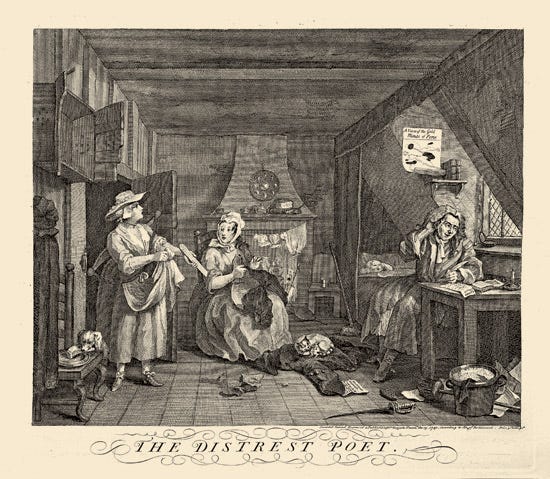
During responded by pointing out that this attitude predated the Partisan Review by hundreds of years and was by no means intrinsically American. It had its origins instead in early eighteenth-century Britain and the flood of popular print produced by the new commercial ecosystem of Grub Street. Anti-populists such as Alexander Pope and Jonathan Swift responded to Grub Street by trying to regulate it out of existence via the powers of ridicule and satire. It was here—in the cultural threat posed by “print capitalism”—that the Swiftian mode of anti-populist literary criticism that Kanakia attributed to the Partisan Review really originated. During felt no need to spell this out explicitly (he was evidently writing for people whom he assumed would know all this). Kanakia and her defenders responded by asking how this supposed “deep dive” into literary history was relevant, exactly.
Here, in miniature form, we have the posting economy of literary Substack laid out for us. The amateurs are facing off against the professionals, the latest in a long chain of binary schisms that have riven the literary world—ancients versus moderns, scholars versus gentlemen, autodidacts versus university-based Literature academics.
From the point of view of those at the centre of literary Substack, During’s intervention no doubt seemed rude and uncalled for. Kanakia, as Ross Barkan put it in a supportive note, had written a long article that offered good value for her subscribers. It was readable and approachable. Moreover, she had performed an impressive-seeming feat—reading every recent issue of several contemporary US literary magazines—that was legible in influencer-economy terms (I read every issue of X, and here’s what I found). What had During done? He’d only complained. He’d offered no detail, no references, and more to the point, perhaps, no helpful info dumps about the aspects of literary history he was referring to for the sake of the general reader. His piece, Barkan suggested, was just “silly”—a “poor” and “flimsy” effort that lacked the marks of formal correctness that underwrite posting quality from a lit-Stack perspective. Moreover, who even was this Simon During? There was no bio to indicate that he might be anyone notable. His follower count was relatively low. He hadn’t even turned on paid subscriptions. Surely lit-stack could be forgiven for asking, who are you, exactly?
Every social media platform is idiosyncratic in its own way. These idiosyncrasies in turn have implications for the kinds of people they initially attract and who therefore has first mover advantage there. Let’s not forget that Substack for a long time has had a slightly iffy reputation among progressives (many academics included). Didn’t a lot of rather disreputable people post there? Wasn’t it somewhat right-coded? It was sufficient for many academics to say simply, “I don’t know much about Substack,” and leave it there. Examine the indexes of even very recent academic books about “literature in the age of platforms,” and you’ll often find surprisingly few references to Literary Substack compared to more ideologically congenial platform communities like BookTok and Bookstagram. With literary academics largely holding off on joining the platform, the platform was instead colonised by the amateurs. Using their first-mover advantage, they built up significant profiles and readerships that were indifferent—or even opposed to—conventional institutional and disciplinary knowledge. Much of literary and publishing Substack duly became a heterodox space. Readers were attracted there by the fact that posters in those spaces offered vigorous critiques of mainstream and institutional values and decision-making. There was a certain kind of pent-up reader demand being satisfied here, in other words, one that flourished in the comparative absence of input or oversight from the more high profile or established professionals in those fields.
As Substack has become a more respectable platform and mainstream academics have begun to join in some numbers, they have encountered a strange simulacrum of fields they thought they knew intimately. Cultural and symbolic capital seem to work differently here. Off-platform names and reputations cannot simply be exchanged at the normal rate; Great Books accounts have often felt no need to familiarise themselves with contemporary academic output. Harold Bloom and Alan Bloom (not influential names in contemporary literary academia) have more cachet here than Simon During (one of the pioneering theorists in modern postcolonial and cultural studies, and one of the key thinkers in contemporary “humanities theory”). In a reversal of the usual state of affairs, the amateurs have the advantage and the professionals are operating from a position of weakness and lack of symbolic capital (renown, reputation, visibility).
From the perspective of a career academic, however, the discourse in large parts of literary Substack appears worryingly thin and poorly informed. Some of the biggest accounts can often seem to be operating wholly outside of what (to an academic) seems like baseline disciplinary knowledge, shadow boxing with debates or personalities that closed down or lost their currency decades ago. They can (as During points out) seem entirely innocent of knowledge or frameworks (such as eighteenth-century print capitalism, or the history of periodicals, or the origins and crises of national literatures) that are taken for granted as intrinsic components of disciplinary knowledge within literary academia. Like the scaled-up versions of social media posts that they are, Substack essays can make undue claims to authority and self-sufficiency. Like X posts, they operate on a fundamentally aphoristic level. They ask readers to take what they say on trust. Much that reads to a professional observer as ill-informed can pass muster as reliable if issued under the right handle and underwritten by the right signals of value (likes, restacks, platform visibility).
The sense of encountering a simulacrum in the wild is enhanced by the fact that literary Substack can also seem decidely backward-looking, as though nostalgic for a version of literary academia that hasn’t really existed for two or three decades. And yet, this is of course precisely the appeal for many readers of these accounts. Young readers flock to Dark Academia because contemporary Literature departments can’t really offer the same promise of deep aesthetic immersion in another (implicitly bygone) world. Literary Substack sometimes seems to offer something of the same appeal.
The truth is, of course, that contemporary institutions of Literature need spaces like literary Substack. Academics migrating here know that things are decidedly not “okay at home.” While majors in traditional Arts subjects like English and History are cratering, non-academic institutions like lit-stack and the History podcast are flourishing. The fact that people like Naomi Kanakia have been able to build large and influential profiles here around the concept of the Great Books is notable in itself (and should of course be celebrated). They have worked extremely hard for their success. Accounts like Romanticon, meanwhile, demonstrate both that there is a real demand for basic literary education at large in the world and that a buzz can still be created around traditional literary concepts like period and literary history. As the platform changes with its new influx of users, both professionals and amateurs are going to have to find some common ground. Both groups, surely, have something to offer each other.
