


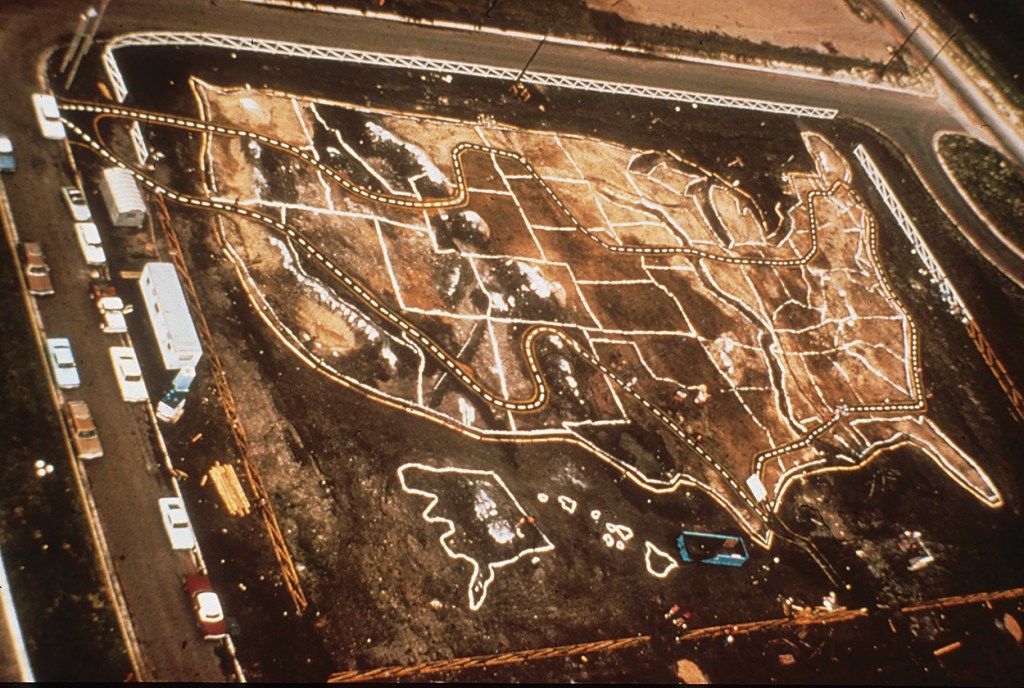
America was an empty mall. America was shoddy caulk oozing from a vinyl arc in a historic heatwave. America was a brutishly redacted Frederick Douglass speech on foam posterboard in a tractor trailer Freedom Truck. America was not even selling corndogs.
What Was America?: Art, Culture, and Politics in the Bicentennial Era is a heavily researched academic art history book, peer-reviewed and professionally produced by the staff of Yale University Press. Its conception thus necessarily predates the actual observance of the country’s 250th anniversary, on the holiday weekend over which this review is being composed, and even predates the outcome of the 2024 election that determined the hosts of the birthday party. Its retrospective past tense of course could not have encompassed these very latest aesthetic and cultural features of late America, and in that interim the very past this timely book studies has already become a more foreign country.
What Was America?: Art, Culture, and Politics in the Bicentennial Era by Elise Armani and Katy Siegel, New Haven, Yale University Press, 2026; 224 pages, 69 color and 47 black-and-white illustrations.
Courtesy Yale Unversity Press, New Haven
In 1976, in what is likely the United States’ most ambitious cultural project ever, an extensively coordinated and remarkably diverse series commemorated the Bicentennial nationwide, on the National Mall and in the desolate former corner stores of Galveston, Texas; at the deYoung and at MoMA; and in mobile trucks on the plains. Time capsule deposits, short films on PBS, a new National Museum of History and Technology, new public parks, fine art triptychs, marquee sculptures, patriotic pediatric paint jobs on fire hydrants, Tall Ships tours, and all manner of handicrafts, documents, maps, and memorabilia were contracted, licensed, promoted, and indexed by the federal government via the American Revolution Bicentennial Commission in conjunction with the General Services Administration, the National Endowment for the Humanities, National Endowment for the Arts, and other agencies.
The Bicentennial offered everyday people in the middle of the map novel opportunities to appreciate and deliberate what America was, and it succeeded in this because it conducted more than a history lesson: Art was surprisingly paramount in this event of collective self-identification, historical commemoration, and political convocation. Imagining, estranging, and making are declarations of independence. The Great American Fyre Festival of 2026 expropriated the taxpayer dollars originally allocated by Congress to the bipartisan America at 250 away to the regime-controlled Freedom 250 fund, and all we got was a DC Air Quality Index of 300.
America was state capacity. As this skillful quilt of a book shows, the diverse, heterogeneous, manifold culture of America displayed across the country on its birthday could have only been facilitated by federal leadership, regional institutions, cooperating states, and civic and philanthropic partnerships, all populated by public servants and career administrators of the type summarily annihilated by Elon Musk’s DOGE. The decade of planning and communication for the Bicentennial was the material condition for the expansive cultural expression it generated, from masterworks by rising stars putting “modern” and “folk” and “American” art into global currency, to workshops held by heartland grandmothers. Local execution and grassroots buy-in were the integral prow, while the federal level helmed themes, funds, and press.
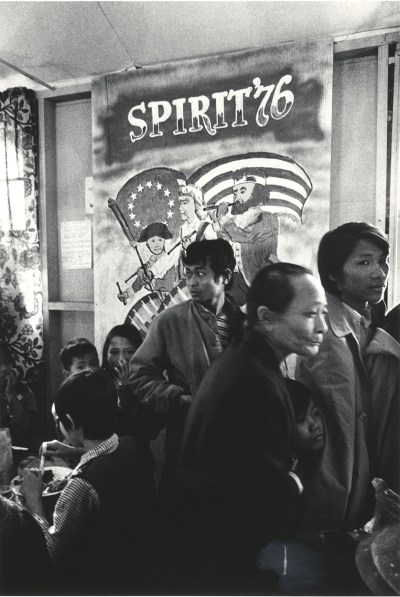
Charles Isaacs: Refugees in Mess Hall Waiting for Meal, 1975.
©Charles Isaacs
Art history as a discipline favors upstarts, the avant-garde, protest, outsiders, and transgression—all those timeless modernisms. The authors of What Was America? look through other lenses, highlighting “the role of the state.” Bias toward Modernism makes it hard to perceive how little public things—like designing postage stamps or National Park Service photographer stipends or spending the pittance of pre-DOGE NEA dollars on public programming—did something to cohere a nation. Everyday aesthetics made place. With their methodological shift to studying federated art, What Was America? tracks state aesthetics in a middle distance, well beneath bloc censorship and oligarch fellatio, and well above slop-memes and vile lies. An essential state role, parallel to provisioning basic services like education and healthcare, is endowing a wide open aesthetic field of form and meaning and collective sensibility.
Elise Armani and Katy Siegel, an art history PhD candidate/museum curator and an art history professor, respectively, coauthor in an engaging voice, and their joint expertise ranges impressively across media. The book’s organization pursues less a single thesis than a collage of different aspects of Bicentennial cultural practice, with each chapter highlighting a dynamic between the Bicentennial and 1970s culture more broadly (Environment, Preservation, Protest, and so on). Many chapters foreground a signature representative artwork from the huge array (Bruce Blackburn’s 1970 graphic logo for the Bicentennial, Ant Farm’s 1975 Citizens Time Capsule, a 1976 Betty Tichich photograph, and more). From this format emerges the tacit thesis that the Bicentennial cultural activities excelled at provoking critical, imaginative reflections on America’s past and future from artmakers and from ordinary citizens alike. Artworks and cultural transmission through documentary, records, historical narrative, and testimony all effectively pose the question of what the country holds in common.
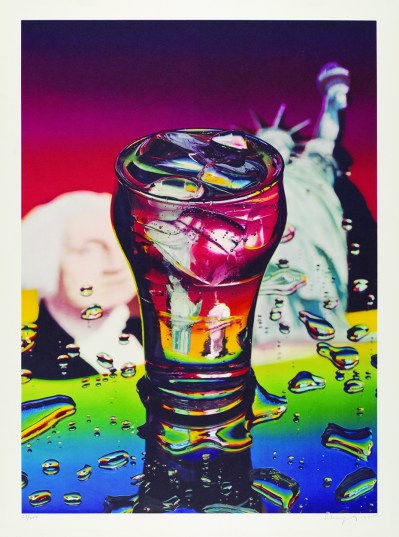
Ben Schonzeit: Yankee Flame, from the portfolio “America: The Third Century,” 1975.
Photo Brenda Bieger/Courtesy Buffalo AKG Art Museum/©Ben Schonzeit
Bicentennial aesthetics incited localized, collectivist, and even ideological meaning-making about the American experiment in pluralism. The authors rightly discern that their time of publication “coincides with a dramatic narrowing of national possibility under the ever-increasing pressure of capitalism, the policy of socialism for corporations and austerity for citizens, and most specifically, the defunding of culture, including art as well as science and public education.” Freedom 250 spectacularizes these forces, consolidating kleptocracy and depriving the people—of ice cream at the poorly-electrified fair, and of the very right to culture: to free expression, curiosity, cultivation. America was “at a high point in collective attention to, participation in, and funding of the arts,” we must rue 50 years later. What Was America? thus importantly broaches how defunding the arts wrought civic disintegration.
America was aesthetic dissent. The book opens with a gesture to more conventional art history topics by focusing on the epic endeavor of painter Benny Andrews’s series Bicentennial (1970–75). It considers along the way the pop pluralism of a “dazzling installation” in the dedicated Smithsonian “A Nation of Nations” exhibition, a neon-sign display fittingly credited to no artist, that collates technicolor logos from real restaurants around the country, “their glowing scripts advertised outposts of chow mein, kielbasa, lechon asado, kosher meat, and spumoni ice.” It celebrates the superstar Faith Ringgold’s The Wake and Resurrection of the Bicentennial Negro (1976), which consummated energy around quilting, especially Black women’s quilting, to center a mixed media tableau that the authors esteem “disavowal of the assimilationist melting pot, the patchwork quilt emerged within the Bicentennial framework as the dominant symbol of a heterogeneous citizenry: an assembly of fabric from various sources, each retaining its own attendant histories, stitched into a single surface greater than the sum of its parts.”
The book somewhat provocatively concludes after 1976 with a penultimate chapter on protest in the art world and an ultimate chapter on horizons for the future, along with a smart sharp epilogue. Invoking the Bicentennial’s dormant legacy of critique, the protest chapter in particular underlines the tension between official Bicentennial events like the “American Art from the Collection of Mr. and Mrs. John D Rockefeller 3rd” exhibition at the Whitney Museum and the scrappy New York collective Artists Meeting for Cultural Change (AMCC). AMCC’s anti-catalog includes an uncredited photograph of protesters surrounding a tuxedoed and gowned couple outside the museum surrounded by protestors, one with a hand-lettered picket sign resounding: Rockefeller uses culture to launder his money. Imagine Musk signing any such contract with cultural capital. The anti-catalog exposed, after the fact of the Bicentennial, the grotesqueries of corporate beneficence and private boosters that had supplemented the government’s project. In giving form to their resistance to Bicentennial events, the anti-catalog retrospectively contests any national fascia union in aesthetics, even though the role of the state was a spine.
America was the cultural expansiveness of the postwar boom in the US cycle of accumulation, which we can perceive 50 years later as a political, economic, and aesthetic peak—and an anomaly. What was the lasting impact of Bicentennial art? In their effort to recall a variety of pieces and themes while foregrounding the public infrastructures that enabled their exhibition, Armani and Siegel demur from much evaluation. There is little judgment of the quality of the works, and consequently little culmination. Where are they now? Which of these works or shows remain in public view? For the prominent artists featured, did the Bicentennial projects change the trajectory of their work or reception? In what art of the ’90s might we detect a cohort informed by youthful experience of the Bicentennial? What artists of the 2020s ought to have been invited for a semiquinquennial smash? Most of all, what aesthetic principles emerge across the study in What Was America?, and how could art historians wield their intellectual heft to promote those principles today? Surely there are particular modes, genres, styles, and media conducive to pluralism, and surely they are not the ones our art establishment favors. Photography, and “public” works like murals are particularly salient in this book, so is there something to be said about spatial forms, especially local ones, aiding social ties? Fine art’s real estate crisis and its wholesale entrenchment in money laundering perhaps commend the political possibilities of unfine modes? America needs a new founding and a new role of the state; what will be the role of art?
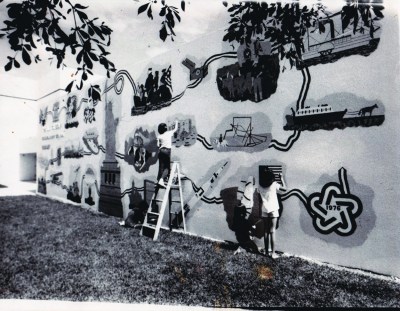
Students paint a Bicentennial mural at Royal Green Elementary in Miami.
Courtesy Tim Chapman Collection at the Museum of Miami
America was cultural dynamism that constituted soft power, from Hollywood and hip-hop to the once finest university system in the world. In their conclusion, the authors finally appraise the Bicentennial’s “intent to foster everyday creativity and access to art and culture, as part of the good life afforded by national affluence.” The bald opposite must be said of our Semiquincentennial, a spectacle as rapacious as it is cheap, whose degradations start in the UFC ring and descend down to festering algae and guard-patrolled mud. Demolishing universities, assaulting the press, violently resegregating the public sphere, ramming degenerative AI down our throats, incarcerating mere zine makers, the regime is systematically repealing the right to culture. Where can we look today, amid cultural stagnation, for American art not just evincing but capacitating the good life, for aesthetics of majoritarianism against authoritarians, for flourishes of freedom against fascism? What Was America? illustrates beautifully how much the now dismantled state, the now defunded culture, once commissioned connective tissue. With such tissue always fine and presently torn, it will take a lot more than art for repair and reconstruction. But big visions and galvanic forms would help.
America was an idea. And it is art’s job to make some new ones.
