


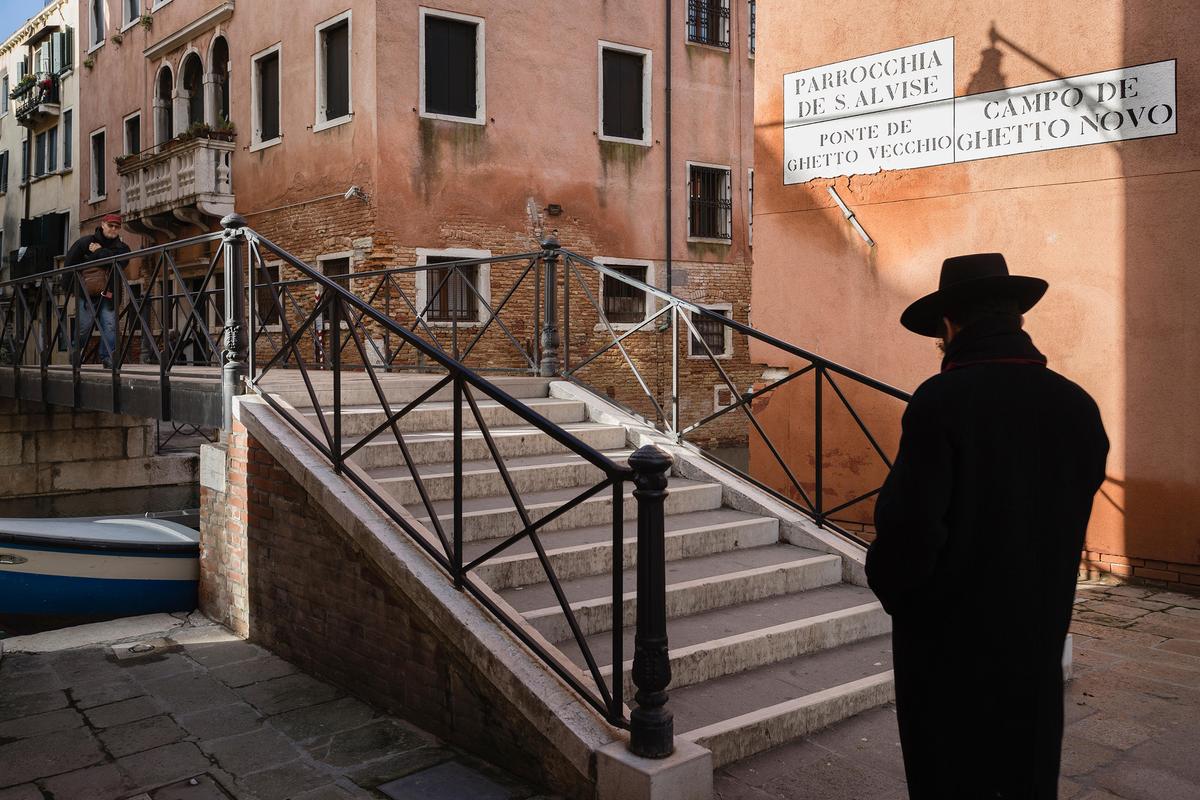
On 29 March 1516, the Venetian Senate voted to create the world’s first ‘ghetto’. All Jews then living in the city – as well as any others who might come later – were ordered to move immediately to a small island in the northeastern sestiere of Cannaregio, a neighbourhood known as the geto novo. It was anything but appealing. Previously used as a dumping ground for the communal copper foundry, it had been converted into a residential quarter for local workers. From the outside, it already looked ‘like a castle’ – ringed by canals and bounded by perilously tall tenements. But by the time Venice’s Jews were herded in, it seemed more like a prison. All outward-facing doors and windows were blocked up; extra walls were built to close off access to the water; and a pair of sturdy iron gates were placed at either end of the bridge leading to Cannaregio. These were closed at sunset and opened in the morning at the ringing of the marangona bell. And just to be sure that no one could sneak out when they weren’t supposed to, four guards – paid for by the Jews themselves – patrolled the canals around the Ghetto ‘day and night’.
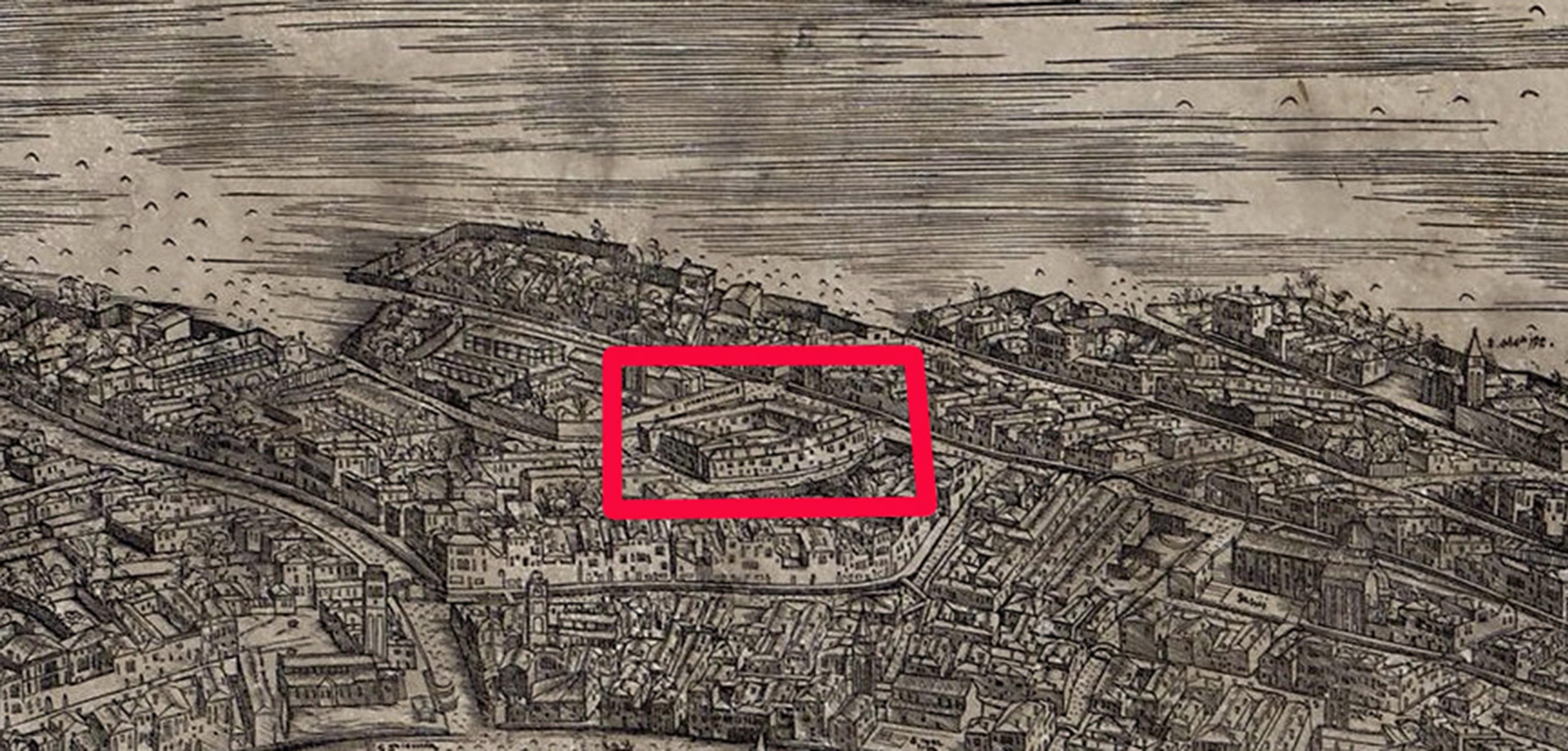
View of Venice (c1500) by Jacopo de’ Barbari, just prior to the Ghetto’s establishment; the location of the Ghetto is outlined. Courtesy Wikipedia
It was not the first time that Jews had ever been confined to a separate quarter, of course. By the early 16th century, Jews in France and in German lands had already been living in designated neighbourhoods, physically distinct from the surrounding areas, for close on 300 years. Nor was it even the first time Venice itself had toyed with the idea of Jewish confinement. Back in the 13th century, it had already obliged Jews in its Cretan colony’s capital Candia (now Heraklion) to live in a separate area.
What made the Ghetto unusual was its name. Etymologically speaking, of course, the word geto had nothing to do with Jews. Derived from the verb gettare, meaning ‘to throw’ or ‘cast’, it was just the local name for a foundry (geto) – and, by extension, for the dump next door. But even after the Venetian government moved the foundry elsewhere, people kept on calling the area by its old name. And when the Jews moved in, the island soon lent its name to the institution of segregation, too – a bit like how, today, we can use ‘the White House’ to refer both to 1600 Pennsylvania Avenue and to the administration that’s based there.
This was no small matter. Before then, Jewish quarters had been known by all sorts of different names (Judenstraße, Judengasse, Juiverie, etc). But none of them had ever broken through into common parlance as a way of describing segregation per se. They were either too closely associated with a specific geographical feature – a street or a square – or so imprecise that they could refer to just about anything. ‘Ghetto’ offered something different. Precisely because the word was being used metonymically, rather than just geographically, the word ‘ghetto’ could be used to describe any Jewish segregation anywhere. And soon enough, that’s exactly what happened. In around 1562, people started calling the Jewish quarter in Rome a ‘ghetto’; and less than 10 years later, another ‘ghetto’ was established in Florence. And so it went on – right through the 17th century, down to the eve of the French Revolution.
That was just the beginning. After Jewish segregation was abolished in Italy, in the wake of the Napoleonic invasions, the word ‘ghetto’ came to be applied even more widely. Now that its link with a specific type of Jewish segregation was broken, it could denote many more varieties of confinement, marginalisation and exclusion. Brought to the United States in the late 19th century, it was used to describe the poverty and precarity of any migrant group. And after the Nazi invasion of Poland in September 1939, it was applied with terrifying potency to sites of captivity and genocide. Even today, its meanings continue to multiply. Open a newspaper or shuffle your playlist, and you’ll find it used to stigmatise an ‘other’ – or, more often, to reclaim a lost power. And though all these ‘ghettos’ are very different, they all trace their origins back to Venice.
When the Venetian Ghetto was established, of course, no one could have foreseen that it would have such a lasting legacy. Its founders never meant to lay down a marker for the future. It wasn’t the result of a long-term plan. In fact, it almost didn’t happen at all. It was a compromise that emerged out of a period of confusion, experimentation and failure – an attempt to balance the apparently irreconcilable demands of religious prejudice and economic need. It was a paradox, born of war and migration, fear and uncertainty. And, to understand how it came into being, we have to go right back to the arrival of the very first Jews in the Venetian lagoon.
By the time the Ghetto was founded, Jews were already a familiar presence in the Venetian lagoon. As early as the 10th century, Jewish merchants from the eastern Mediterranean are known to have travelled on board Venetian ships; and at least a few spent some time in the city itself. They were, however, a transitory presence, staying only for as long as it took to unload a cargo or conclude their business, and then moving on to harbours new.
Towards the middle of the 14th century, however, a new wave of Jewish migrants began arriving from Germany. These ebrei Tedeschi (German Jews) were not visitors, pausing in the middle of a journey, but refugees. Having been forced to flee their native land by the waves of persecution unleashed by the Black Death, they came to Venice in search of safety – and in the hope of sharing in its commercial might. They first settled in Mestre, just across the lagoon from the city. And they quickly flourished. Some became labourers, others merchants, tailors or jewel-cutters. There were even a few doctors. But it was as money-lenders – or, more properly, pawnbrokers – that they found their niche.
Their success was hardly accidental. Since the mid-12th century, Christians had been forbidden to lend each other money at interest (a practice known as usury). To be sure, some enterprising souls had found a way round this – at least insofar as larger sums were concerned. Were a banker to lend a merchant 2,000 ducats to speculate on wood, for example, he could always dress up the loan as a ‘partnership’, and pretend that the interest was just his share of the profits. But smaller loans were another matter. If a sailor needed to borrow 2 ducats to buy food for his family, and agreed to pay it back, with a bit extra, a month later – well, that was usury, pure and simple. And that’s where the Jews of Mestre came in. As the Fourth Lateran Council had noted, usury was forbidden only between people of the same faith. Provided interest rates were not ‘excessive’, however, there was no reason why Jews couldn’t lend money to Christians. So, by lending small sums – the equivalent of today’s payday loans – the ebrei Tedeschi were able to fill a major gap. And the Venetian government was only too glad for them to do so. More likely than not, in 1366, several German Jews signed a contract (condotta) with the chief magistrate of Mestre, granting them protected status, in exchange for keeping their interest rates down.
No sooner had Venice recovered its prosperity than the ‘need’ for toleration of Jewish migrants began to wane
However, what the ebrei Tedeschi really wanted was to live in Venice itself. But the Venetians were having none of it. Although they were happy enough to borrow money from Jewish bankers when it suited them, they still regarded the same bankers with undisguised hostility. In the Venetians’ eyes, Jews posed a clear and present danger to the Christian faith. If they were allowed to take up residence in the city, the thinking went, they could easily ‘infect’ unsuspecting believers – and thereby undermine the health of Christian society as a whole. There was no question of them being allowed in.
It didn’t take long for Venice to change its mind, though. After a devastating war with Genoa, the Venetian economy was in ruins. Trade had dropped, food prices had soared, and poverty was rising fast. With more people borrowing than ever before, interest rates skyrocketed. If Venice was to stand any chance of getting back on its feet, it needed cheap credit – and fast. Therefore, it put pragmatism ahead of prejudice. In February 1382, the Venetian government offered any banker who would agree to lower their interest rates the chance to live in the city for a period of five years. Theoretically, anyone could apply; but, with only one exception, all those who signed up were Jewish.
It worked like a dream. Little by little, the Venetian economy began to recover. The government was so happy, in fact, that just three years later it voted to offer the ebrei Tedeschi a new condotta, allowing them to go on living in Venice for another decade, after the last arrangement expired. And that wasn’t all. The Venetians were so keen to attract more Jewish bankers to the city that the government even decided to set aside a quarter especially for Jews. In the event, nothing came of this – but the intention was clearly to give Jews a more settled status, and to make Venice a more attractive home for Jewish migrants. A bright future seemed to lie ahead.
But no sooner had Venice recovered its prosperity than the ‘need’ for such toleration began to wane and prejudice once again reared its ugly head. Disagreements sprang up. Threats were made. And, after briefly reviving the plan to create a separate Jewish quarter – albeit to segregate, rather than to welcome the community – the Venetian government decreed that, when the condotta expired in 1397, the Jews would have to leave.
With no other choice, the ebrei Tedeschi dolefully made their way back to Mestre. Although they were not forbidden to visit Venice, they would be allowed to stay only for 15 days at a time and were required to wear a yellow circle on their outer clothing at all times, so that they could be clearly identified – an obligation that had already been foisted on their coreligionists in Sicily, and which would subsequently be imposed in many other Italian cities.
However, the Venetian government quickly realised that it had made a mistake. Although it had seemed easy enough to get rid of the Jews, it proved almost impossible to do without them. Even at a time of economic recovery, ordinary people still needed Jewish loans – and, despite everything, the Jewish moneylenders still wanted their business. It did not take the ebrei Tedeschi long to find a way round the ban. After their 15 days in Venice were up, they simply took a boat to Mestre, stopped for as short a time as was needed to reset the clock, and then went straight back to the city. In this way, they were able to maintain an almost permanent presence in Venice – without ever ‘officially’ residing there.
Naturally, the Venetian authorities tried to clamp down on such infractions. In 1402, they decreed that, after the 15 days were up, Jews could not return to the city for another four months. But there were so many exceptions that it was virtually impossible to enforce. Therefore, even though the Venetian government had no intention of revoking the Jews’ expulsion, it had to reconcile itself to the fact that a Jewish presence of sorts was inevitable – even desirable. As such, its approach shifted from expulsion to containment. Efforts were made to enforce the wearing of the yellow circle, to prohibit acts of worship, and to prevent ‘sexual pollution’. By the 1420s, however, there were just as many Jews in Venice as ever.
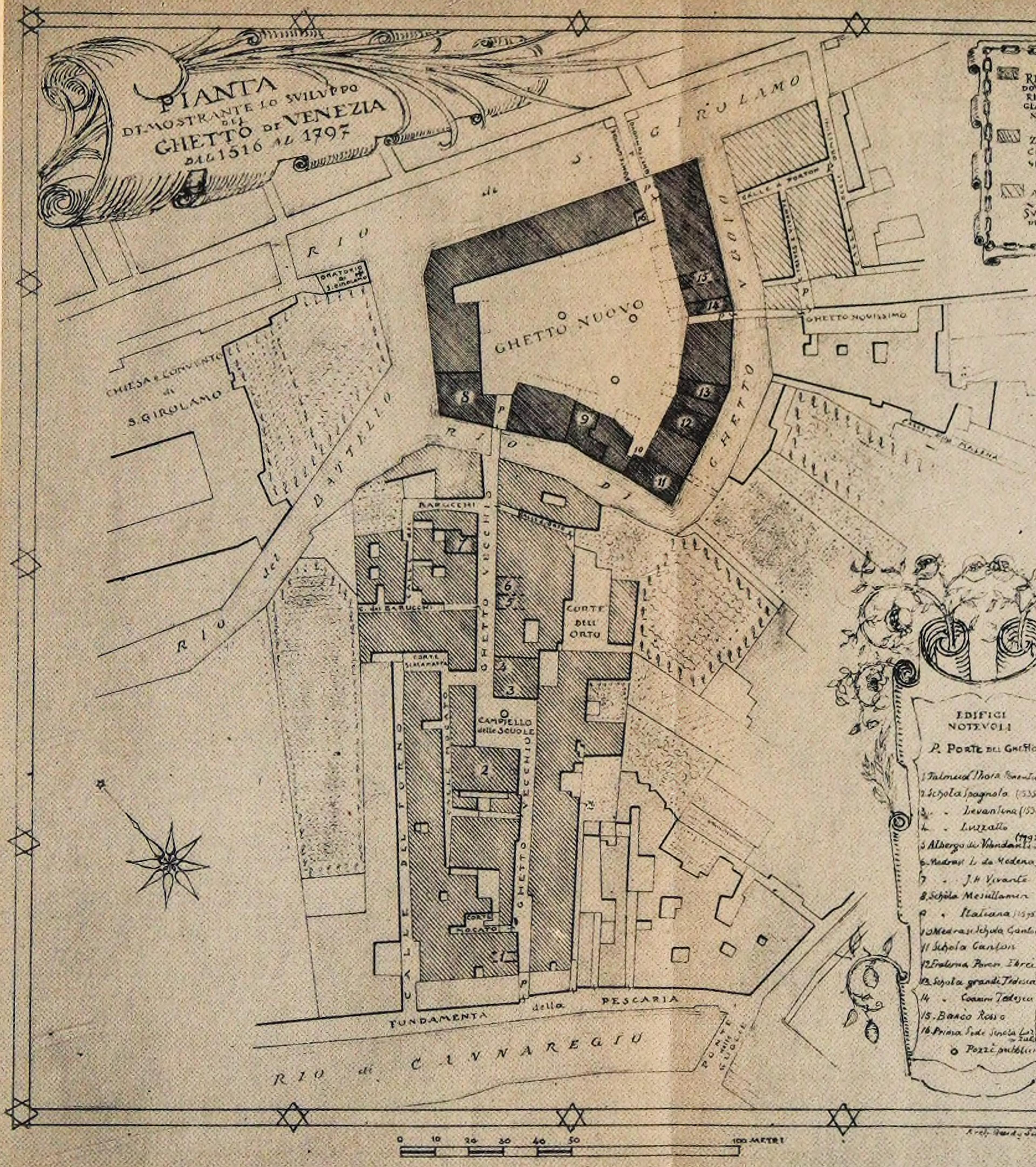
Plan of the Jewish Ghetto of Venice (1516-1797) by the architect Guido Costante Sullam, late 19th century,
from the book Venice (1930) by Cecil Roth. Courtesy the Internet Archive
Such pragmatic ambiguity might easily have continued indefinitely, had a new wave of antisemitic hostility not swept Europe in the mid-15th century. In response to a complaint from King John II of Castile about the ‘scandalous’ offences Jews were supposedly committing against Christians in his kingdom, Pope Eugenius IV promulgated a bull – Dudum ad nostram audientiam (1442) – that attempted to separate the two religions as completely as possible. All the privileges Jews had previously enjoyed were annulled; harsh new legal restrictions were imposed; and the opportunities for social interaction were cut down to an absolute minimum. Officially, this was intended to apply only to Castile; but in Italy, the mendicant orders were not slow to pick up on its implications. Wandering from town to town, itinerant friars like Domenico da Leonessa preached against Jewish usury and urged municipal authorities to expel Jewish populations once and for all.
This was easier said than done. As Venice had already recognised, most towns depended so much on Jewish credit that it was difficult to imagine doing without them. The friars therefore proposed a solution. With the papacy’s approval, they proposed that towns should set up monti di pietà (‘banks of compassion’). Funded by voluntary donations, these would offer small loans to the working poor on a charitable basis – that is to say, either without asking for any interest at all, or charging rates no higher than they needed to cover their running costs. In principle, this would then relieve Italian towns of the need for Jewish moneylenders, while still respecting the prohibition on Christians lending money.
Several towns had already banned Jews from lending money, or expelled them outright
The first reliably attested monte di pietà was established in Perugia in April 1462. Over the subsequent decades, dozens more followed across Italy and, in most cases, they worked pretty much exactly as the friars had hoped. Once a ‘bank of compassion’ was operating, Italian towns generally didn’t waste much time before ordering the local Jews to leave.
In the Republic of Venice, the friars’ message struck a chord. Since the 1420s, many of Venice’s nearby subject towns on the Italian mainland had grown increasingly hostile to their Jewish residents. Shortly after the promulgation of Dudum ad nostram audientiam, several of them had already banned Jews from lending money, or expelled them outright. And that was just the beginning. When, in 1475, the Jews in Trent (now Trentino) were arrested on suspicion of having ritually murdered a toddler named Simon, a new wave of antisemitic fury was unleashed. Encouraged by preachers like Bernardino da Feltre and Marco da Montegallo, this led to the establishment of monti di pietà in Vicenza, Brescia and Verona just a few years later.
Venice itself seemed close to following suit. Although the Jews’ contribution to the city’s financial stability ultimately prevented the government from taking any precipitous steps just yet, a growing number of patricians were anxious to see them gone. To many of them, it must have seemed like a matter of when, not if.
Their confidence was misplaced, however. When King Charles VIII of France set out to conquer Naples in 1494, Italy was plunged into a series of devastating wars that would rage, on and off, for much of the following 65 years. Venice could not help being drawn into the fray. Yet if it hoped to profit from the fighting, it was cruelly mistaken. It was woefully unprepared. And as its military position worsened, it found that it had no choice but to call on the Jews for help. Heavy taxes and loans were asked of Jewish communities throughout the terraferma (mainland); and, with food prices rising by the day, Venice did whatever it could to keep Jewish credit flowing. On 14 January 1503, the government offered the Jewish bankers of Mestre a new condotta on unusually generous terms. Provided they continued to lend money at reasonable rates of interest, they would be allowed to come and go as they wanted, to rent houses in Venice, and to observe their rites. Most importantly, they were also given an assurance that, if the war on terraferma threatened their safety at any point, they would be allowed to take refuge in Venice itself, and to remain there as long as necessary.
This last clause was probably just meant to be a sweetener. Although Venice was struggling on the battlefield, things were not so bad that anyone seriously expected the bankers of Mestre to flee. But, before long, all that would change. Following a catastrophic defeat at the Battle of Agnadello on 14 May 1509, Venice’s control over the terraferma suddenly collapsed. As French troops advanced on the lagoon, refugees began to stream into the city – including hundreds of Jews from Mestre and other subject cities. The bankers who had signed the 1503 condotta came with the government’s blessing, but a great many more did not.
Terrified that this sudden influx of people would cause a shortage of food, the Venetian government tried desperately to expel anyone who did not have permission to stay. But the frightened refugees refused to budge – and no amount of cajoling could persuade them to do otherwise. Quite suddenly, Venice found itself confronted with precisely the Jewish presence it had tried for so long to avoid.
Even the Jews’ most ardent detractors had to admit that having Jewish bankers in the city at a time of crisis was something of a boon
A paradoxical situation now began to unfold. As the months passed, pressure on the government to expel the Jews – or even worse – only grew. Despite a few fleeting moments of hope, Venice’s position remained critical; and more than once, the city itself was threatened with a direct assault. In the eyes of its inhabitants, every setback began to assume a religious significance. Encouraged by preachers, they came to believe that their misfortunes were a form of divine punishment and that the Jews were ultimately to blame. At Eastertide – when Jews were traditionally held responsible for Christ’s crucifixion – the calls for retribution became intense. On 2 April 1511, for example, Fra Rufin Lovato suggested that the best course of action would be ‘to deprive [Jews] of everything they owned and put them to the sack’.
At the same time, it was increasingly clear to the government that it would not just be difficult to remove the Jews – but positively dangerous to do so. Even the Jews’ most ardent detractors had to admit that having Jewish bankers in the city at a time of crisis was something of a boon. The diarist Marin Sanudo the Younger is a case in point. Although he complained bitterly about the ‘great number’ of Jews he saw in the street, he acknowledged that it was impossible to say anything because ‘they are needed’. And the more the war dragged on, the more essential they became.
The question facing Venice therefore shifted. Instead of focusing on how the Jews might be expelled, the government now began to ask itself how best it could take advantage of the Jews’ presence, while minimising the ‘risk’.
It was not long before a new ‘solution’ presented itself. On 23 April 1515 – 18 months after the Venetian defeat at the Battle of Schio – Giorgio Emo, an important member of the Collegio – the nearest thing Venice had to a cabinet – proposed that the Jews should be confined to the island of Giudecca. It seemed to be a reasonable compromise. There, Emo argued, the Jews would be kept far enough away from the Christian population to prevent religious ‘infection’ from spreading, yet close enough that they could keep the wheels of finance turning. Naturally, the Jews were appalled. They protested that, if the Jewish community was forced to move to Giudecca, it would be in danger of being attacked by the mercenaries billeted there. They therefore suggested the island of Murano instead. But when this, too, turned out to be unworkable, Emo’s proposal was quietly shelved. The principle of segregation was not in any doubt, though. It was just that, for the moment, the government didn’t have the time – or the inclination – to find a more suitable location.
It didn’t take much for that to change. The following year, the Emperor Maximilian invaded the Duchy of Milan, threatening the security of Venice’s remaining possessions on terraferma. In Venice itself, public anxiety rose. That Easter, Fra Lovato once again railed against the Jews. His sermons were apparently no more violent than before. But it was enough to revive the idea of segregation – and stirred the government to action. On 26 March 1516, the Venetian patrician Zaccaria Dolfin presented a proposal to the Collegio similar in outline to that put forward by Emo the previous year. Dolfin stressed that the Jewish presence was the source of Venice’s ills. Given that the Jews could neither be expelled nor confined too far from the city’s markets, he therefore proposed that they should be sent to live on the island of the geto novo in Cannaregio. Despite strong opposition from the Jewish community, the Collegio approved the proposal and, three days later, the Senate confirmed its decision. On 1 April, city criers read the decree in public, and by 25 July, all Venice’s Jews, without exception, were in the geto novo. The Ghetto had been born.
The Ghetto was never meant to be anything more than a temporary measure – a quick fix for a passing ‘problem’. But over the decades that followed, the persistence of war and an abiding reluctance to establish a monte di pietà in Venice prevented the government from ridding itself of the city’s Jewish quarter. In fact, as time wore on, the steady decline of Venice’s fortunes not only guaranteed the Ghetto’s endurance – it also paved the way for its expansion. Later, two further ghettos would be created – the Ghetto Vecchio (1541) and the Ghetto Nuovissimo (1633) – each intended to accommodate different groups of Jewish migrants from the Iberian peninsula (those who came via the Ottoman Empire being known euphemistically as ‘Levantines’, and those who subsequently arrived by a more direct route as ‘Ponentines’), whose involvement in international trade increasingly sustained Venice’s faltering commercial standing. And though the Ghetto itself would endure its own decline, it would not be abolished until after the arrival of Napoleon in 1797.
The Ghetto was, from its inception, a site of exclusion. As the centuries wore on, efforts were repeatedly made to reinforce the barriers – both real and metaphorical – that separated its inhabitants from the Christian world beyond. Yet at no point was it ever hermetically sealed. Its very existence was founded on the necessity of exchange, interaction, even co-existence. The credit market, and later international trade, required there to be a constant to-ing and fro-ing between Jews and Christians. Exactly the same was true of cultural life. In a city as intellectually vibrant as Venice, where humanists were as fascinated by anything Hebrew as they were by Latin and Greek, the exchange of ideas was inevitable. And this is to say nothing of the fact that identities in early modern Venice were often so complicated that it was virtually impossible to separate any communities completely.
In some ways, then, the Ghetto is a reminder of the paradox that lies at the heart of all forms of social exclusion, even today. It speaks to the fact that any attempt to marginalise a community ultimately arises out of ties that bind – and speaks more eloquently to the failures of those doing the marginalisation than it does to any perceived ‘differences’.
Yet perhaps the Ghetto’s most powerful lesson for our own times lies in its contingency. The path to its foundation was not travelled in giant leaps, but in hesitant steps. It was made up of small, incremental decisions, each of which was contested – and all of which seemed conditional, at best, in the moment. At any stage, it could have been stopped. Venice could have reversed its steps or chosen a different road. And this is where its real message lies. Today, antisemitism is once again on the rise, influenced by wars beyond our reach, and events beyond our control. It is built on paradoxes and contradictions, prejudices and failures. And it advances by small steps – steps that we tell ourselves are isolated or unrepresentative in themselves. A piece of graffiti, a shouted slogan, a casual assault in the street. But Venice shows where those steps lead – and reminds us that every one can, and must, be fought.
