

AITWA welcomes major GST Relief for Transporters; calls 57th GST Council decision a significant step towards EoDB

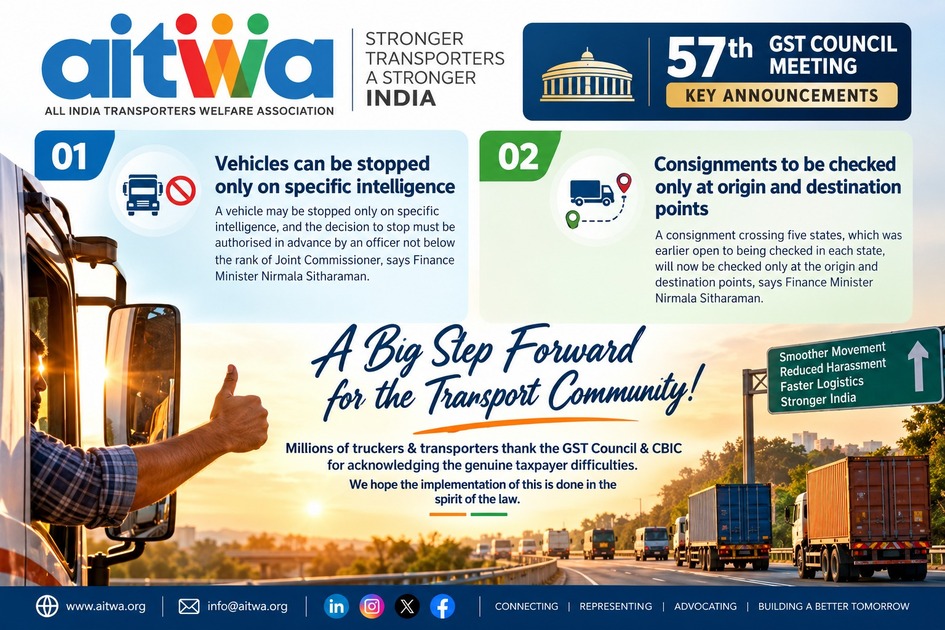
MUMBAI: The All India Transporters Welfare Association (AITWA) has welcomed the key decisions announced at the 57th GST Council meeting to make the inspection of goods in transit more targeted and reduce unnecessary intervention on vehicles and consignments.
Under the new approach, vehicles will be stopped only on the basis of specific intelligence, with prior authorisation by an officer not below the rank of Joint Commissioner. Further, consignments moving across multiple states will be subject to checks primarily at the origin and destination points, rather than being repeatedly checked during transit.
AITWA said these measures address a long-standing concern of the road transport industry and will significantly reduce unnecessary stoppages, delays and uncertainty during the movement of genuine consignments.
AITWA has been fighting for this reform for years
AITWA has consistently raised the issue of excessive transit checks and disproportionate penalties under the GST regime with the Government and tax authorities.
In 2021, AITWA had supported the call for a Bharat Bandh and Chakka Jam on 26 February, with the transport industry specifically demanding relief from impractical E-Way Bill provisions and the harsh consequences under Section 129 of the CGST Act.
Detention of goods for E-Way Bill-related issues could result in penalties running into lakhs of rupees, with the applicable penalty being linked to 200% of the tax payable.
For genuine taxpayers and transporters, even inadvertent documentation errors, delays or circumstances beyond their control could therefore create a disproportionate financial burden. The statutory provision today continues to provide for a penalty of 200% of the tax payable in specified cases.
A major step towards reducing transit-related harassment
AITWA believes the latest decision can fundamentally change the experience of compliant taxpayers and transporters on Indian highways.
With checks becoming intelligence-led rather than routine or repetitive, legitimate consignments should be able to move with greater predictability. Importantly, when an issue does arise, taxpayers and their representatives will have a better opportunity to reach the vehicle and explain the documentation and transaction, rather than facing repeated intervention at multiple points during an inter-state journey.
Mr. Abhishek Gupta, General Secretary, AITWA, said: “AITWA has been fighting this battle for years. We have repeatedly highlighted that a genuine transaction should not become a victim of procedural complications or disproportionate penalties. Error vs Evasion was our representation always. Section 129, particularly the 200% penalty provision, created enormous anxiety and financial exposure for transporters and taxpayers even where there was no intention to evade tax.”
Mr. Ashok Goyal, National President, AITWA, said: “The decision of the GST Council to move towards intelligence-based intervention and restrict unnecessary checks during transit is therefore a very significant relief for the transport community. It will reduce transit disruptions, improve logistics efficiency and strengthen the principle of trust-based taxation.”
“AITWA sincerely appreciates the intervention and efforts of the CBIC, the Policy Wing and the GST Council for listening to the industry’s concerns and acting on issues that we have been consistently raising. Millions of truckers, transporters and genuine taxpayers welcome this step.”
AITWA further said that effective implementation in the spirit of the decision will be critical. The Association hopes that the new framework will bring greater consistency across states, minimise discretionary stoppages and ensure that enforcement remains focused on genuine cases of tax evasion rather than compliant movement of goods.
AITWA looks forward to working constructively with CBIC, the GST Council and state tax administrations to ensure that this important reform translates into a smoother, faster and more transparent movement of goods across India. Further bottlenecks may also be removed in due course with continued dialogue.
