


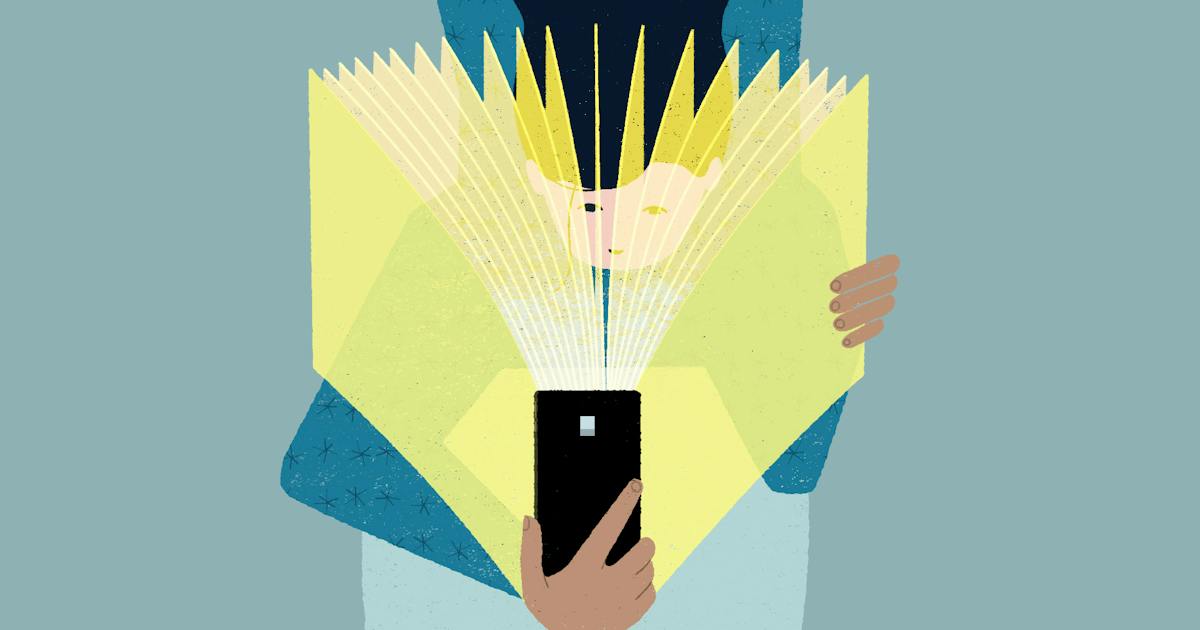
This is also what makes it profoundly strange for Marriott to write that, while books “can even console us,” a smartphone “very rarely does”—engineered as smartphones are, as he understands them, to make reality seem incomprehensible. The advantage of books, he writes, is that they’re capable of rendering the world “as a comprehensible whole, not as a whirling snow-storm of fragments.” But he has it exactly backward. It’s our screens that give us the impression, necessarily an illusion, that we’re seeing the whole world and what really matters in it—sound and vision and an infinite web of interlinked text delivered to our eyes and ears, perhaps in real time, all at once, without the work of extrapolation, synthesis, and imagination required to read bare text on a printed page. It is impossible to read a printed book, no matter how well-written, how long, and how tightly argued, with the belief that all reality lies within your hands. The smartphone convinces its users of this easily.
It was the former world of books and print, not the world of screens, that was the world of fragments, partiality, and disorienting, incomplete abstractions. And what we ought to miss the most about it are the ways it forced us—even physically, in the weight of the texts we carried—into an understanding that making sense of ourselves and the world around us is a struggle, not a matter of settling into the right channel or feed, and that our knowledge is often incomplete. The viewer of a tree on a screen thinks, if only for a second, that they have really seen a tree. A reader who comes across a passage about trees has to imagine it, conceptualize it, compare it to another description, or go out into the world and find it. And unless they are particularly skilled, writers who have made a pass at describing trees may find themselves in trouble—it is difficult to make the reader see what they see, think what they think, and feel what they feel through text alone, especially when they are in competition with the readers’ own intuitions, senses, and habits of mind.
All told, reading and writing matter because written language complicates the world as often as it clarifies it. Indeed, it often helps us make sense of it by convincing us the world is not as simple as it outwardly appears. And as Marriott suggests in the book’s more grounded moments, the written word has been fundamentally Promethean in character—it has shaken peoples out of their complacency and into new ways of thinking and seeing the world, for good and for evil.
