

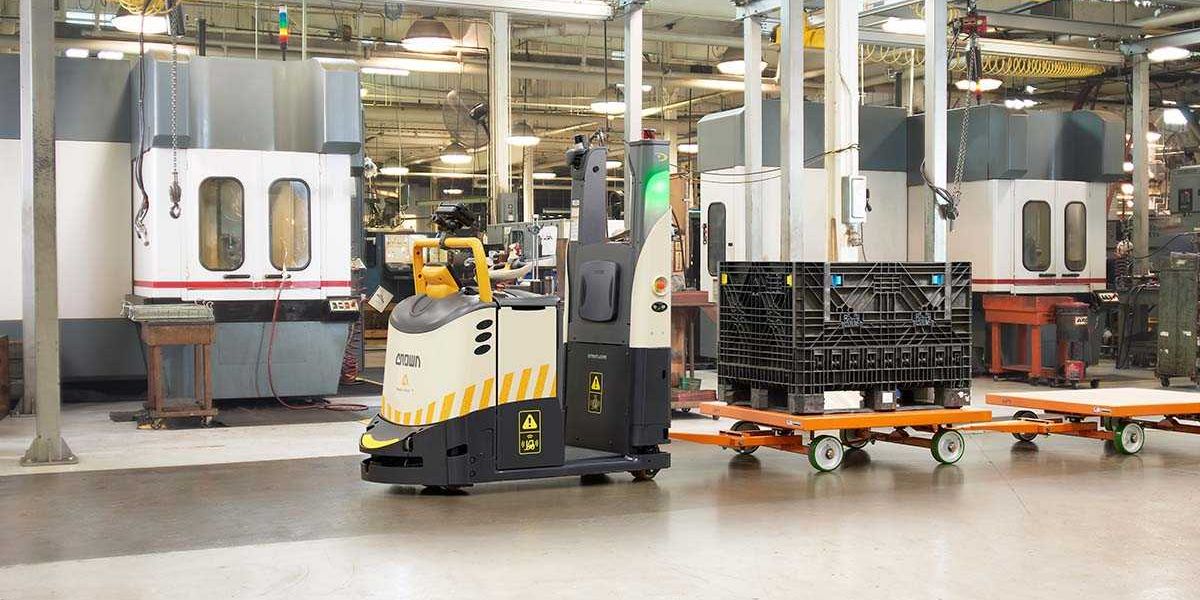
The number of companies offering forklifts that can lift, lower, pick, put away, and transport loads without a human operator on board has exploded. At material handling shows in the U.S., Europe, and Asia, dozens of companies from around the world are exhibiting driverless (a.k.a. robotic or automated) lift trucks. They’re just the tip of the iceberg, though: One industry executive estimates that hundreds of companies offer automated forklifts today—some large and well-established, but many of them tiny and untested.
Although automated lift trucks have been available in the U.S. for more than a decade, only a limited number of fleets have adopted them, and it’s unclear how many units have been leased or sold to date. It’s also unclear whether the market for driverless forklifts can support so many vendors. To get some sense of the near-term outlook for this equipment—primarily automated trucks with masts and forks—we looked at the current market, what is driving or constraining adoption, and how much demand is expected to grow.
THE CURRENT LANDSCAPE
When it comes to suppliers of driverless forklifts, vendors fall into two main categories. The first includes original equipment manufacturers (OEMs) of manual lift trucks that have added automated forklifts to their lineups. In the U.S., that list includes such familiar names as Toyota, Raymond, Crown, Hyster, Yale, Linde, and Big Joe, among others.
The second category could be called “robotic from the start” and includes Seegrid, Rocrich AGV Solutions (a joint venture between Logisnext Americas Inc. and Jungheinrich that sells Rocla and Jungheinrich automated forklifts in North America), Oceaneering, Fox Robotics, VisionNav, and Vecna Robotics, to name just a few of the many players.
We spoke to companies in both categories for this article. Each one offers a different mix of products, including automated counterbalanced trucks, pallet stackers, reach trucks, very narrow aisle (VNA) equipment, and tow tractors, which are also known as tuggers. Some automated forklifts are versatile, while others are very specialized. Equipment offered by Fox Robotics, FlexNav, and Gideon, for example, is specifically designed for loading and unloading trailers and containers.
Which product types are most popular? Automated tow tractors or tuggers for horizontal transport are among the biggest sellers for companies such as Seegrid, Toyota, and Yale. Globally, automated pallet stackers are the most popular with Linde’s customers, because they are a “good fit” for the most common warehouse applications and are an affordable option for customers that are starting their journey into automation, says Yanis Harmance, senior product manager with Linde North America. Jim Gaskell, managing director, automated warehouse and emerging technologies for Crown Equipment, says the versatility of automated reach trucks makes them a good choice for many warehouse applications: They can be used for full-pallet putaway and retrieval and as transport vehicles to the docks, plus they can pick pallets and deposit them in pallet positions on other rack levels or on the floor. “You can automate an entire building using just one model of an automated reach truck,” he says.
Some OEMs handle both hardware and software entirely in-house, while others have partnered with specialists. Yale and Hyster, for example, recently brought forklift automation in-house and launched their own technology platform after years of partnering with another company. And in June, The Raymond Corp. announced that it will add Third Wave Automation’s AI (artificial intelligence)-enabled navigation and control technology to several of its automated models, beginning with its Swing-Reach truck. (Raymond’s parent company, Toyota, is an investor in Third Wave through its Toyota Ventures and Woven Capital funds.)
Many of the automated trucks offered in the U.S. are designed and built here or in Europe, an early leader in forklift automation. China, however, is home base for a swiftly growing cadre of robotic forklift vendors. Regardless of their origins, OEMs see substantial growth opportunities in North America. Croatia-based Gideon, for instance, signaled its confidence in the market late last year by opening a factory near Chicago to produce its Trey autonomous trailer loading/unloading forklift.
Such confidence appears to be well-placed. A recent report on the autonomous forklift market from U.S.-based Grand View Research pegs the global market in 2026 at $5.9 billion, while a report from Dubai-based Fact.MR similarly estimates it at $5.6 billion. In an attempt to translate those estimates into “facts on the ground,” we asked several vendors how many automated forklifts they had sold or leased in North America so far, how many customers are using them, and how well sales matched up with forecasts. A few declined to answer those questions, while others said they could only provide estimates.
David Griffin, chief sales officer of Seegrid, said his company has shipped and deployed more than 2,500 robots “across hundreds of facilities to 50-plus customers.” Rocrich’s director of sales, Brian Markison, said his company had deployed “a little over 500” units at about 70 to 75 locations, while Harmance said Linde has sold “more than 1,500” globally. Kyle Smart, sales manager, automation for Yale Lift Truck Technologies, said that “hundreds of units are deployed and operational in North America” for more than 50 different customers. That is “about what [Yale] expected,” given that industrywide, most companies that have invested in automated forklifts are large firms with enough capital available to take on sizable, complex projects, he explains.
Even for large customers, though, most automated forklift projects have been “small, more like pilots,” Griffin observes. One of Seegrid’s customers has deployed more than 100 automated vehicles, but that scale is still uncommon, he says; most companies “start with a handful of trucks, and then they may scale to dozens over a few years”—if they scale at all, that is. (Griffin contends that some other vendors’ projects often fail to move beyond the pilot stage.)
Generally speaking, Smart says, automated forklifts are appropriate for industries with “repeatable material flow processes that are well-designed and are able to accommodate automation, with design changes if needed.” Customers using Yale’s automated products are in consumer packaged goods, e-commerce, retail, large warehouses, and heavy manufacturing. The majority of Seegrid’s installations are in manufacturing, including the automotive industry, which Griffin says is “by far the leader in the use of automated fork trucks today.” Linde’s most frequent customers are in general warehousing, third-party logistics (3PL), and automotive, and more of those installations have been implemented in existing facilities than in new, “greenfield” environments, Harmance says. Many of Rocrich’s customers are in food and beverage, retail, wholesale, pharmaceutical, 3PL, and manufacturing, including paper and cardboard manufacturing, according to Markison.
DEMAND DRIVERS AND CONSTRAINTS
As for what’s driving demand for automated lift trucks, OEMs say it largely comes down to the trucks’ labor- and safety-related advantages. Labor expenses are a prime motivator for many of their customers, particularly in manufacturing, where labor costs are high. “The more expensive the labor, the more you can justify automation,” Griffin says. Warehouse labor generally is less expensive than its manufacturing counterpart, but because labor can represent 50% to 65% of warehouse operating costs, more high-throughput warehouses and distribution centers are considering driverless forklifts, Markison says. The lower labor cost means that warehouse operators require a lower price point than manufacturers do; with that in mind, Seegrid plans to release a new model in early 2027 that is targeted at warehouse applications and will be about half the price of the company’s manufacturing-focused equipment.
Labor availability is an equally influential factor. At many facilities, turnover rates are high, up to 25% of the staff may fail to show up for work on any given day, and open positions for forklift operators are hard to fill, leading some to hire inexperienced operators or loosen their hiring standards. Those situations can lead to work backlogs, late shipments to customers, costly overtime, or increased accidents and damage. Automated forklifts have none of those problems, and their consistency, predictability, accuracy, and reliability make them an effective solution for many companies that are struggling with staffing.
Improving safety is a third major reason businesses are interested in driverless forklifts. OEMs say that these forklifts’ traffic control software, sensors, scanners, obstacle-detection systems, and automated braking capabilities reduce or eliminate collisions, worker fatigue, accidents and injuries, damage to product and racking, and failure to comply with safety rules. “The data is crystal clear: The work environment becomes safer on Day 1 with automation,” Griffin asserts. “Safety incidents immediately go down to zero.”
Despite these and other factors that favor the adoption of autonomous forklift systems, several concerns may give potential adopters pause. For instance, managers may be worried about the potential complexity of integrating automation software with legacy information systems, or about technology acceptance and capabilities among their workforce. But in Griffin’s view, the most important factor holding back implementation “is not the technology, which has matured and been proven.” Most of the constraints, he believes, lie in a facility’s operations. Successful automation requires consistent, disciplined processes and an overarching automated system that orchestrates activities—something that is lacking in many operations, he says. “If you want to automate, there has to be an orchestrating system” as well as internal processes that enable and support automation.
Even when operating conditions are amenable to automation, cost may be a big issue for many organizations. Grand View Research estimates upfront costs of $100,000 to $200,000 per unit, depending on the complexity of the technology and the required equipment features. That cost typically includes hardware, software, and systems integration, such as integration with legacy warehouse management systems. Other expenses may include things like infrastructure modifications, facility mapping, employee training, and system maintenance.
While nobody disputes that an automated forklift system is expensive, Grand View’s figures are broad estimates that may not reflect every user’s experience. Rocrich’s Markison notes that the per-unit cost will decline as the number of automated trucks increases because the fixed costs for every project regardless of its size—such as design work, software development, and facility preparation and integration—will be spread across more units. And some OEMs are taking steps to make automation more affordable and accessible, especially for small and medium-sized businesses. Just one example is the Yale Relay automation platform, which uses a drag-and-drop visual interface so users do not need software coding expertise to set up automated lift trucks, map or change routes, or add or drop a truck. A rental model that rolls all costs into one monthly fee directly addresses financial concerns, allowing facilities to “prove out the business case without making a long-term commitment,” Smart explains.
Focusing entirely on upfront expenses, though, will not give a prospective buyer a complete understanding of the potential cost benefits of automation. Any return on investment (ROI) analysis, vendors say, should balance capital outlays against less-tangible benefits, such as lower labor costs (including the cost of hiring and training new forklift operators in high-turnover environments), fewer accidents and less damage, lower insurance costs, the avoidance of regulatory fines, and a reduction in late shipments (and, therefore, better customer service and retention).
A LOOK AHEAD
Labor challenges and the need for safety improvements in warehouses, DCs, and factories are unlikely to diminish anytime soon. Those factors alone may be enough to incentivize more companies to invest in driverless forklifts, but analysts predict that technology like AI that makes navigation, material flows, and project implementations more efficient; integration of autonomous forklifts with “smart” warehousing solutions and internet of things (IoT) platforms; and lower-cost, scalable solutions that make automation accessible to small and mid-sized companies will also fuel growth in forklift automation. Their outlook for robotic forklift sales is upbeat: Grand View Research forecasts a market value of $14.5 billion by 2033, with a compound annual growth rate (CAGR) of 13.7%, for all types of automated lift trucks, while Fact.MR forecasts a market value for automated equipment with forks and lift mechanisms of $8.79 billion by 2036, with a CAGR of 4.6%. Interact Analysis, meanwhile, reports that two-thirds of respondents to its June 2026 survey of more than 270 forklift buyers said they plan to increase spending on forklift automation in the next 12 months.
The vendors we spoke with foresee steady growth in demand for both their own products and industrywide. Rocrich, for one, expects year-on-year sales growth approaching 50% this year, despite U.S. companies’ uncertainty about tariffs and geopolitical developments, according to Markison. He expects double-digit growth for the North America automated forklift market as a whole and says he “wouldn’t be surprised” to see 10% to 15% annual growth over the next few years. Linde’s Harmance is confident that demand for automated vehicles “will keep growing every year and … will not stop anytime soon.” He cautions, though, that any forecast will vary depending on the application, the specific type of automated vehicle, and whether sales figures include ancillary equipment or software.
While manufacturing applications have dominated sales of driverless lift trucks, that is shifting as demand from warehouse operators strengthens. Crown’s Gaskell is seeing a trend toward greater deployment of automated forklifts in high-bay warehousing, which creates opportunities for reach trucks, turret trucks, and other warehouse-specific models. Automated counterbalanced trucks will have less of a role in warehouse applications than they have had so far, he predicts.
A key question for buyers and providers alike is whether there will be enough sustained demand growth in the next decade to support both the established OEMs, whether “traditional” or “robotic from the start,” that have long-term production and implementation experience in the U.S. and the plethora of new market entrants that may not have much more than their technology to offer at this point. The answer appears to be no. “Hundreds of companies are designing, experimenting with, piloting, and (in some cases) selling automated forklifts, and the market isn’t big enough for all of them,” Seegrid’s Griffin says. He estimates that more than 80% of automation-only startups won’t survive as standalone companies.
One reason their prospects could be shaky, Gaskell says, is that startups dedicated to automation face the dual challenge of scaling their businesses and delivering reliable solutions. “Getting an automated system to perform consistently and cost-effectively with minimal intervention is difficult enough, particularly when customers expect a certain rate of return,” he observes. “If a customer has an expectation to be able to operate a 1.5 million-square-foot warehouse with a fleet of 50 automated forklifts and five ‘forklift tenders’ to monitor the vehicles and to resolve issues that may occur, only the most capable automation systems provided by the most capable companies will be able to meet that expectation.”
Another factor that may work against the long-term success of new market entrants, particularly “automation-only” startups, is that they may not have the capability to fully install, integrate, and operationalize their solutions, or to maintain the equipment and systems they provide. Buyers want a supplier that will be stable and reliable over the long term, and also has a national and local service network that provides expert technical and maintenance support, Yale’s Smart says. These are all things customers should be thinking about as they select a vendor.
But companies that are solely dedicated to automation do have an advantage that potential buyers should keep in mind, Markison says: a “project mindset” as opposed to the “product mindset” that often characterizes traditional forklift OEMs. Those OEMs can, of course, create specialized automation groups, he adds, but automation projects require software integration, facility configuration, and change management alongside the lift trucks—all primary responsibilities for teams at a pure automation provider.
