


It was two in the morning. The air in my apartment was thick with the grease-slick stench rising from the dueling dollar pizza stores beneath my window, a miasma punctured by the thumping synth bass of a Troye Sivan track bleeding from the bar across the street. There, in the haze, I decided that the only sane thing to do was to make a millionaire shoot himself in the thigh. Not to kill him, mind you; just to goose the room and get everyone moving the way I wanted.
A play I mindlessly wrote during lunch breaks at my summer internship had, by the grace of God Almighty himself, gotten into a downtown playwriting festival. After converting the acceptance letter into its most socially sanctioned form (an Instagram story), I reread the play and realized it was quite literally… dogshit. Tech wouldn’t start until January, so I did what any reasonable person would do with months to spare and a masochistic streak that breeds paralyzing, crippling anxiety: hallucinated a deadline three weeks away and treated it like I owed 50 Gs to a guy named “Tony the Nutcracker,” which is not a reference to the ballet.
The problem was the ending. It just was inert. And predictable. And boring. And lacked any sort of pulse that makes a piece of writing live truthfully on a stage. And maybe it was just the neurotic desperation kicking in, but that night, I finally saw it: Lyle (one of the multimillionaires who kidnap a software engineer in a West Village brownstone for his crypto key) looks at the gun, then at the wreck around him, and shoots himself. Right in the thigh.
I was convinced that this solved my “keep the audience engaged” problem and neatly completed the script. The only issues that remained were logistical, my day job. I began running through my contacts with the persistence of a man raising bail money for an uncommitted crime, and the terrible finality of putting on a play began to settle over me. A film wanders the festival circuit like a divorced uncle crashing on couches until some distributor takes pity on it, while a play just kind of, ends. I can force this play into existence once, but would need real support to make it happen at the scale I envisioned in my mind’s eye. Sure, the dream is that some hotshot producer swoops in and options it, but I’m a cynic; no commercial shark is going to dump real money into a nobody without the imprimature of the established regional theatres. So I started building the spreadsheet out of pure, unadulterated panic. I needed to know if the institutions I was counting on to validate my work to the rest of the world were capable of saving anyone at all.
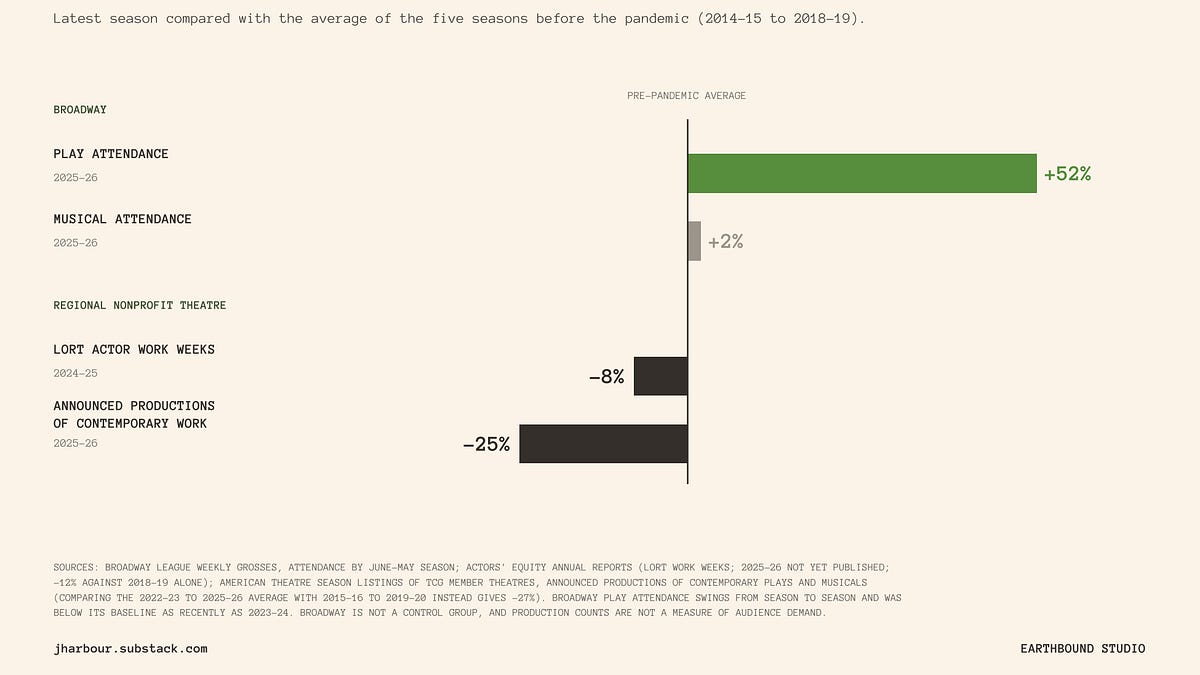
The first tab already looked wrong. Broadway and everywhere else had gone in opposite directions.
Last season, Broadway plays drew 52% more admissions than their 2015-2020 average. Musicals, the industry’s indestructible behemoth, barely budged. Outside of midtown, productions of contemporary work fell from 1,800 a season before the pandemic to 1,300 after, a 27% decrease. At the big regional houses on Actors’ Equity’s LORT contract, work weeks are still 12% below their pre-pandemic level.
Broadway is a deranged microcosm of an economy, whose mania I’ve personally financed. A few years ago, possessing that strange disposition where staying in your apartment all night feels immoral and the only antidote is an expensive night out by yourself, I decided to see Denzel Washington and Jake Gyllenhaal in Othello on a whim… for $300. For several wonderful minutes I congratulated myself on this small victory over the tyranny of thrift, emancipated from the tedious bookkeeping of living. Denzel was Denzel; then, after the curtain dropped, I checked my bank account, and a paltry 3-figure number remained. It’s amazing how quickly a feeling of personal growth can deflate. Still, I understand the family from Ohio who spends $800 on Other Desert Cities because they’re on vacation and Veep is their favorite TV show. They are necessary to the industry’s economic sustainability, especially now, but their fondness for spending that kind of money on a “safe” product helps sustain a market where a play that premiered at Lincoln Center in 2011 can enjoy another lucrative life. A regional theatre has the considerably less glamorous job of persuading people who live fifteen minutes away to take a chance on something they’ve never heard of, then somehow convincing them to return.
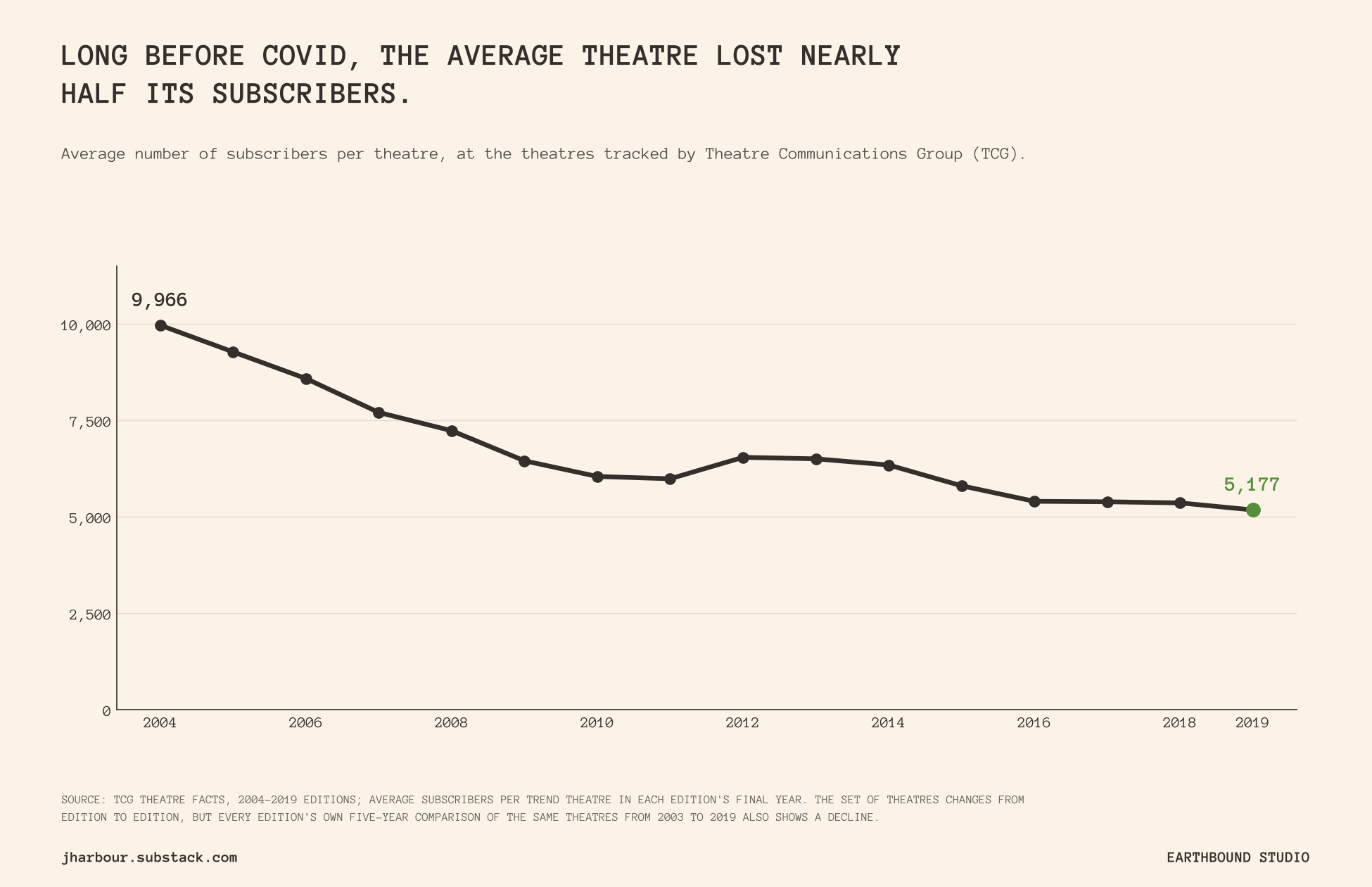
Over time, fewer subscribers were willing to finance an artistic director’s taste before figuring out if they shared it. Among the theaters TCG tracks, subscriber counts have decreased in nearly every five-year window since 2003. The Spektrix Report found the annual ticket buyer return rate fell from 35 percent in 2005 to 26 percent in 2018. Weirdly, after COVID, subscription numbers were back within 1 percent of their 2019 level even though total attendance was down 22 percent.
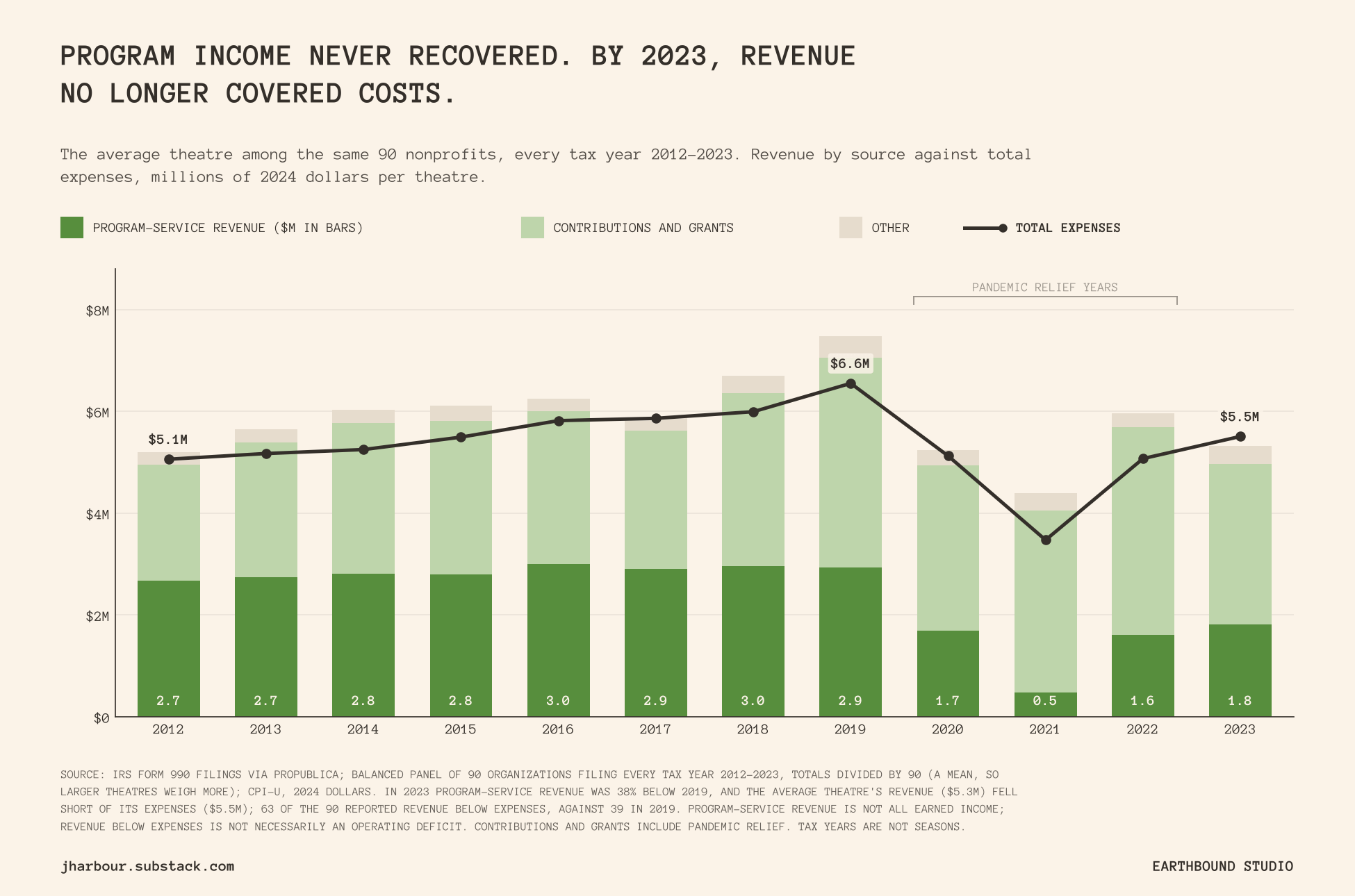
Somewhere along the way, Broadway discovered the marvelous trick that ticket prices could confer its own prestige. Meanwhile, regional theatres spent more money to become less desirable. In the five-year period before 2020, theatres spent 9% more than usual and lost 4% of their subscriber base, all while maintaining a 73% attendance rate from beginning to end. Soon enough, theaters began cutting their seasons like a cancer patient giving up his oxygen tank to smoke more cigarettes. Of the 90 theatres’ tax filings I looked through (a miserable way to spend a Sunday afternoon), 63 were spending more than they took in revenue by 2023, a 61.5% increase.
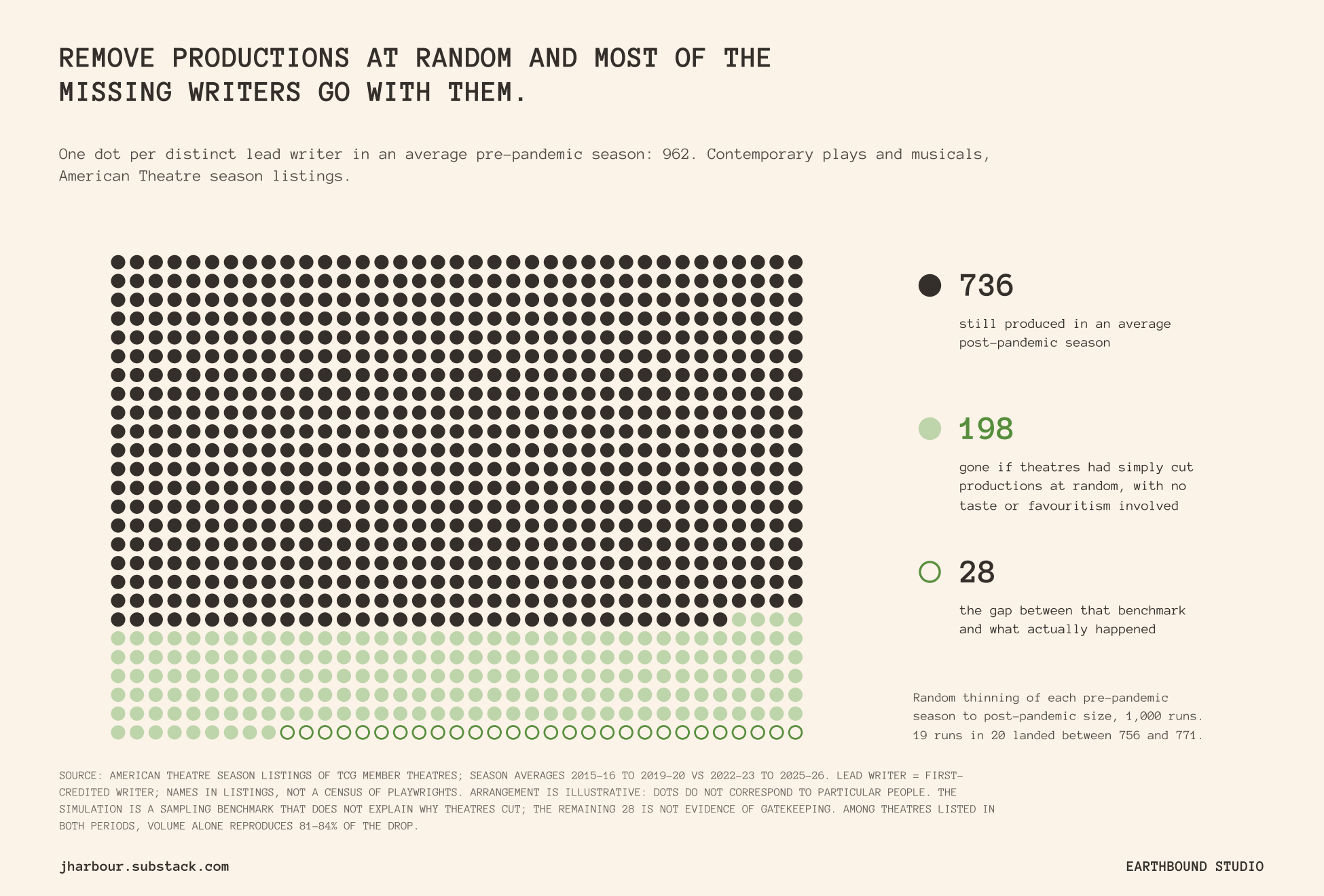
Before COVID, American Theatre listed 1,800 new productions annually. Since then, 1,300. I counted the writers, too. The count fell from 962 to 736 post-pandemic, meaning 226 playwrights vanished from the annual listings, gone quicker than a room clears when someone at a party announces they just joined a new improv troupe.
Picture a small city with ten slots and seven playwrights:
-
Gil has three productions this season, all about some weird shit his dad did at an Olive Garden in Mamaroneck, New York in 1998.
-
Constance has two that have been produced every year since 2009.
-
Priya has a play about a dead mother and a lake that may or may not reflect her apathy toward her mom for putting her in regional beauty pageants.
-
Dennis has a comedy. Or a cry for help. Critics remain divided.
-
Marisol has a two-hander set inside a Costco (she swears it’s a metaphor for colonialism)
-
Theo has adapted Oresteia into a play about a Crown Heights thruple.
-
Ruth, poor, poor Ruth, has her first play ever, which, as of now, is her only known psychological disorder.
Then the funding dries up, and they have to drag three productions out behind the theatre and shoot them. What follows is triage, with three possible splits, none particularly flattering to the people calling the shots:
-
Cut slots at random at the rate they were actually lost (A Lottery)
-
Those with one slot (Ruth, Theo, Marisol, Dennis, Priya) have a 27% chance of disappearing.
-
2 Slots (Constance) has a 7% chance
-
3 Slots (Gil) has a 2% chance.
-
-
The theaters protect the people they already know (A Pile-Up)
-
Gil and Constance keep their 5 slots, leaving the other 5 playwrights to duke it out for the final 2 slots and the consolation prize of being told how competitive the selection process was.
-
-
Seven entirely new playwrights enter the space with the initial 10 kicked to the curb. (A Door)
Take each real pre-pandemic season, blindfold an artistic director, arm her with a red pen, and let her go crazy eliminating productions at random until the season is as small as a post-pandemic one. When I repeat this process enough times, we arrive at the number of writers we’d expect to lose through chance alone:
The real seasons had 736. Cutting at random costs 198 writers, while the real cuts cost 226, so chance alone accounts for nine in ten of the playwrights who disappeared from the listings.
The number of writers with 4+ productions per season dropped from 8% pre-pandemic to 7% post-pandemic. So maybe Gil didn’t keep all three and lost one like everybody else.
The bigger theatres held the real advantage, keeping more of the shrinking season as smaller houses disappeared. After the pandemic, 35 fewer theaters staged at least one contemporary work in an average season (360 vs. 325). The twenty biggest accounted for 14 percent of productions then and 16 percent now.
I then split the productions between playwrights who’d appeared in the previous four seasons and those who hadn’t, to see what kind of writer was actually being pushed offstage. I called those who hadn’t “newly observed,” a category I occupy at most parties until I say something sufficiently offensive to become memorable.
Unexpectedly, the newly observed’s share grew while the theatres favored fewer returning playwrights. But with fewer productions overall, the number of newcomers still fell from 430 to 360 a season.
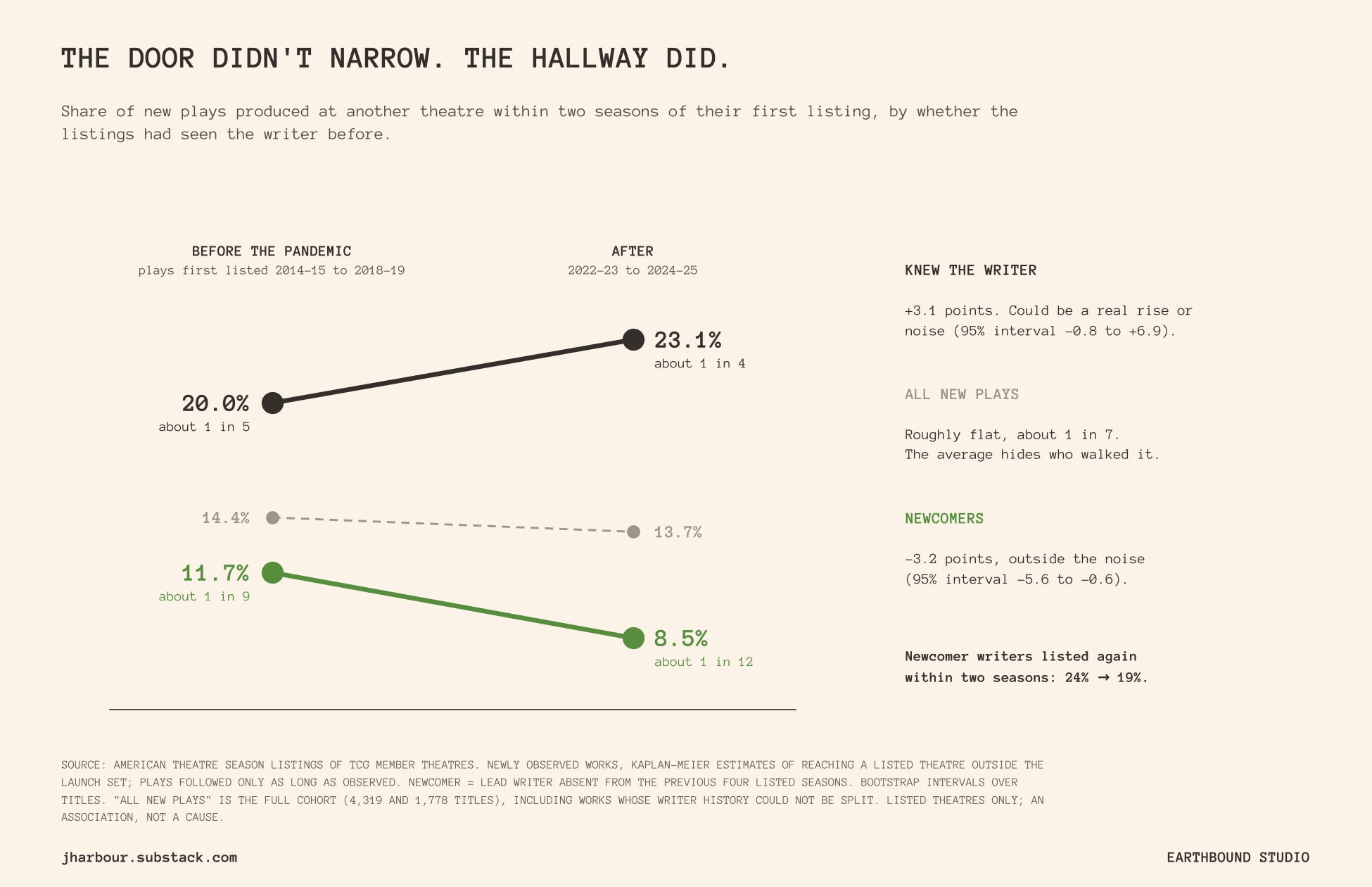
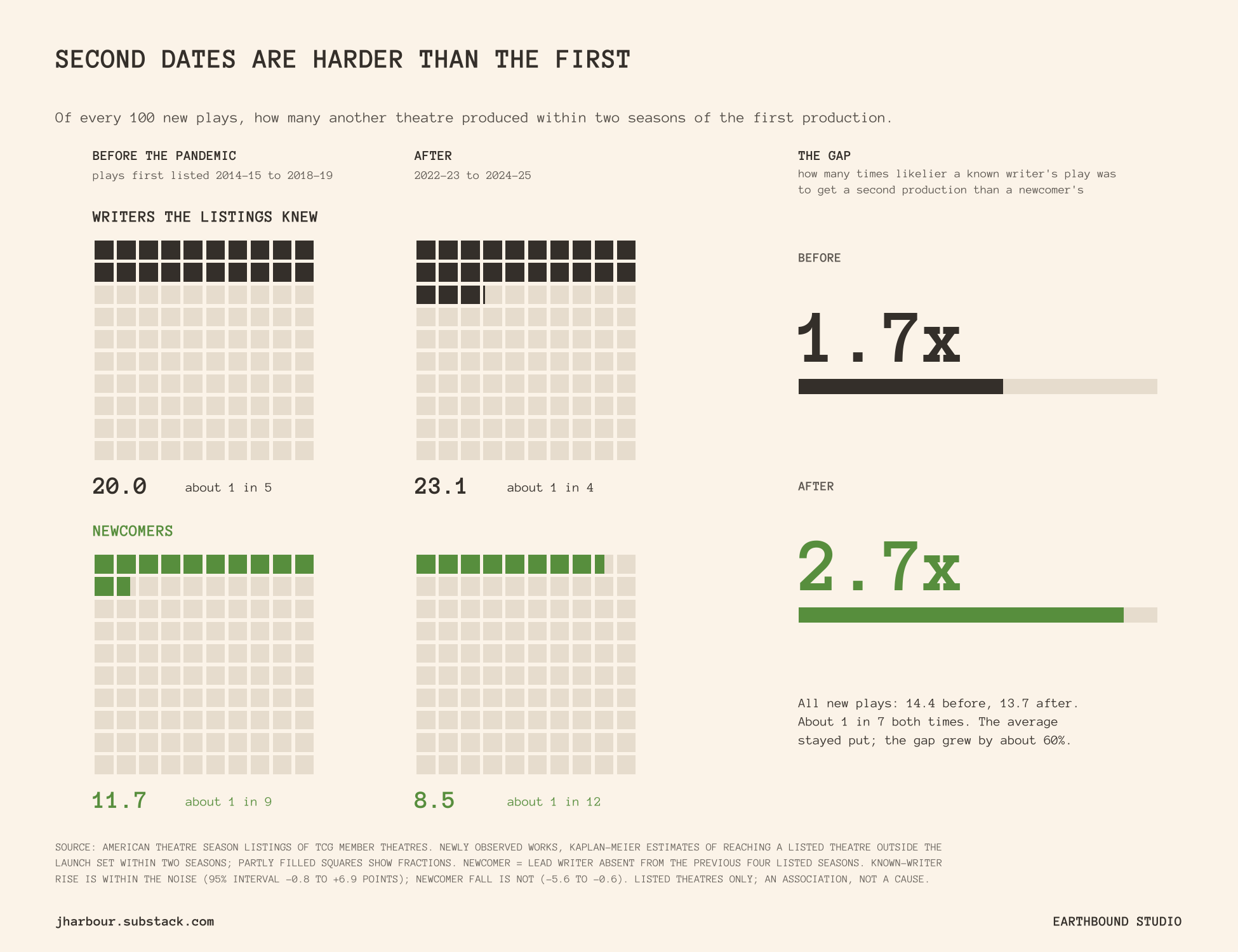
After the premiere of her first production, Ruth’s second production gives her another chance to develop it, which, with further productions, eventually attracts a licensing house, bringing the play to colleges and community theatres and earning her royalties for years.
Plays still reach second productions at the same rate, 14%, pre- and post-pandemic. Established writers’ odds of another production rose 3%, while newcomers’ fell 3.2%. And for first-time playwrights, the odds of a second production within two seasons fell by 5%.
A play’s previous production offers something even the most promising manuscript cannot: evidence that another theatre was willing to bet on it.
Among first productions in the season listings, one in five involved plays now represented by a licensing house. By the second production or later, that figure rose to three in five.
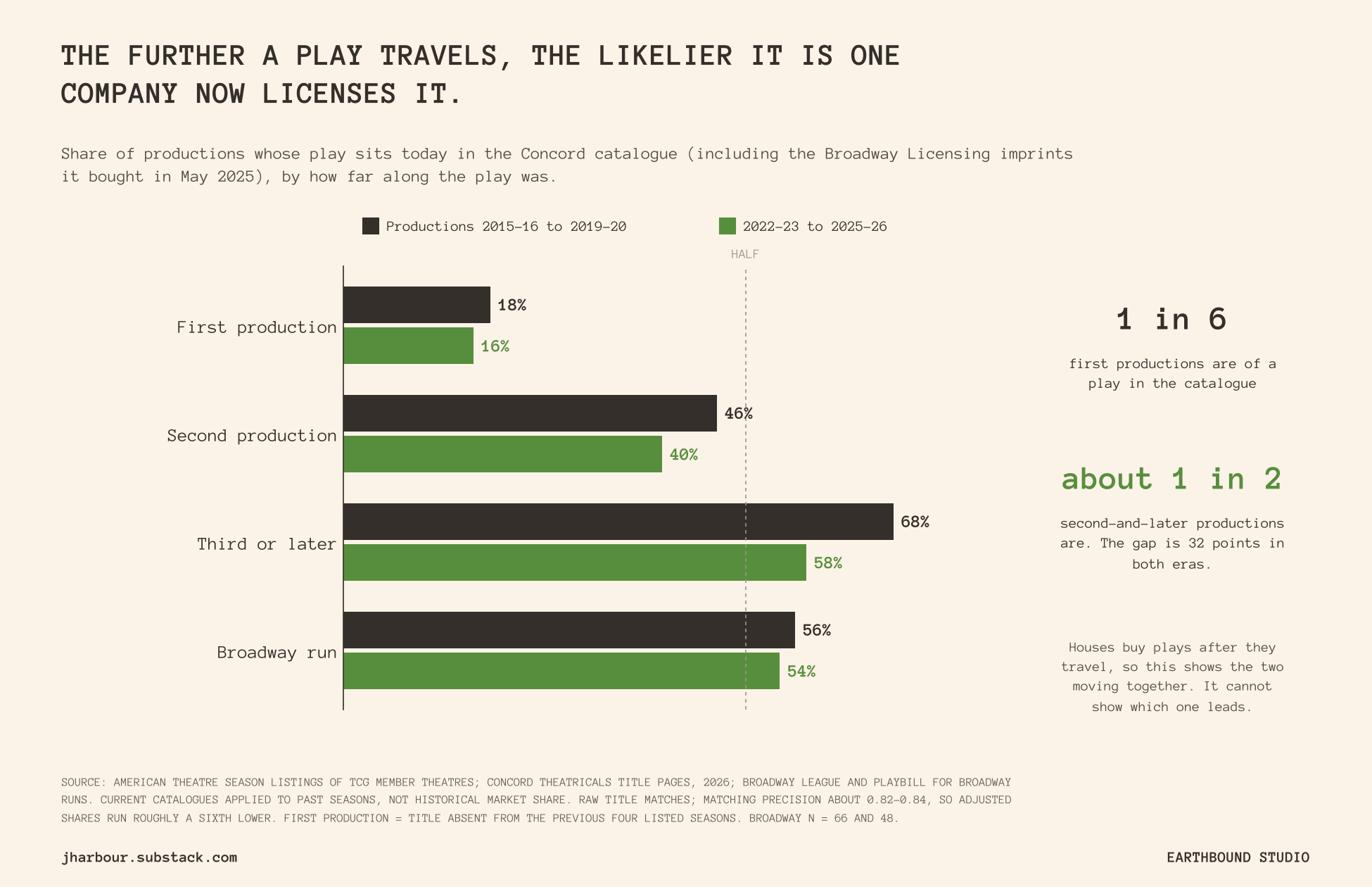
Concord Theatricals licenses plays accounting for 16% of first productions, nearly half of second-and-later productions, and almost 60% of those reaching a third production. Before a series of recent mergers, Samuel French and Dramatists Play Service each held a third of the licensed afterlife, and a handful of smaller houses split the rest.
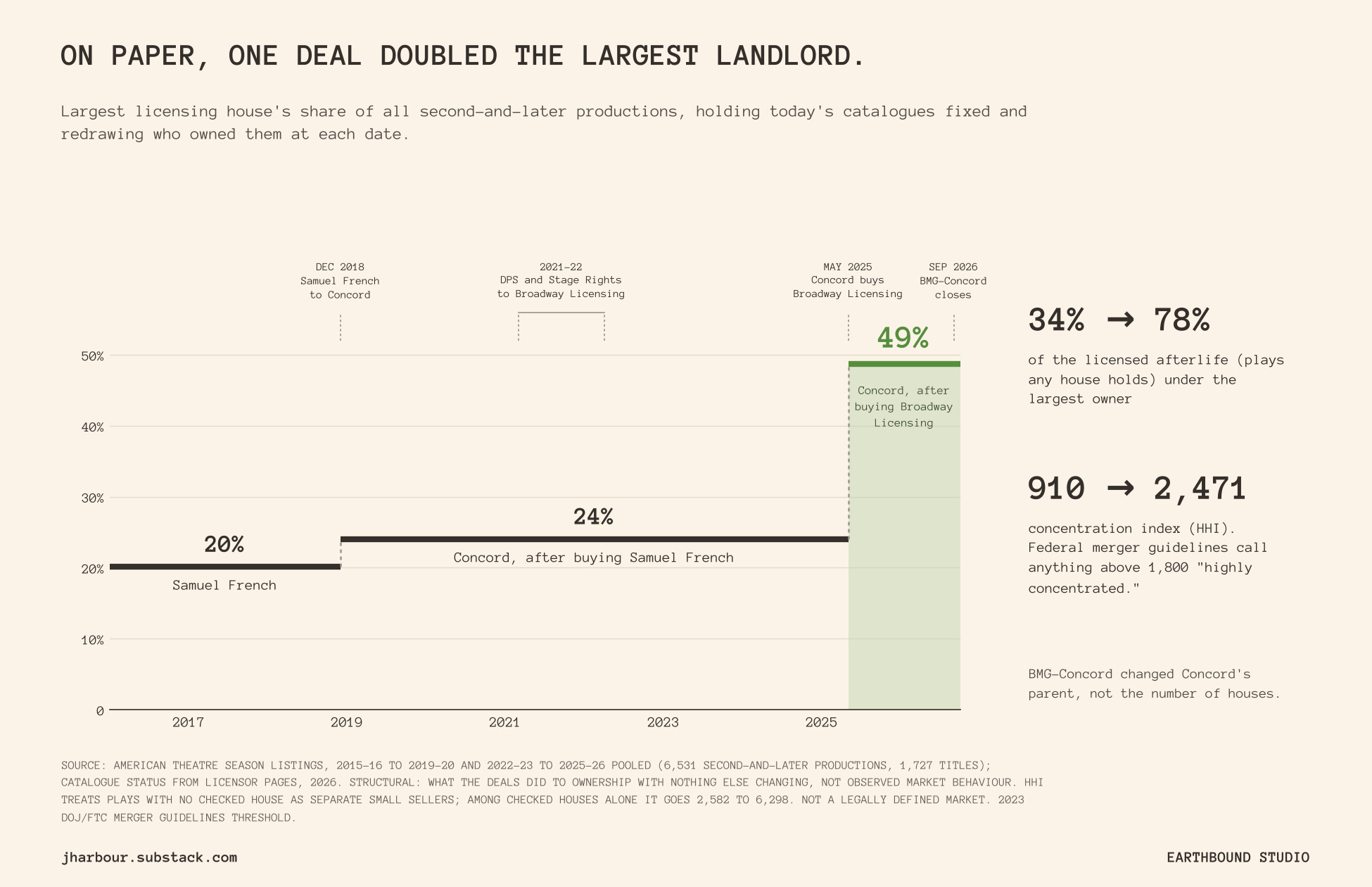
Then the houses started buying each other. Concord bought Samuel French in December 2018. Broadway Licensing bought DPS in March 2021 and Stage Rights in April 2022. In May 2025, Concord bought Broadway Licensing. The largest house’s share of all second+ productions increased from 20% under Samuel French to 24% under Concord after 2018, then to 49% after Concord bought Broadway Licensing in May 2025.
Within a decade, the largest owner goes from controlling a third of the marketshare to more than three-quarters.
Like most new comedies, the antitrust arithmetic isn’t funny. I would get laughed out of any antitrust conference if I presented my TCG season listings as a “relevant market”, even though John D. Rockefeller would see the trends and ask why nobody invited him to invest. But, based on the standard measure of market concentration (the Herfindahl-Hirschman Index), concentration rose from 900 before Samuel French’s sale to 2,500 today, way past the 1,800 highly concentrated threshold.
From my dataset, 66% of plays that went on to a Broadway run sit in the Concord catalogue today vs. 14% of plays that stayed regional.
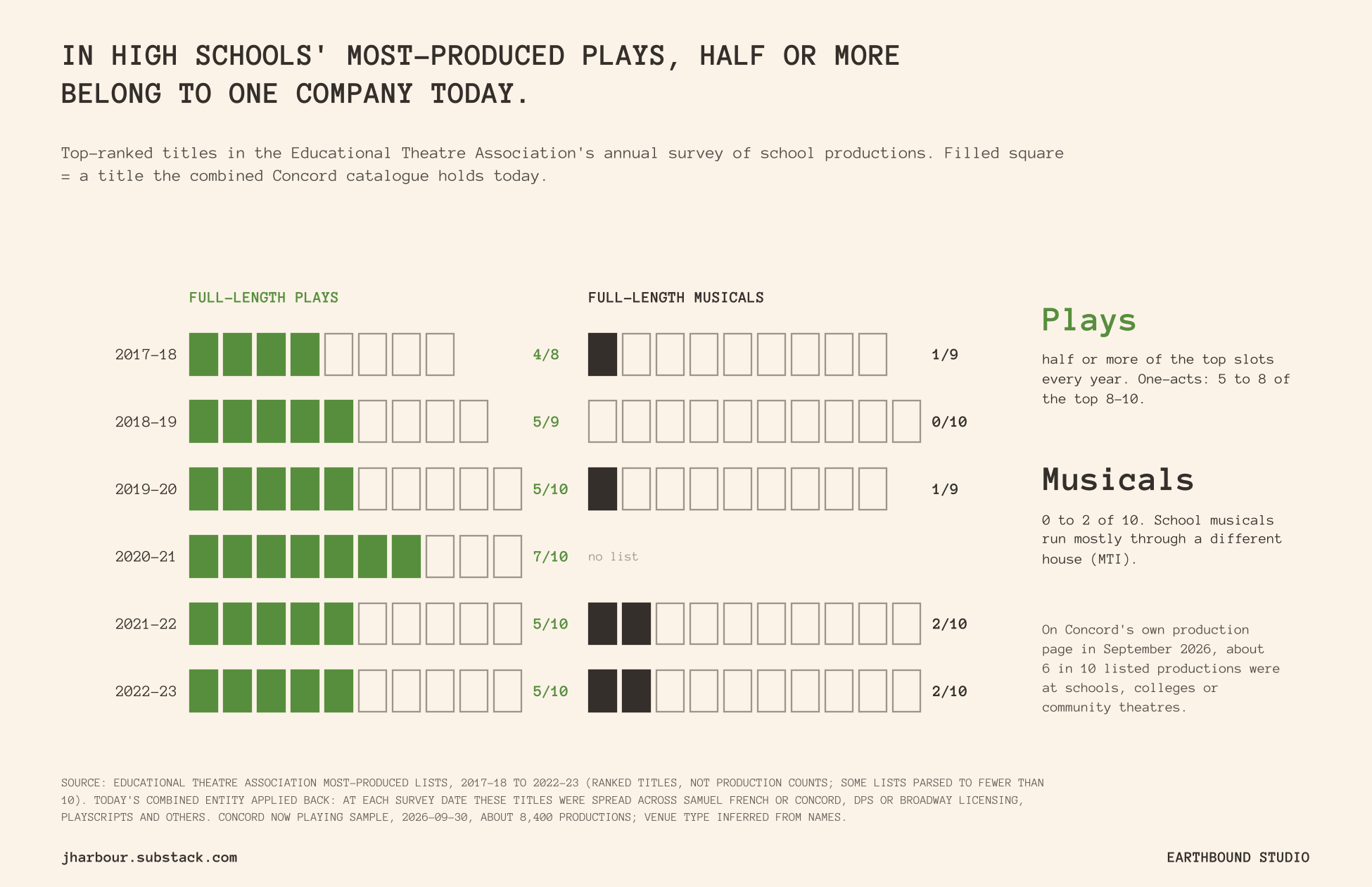
In the Educational Theatre Association’s annual lists of the plays schools produce most, titles licensed by Concord filled more than half of the top full-length slots in every year from 2017-18 to 2022-23, and most of the one-acts. When I looked through Concord’s “Now Playing” page for the end of September, 60% of the shows were for amateur markets.
The Concord–Broadway Licensing deal is seventeen months old. Nothing measurable has moved yet. On September 1st, BMG merged with Concord, putting this entire catalogue (with shows like Death of a Salesman, Clue, The Laramie Project) under the German media monolith, Bertelsmann.
For all itss current cornucopia of plays that BMG/Concord control, it still has to persuade drama teachers and artistic director alike to pay for its plays when Shakespeare, Sophocles, and Chekhov have been offering their services free of charge for the better part of the last century. That, mixed with a price-sensitive consumer base, suggests that the price for the college and community theater on a per performance basis will remain relatively fixed. The most formidable argument for a competitive marketplace has become a collection of dead playwrights.
In 2022, a judge blocked Penguin Random House, owned by Bertelsmann, from acquiring Simon & Schuster on monopsony grounds that a consolidated publishing market could lead to smaller advances for authors. Concord’s greater power lies in what happens after Ruth spends six years getting her play produced, when the luxury of competing offers is theoretical.
Concord has a listed minimum of $130 per performance. Four nights in a high school gym bring in $520; after a hypothetical 20% licensing share and an agent’s commission, the writer gets $416. MIT says living alone in Manhattan costs $75,164 a year. That’s 180 high schools and 720 performances a year, a theatrical empire of acne, stage fright, and borrowed cafeteria chairs, assembled so one woman can afford groceries and an apartment with a window.
Ruth might spend six years getting her first play produced, collect a few hundred dollars, and watch it close on a Sunday afternoon. Her hope of making a living from it depends on whether another theatre decides to put it on. And another, and another and another.
Playwrights once asked Congress for permission to bargain together over licensing terms. Chuck Schumer and Orrin Hatch introduced a bill to let them do it; Arthur Miller and Stephen Sondheim later testified for it. It never passed.
No fix should require Concord or Bertelsmann to sell off assets. Let playwrights bargain collectively with them instead, with a reversion right that triggers if Concord doesn’t license the work for five years. And the next time another minnow gets eaten by a whale, count playwrights as a market worth protecting.
If you haven’t come to the realization yet, I’m Ruth: a first play at a downtown festival. A first-time playwright now has a one-in-five shot at a second production within two seasons. If mine gets one and keeps traveling, the money waits in a catalogue Bertelsmann owns. (Haggling over those terms alongside the other Ruths would take an act of Congress, and I mean that literally.) After the last performance, I’ll add a row to my own spreadsheet, newly observed, with nothing yet in the column for a second production.
