


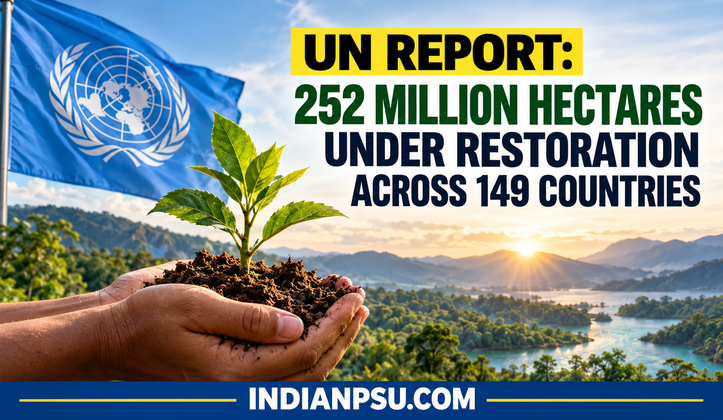
Ecosystem restoration efforts are gaining momentum worldwide, with 252 million hectares across 149 countries now under restoration, generating more than one million green jobs. However, the United Nations has warned that the world must accelerate its efforts to meet global restoration targets by 2030.
The findings are contained in a new report, Nature’s Comeback – Scaling Ecosystem Restoration for People and Planet, published midway through the UN Decade on Ecosystem Restoration (2021–2030). The report assesses progress towards commitments to restore approximately one billion hectares of degraded ecosystems globally.
The assessment also examines progress towards the Kunming-Montreal Global Biodiversity Framework target of placing at least 30% of degraded terrestrial, freshwater, marine and coastal ecosystems under effective restoration by 2030.
Co-published by the UN Environment Programme (UNEP), the Food and Agriculture Organization of the United Nations (FAO) and the Convention on Biological Diversity (CBD) Secretariat, the report was launched during the UN Biodiversity Conference (COP17).
Asia Leads Global Restoration Efforts
Asia accounts for the largest documented restoration area, covering 192.2 million hectares, followed by Africa with 36.3 million hectares and Europe with 9.1 million hectares.
North and Central America account for 5.8 million hectares, South America for 5.4 million hectares and Oceania for 3.2 million hectares.
China has reported the largest terrestrial restoration area, covering 127.4 million hectares. Substantial restoration activities have also been documented in Mongolia and Kazakhstan.
However, progress varies considerably across ecosystems. While terrestrial restoration has reached nearly half the global target, freshwater, marine and coastal ecosystems continue to lag behind.
Only 11 million hectares of freshwater ecosystems and 5.7 million hectares of marine and coastal ecosystems have been documented as being under restoration. Limited reporting may mean that actual restoration activity in these areas is higher.
UN Calls for Faster Action
UNEP Executive Director Inger Andersen warned that restoration efforts were not progressing at the scale or speed required.
She called for successful individual initiatives to be transformed into coordinated, system-wide action, with countries developing restoration economies that protect existing natural assets and recover degraded ecosystems.
FAO Director-General QU Dongyu emphasised that restoration must become an integral part of sustainable land, water and natural resource management.
The report highlights the potential of ecosystem restoration to strengthen food and water security, create employment, improve climate resilience and protect biodiversity.
Research cited in the assessment indicates that restoring just 15% of global priority areas could capture and store carbon equivalent to 30% of carbon dioxide emissions released since the Industrial Revolution. It could also help prevent 60% of projected species extinctions.
Successful initiatives have contributed to the recovery of mountain gorillas in East Africa, jaguars in Brazil, snow leopards in Kyrgyzstan and Ganges River dolphins in India.
Restoration Funding Needs to Quadruple
Financing remains a major challenge. The report estimates that annual investment in ecosystem restoration must rise from US$64 billion to US$296 billion by 2030.
Agroforestry requires the largest estimated annual investment of US$87 billion, followed by restorative reforestation at US$52 billion, peatland restoration at US$44 billion and seagrass restoration at US$28 billion.
The global restoration partnership network has expanded to more than 300 organisations since the UN Decade began, bringing together governments, businesses, schools, cities and community initiatives.
The report stresses that long-term success will depend on sustained political commitment, stronger monitoring mechanisms and meaningful community participation.
With four years remaining in the UN Decade on Ecosystem Restoration, the message is clear: restoration is delivering results, but significantly greater investment and faster implementation are essential to achieve the world’s 2030 environmental targets.
The writer of this article is Dr. Seema Javed, an environmentalist & a communications professional in the field of climate and energy
