

Climate Change Must Be Declared a Global Health Emergency: Lancet Countdown Report – Indian PSU

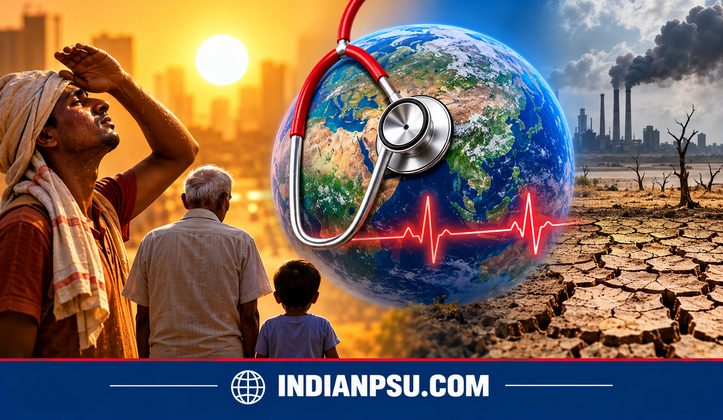
Climate change must be formally recognised and addressed as a global health emergency, with health considerations placed at the centre of climate policies, funding decisions and emissions-reduction strategies, according to the 2026 Lancet Countdown on Health and Climate Change report.
The report warns that climate-related health risks are intensifying faster than efforts to mitigate global warming and protect vulnerable populations. Its findings highlight the growing threat of extreme heat, drought and fossil-fuel pollution, with India among the countries facing significant health risks, particularly for infants and older adults.
Released ahead of the upcoming COP31 climate summit, the 10th edition of the report brings together the work of 146 researchers from more than 100 institutions across over 30 countries.
Heat-Related Deaths Rise Sharply
The report finds that annual average heat-related deaths worldwide have increased by nearly 36% compared with the period before the Paris Agreement entered into force in 2016.
In 2023, heat was associated with a record 710,000 deaths globally, with more than 70% of the toll attributed to human-caused climate change.
The findings underline the growing public health consequences of rising temperatures, particularly for people who are more vulnerable to extreme heat because of their age or living conditions.
India Faces Growing Heatwave Risks
India is among the countries with the highest heatwave exposure for infants and older adults, alongside China, the United States and Russia, the report says.
Although global heatwave exposure declined from the record levels recorded in 2024, 2025 remained the second-highest year on record for combined exposure among these vulnerable groups.
Older adults experienced 10.8 billion person-days of heatwave exposure globally in 2025, while infants experienced 1.1 billion person-days.
On a population-normalised basis, older adults experienced an average of 12.8 heatwave days per person, compared with 8.7 days for infants.
The findings highlight the need for stronger heat-action plans, improved health surveillance, climate-informed early-warning systems and healthcare facilities better equipped to respond to extreme temperatures.
Drought Threatens Food Security and Sanitation
Extreme drought affected nearly 52% of the world’s land for at least one month in 2025, making it the second-highest level on record.
The report also highlights satellite-based evidence indicating that since 2003, around 80% of the world’s land has experienced significant shifts in groundwater storage patterns, involving changes in both increasing and decreasing water storage.
These changes have serious implications for food security, access to water and sanitation, and the resilience of communities facing increasingly unpredictable weather conditions.
For countries such as India, where agriculture and rural livelihoods depend heavily on water availability, such changes add to the challenges of climate adaptation and public health protection.
Clean Energy Saves Lives, but Fossil Fuels Remain Dominant
The report points to progress in the global transition towards cleaner energy. Investment in clean energy reached a record US$2.1 trillion in 2025, almost twice the amount invested in fossil fuels.
Falling fossil-fuel-related air pollution has also delivered measurable health benefits. The report estimates that cleaner air has prevented approximately 323,000 deaths annually across at least 77 countries where air pollution from fossil fuels has declined since 2016.
However, fossil fuels continue to supply more than 80% of global energy.
The report also warns that the world’s 100 largest oil and gas companies are on course to produce fossil fuels at levels 150% above those compatible with limiting global warming to 1.5°C by 2040.
This gap between clean-energy investment and continued fossil-fuel expansion highlights the need for faster emissions reductions and more ambitious climate policies.
Health Must Become Central to Climate Policy
The report’s authors are calling for climate change to be formally recognised and addressed as a global health emergency. They argue that health considerations must be integrated into climate mitigation, adaptation and financing decisions.
Key priorities include accelerating greenhouse gas emission reductions, expanding support for climate adaptation, strengthening healthcare systems and investing in early-warning mechanisms that can protect vulnerable populations.
“Climate change is already harming health in every region of the world, and the evidence shows that many of these impacts are accelerating,” said Dr Diarmid Campbell-Lendrum, Head of the Climate Change, Air Quality and Energy and Health Unit.
He emphasised that climate action itself is a public health intervention, noting that cleaner energy, stronger health systems and early-warning systems are already saving lives.
As countries prepare for COP31, the report urges governments to put public health at the heart of climate decisions to protect communities, strengthen resilience and deliver immediate benefits for human health and well-being.
WHO’s Response to Climate-Related Health Risks
The World Health Organization (WHO) is addressing climate-related health threats through disease surveillance, climate-informed early-warning systems, health adaptation planning, technical guidance and emergency-response operations.
WHO also serves as the Secretariat for the Alliance for Transformative Action on Climate and Health (ATACH), a network bringing together health ministries and partners to support climate-resilient, low-carbon and sustainable health systems.
Under the International Health Regulations (2005), a Public Health Emergency of International Concern is an extraordinary event that poses a public health risk to other states through the international spread of disease and may require a coordinated international response.
Public health events meeting the applicable criteria may include those driven by climate change, although climate change itself is not automatically classified as a Public Health Emergency of International Concern under these regulations.
The Lancet Countdown report concludes that, despite progress in clean energy and other climate interventions, global action remains insufficient to match the accelerating health risks associated with climate change.
For India, the findings reinforce the importance of heat preparedness, resilient healthcare infrastructure, cleaner energy and effective early-warning systems as climate pressures intensify.
The writer of this article is Dr. Seema Javed, an environmentalist & a communications professional in the field of climate and energy
