


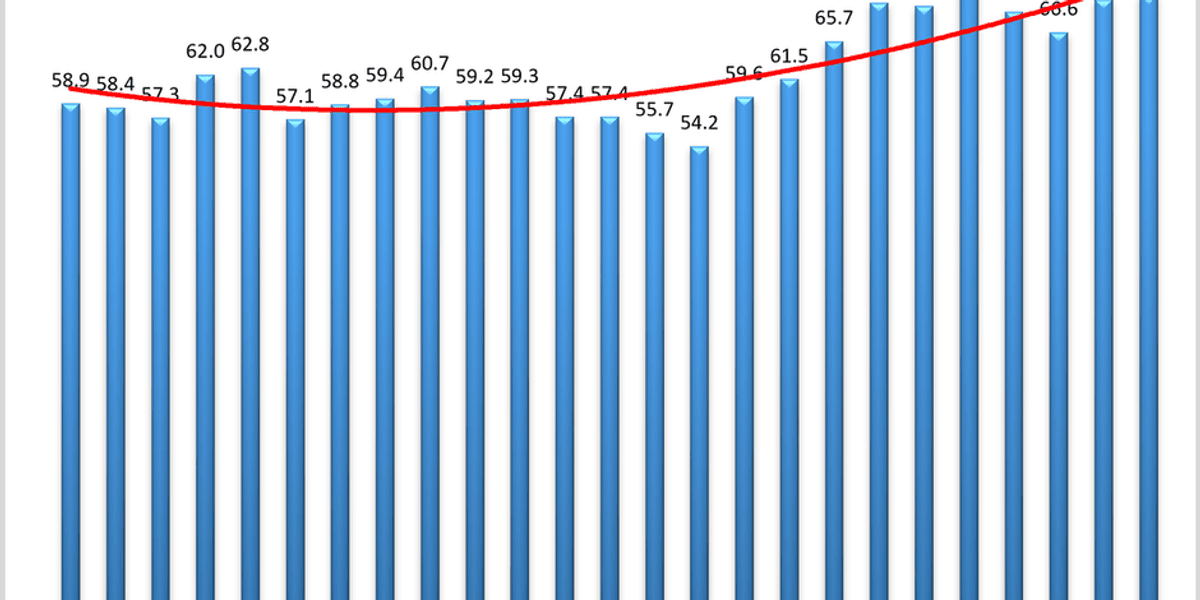
Economic activity in logistics grew in October, driven by a continued expansion of inventory levels heading into the holiday shopping season.
The information comes from the October Logistics Managers’ Index (LMI), released today, which rose to 70.7 compared to a reading of 70.2 in September. That’s the second highest reading in four years, behind June’s level of 71.1.
The LMI is a monthly reading of economic activity across warehousing and transportation, based on a survey of logistics managers nationwide. A reading above 50 indicates expansion in logistics activity, and a reading below 50 indicates contraction.
Readings above 70 indicate strong logistics activity across the country.
Inventory levels rose 8.0 points in October as retailers stocked up for holiday sales—a move that came with a price, as the LMI’s Inventory Costs index rose nearly 9.0 points to 88.8, the highest reading for that metric since March of 2022. What’s more, the increase in inventories is affecting available storage, as both the Warehousing Capacity and Transportation Capacity indices continued to contract during the month, falling to 43.5 and 38.0, respectively, according to the report.
Those results occurred alongside expanding cost pressures. Inventory costs, warehousing prices, and transportation prices all expanded in October, combining to create the fastest expansion in aggregate logistics costs in more than four years—a factor the researchers say, “may foreshadow continued supply-driven inflation.”
Aggregate costs reached a score of 257.5 on a scale of 0-300—up more than 11 points from September.
“This is the highest reading for this aggregate metric since March of 2022, when supply-driven inflation was rampant in the wake of both the cessation of Covid-era demand and the invasion of Ukraine,” the researchers wrote in the November 3 report. “Given the pressure on logistics costs, it is likely that we will continue to see supply-driven inflation continue to increase in the near term.”
The LMI tracks industry growth overall and across eight areas: inventory levels and costs; warehousing capacity, utilization, and prices; and transportation capacity, utilization, and prices. The report is released monthly by researchers from Arizona State University, Colorado State University, Rochester Institute of Technology, Rutgers University, and the University of Nevada, Reno, in conjunction with the Council of Supply Chain Management Professionals (CSCMP).
