Support CleanTechnica’s work through a Substack subscription or on Stripe.
Remember a few years ago when the posts here at CleanTechnica were filled with graphs showing S curves that foretold the inevitable success of the EV revolution? The S curve is a way of graphically representing the path new technologies typically take on their way to becoming dominant.
They tend to start off slow, with only a few early adopters paying exorbitant prices in order to own the latest new thing. Then, as those people spread the word, more people hear about this new thing and want in on the fun. Demand increases, production goes up, and prices come down because it it cheaper to make thousands of things than it is to make a few of them.
Soon prices have dropped to the point where it is cheaper to buy the new thing than the old thing. Sales explode and manufacturers make bundles of money. Eventually, demand and supply reach equilibrium and the S curve flattens again.
There are many examples of how new technologies tend to follow the S curve model — microwave ovens, VCRs, cell phones, and flat screen TVs are just a few. Not all new technologies succeed, of course. Quadraphonic sound and Blu Ray video both bombed in the market place. [I owned both.] So did the electric fork.
20 years ago, my wife and I purchased a 40″ digital TV for $2000. We paid it off at $200 a month and thought we were trendsetters. Two weeks ago, we bought a 55″ flat screen TV for $250. How does the manufacturer make any money at that price? We don’t know and we don’t care. What we do know is that there are no alternatives in stores today. Flat screen TVs have obliterated the market for every other type of television and there is no going back.
Elections Have Consequences
Four years ago, the chatter around the CleanTechnica hookah lounge was that EVs were about to hit the steep upward part of the S curve. The European Union set 2035 as the date for phasing out internal combustion engines in passenger cars. China was ramping up its EV incentives.
The US was making plans to install EV chargers nationwide. Ford, GM, and Stellantis were issuing glowing press releases about electric pickup trucks that could tow freight trains or do wheelies. In 2022, the Inflation Reduction Act gave a big boost to electric vehicles with a slew of tax incentives. For proponents of EVs, the future was so bright we all had to wear shades!
Then 2024 happened. Voters in the US were pissed off at post–COVID inflation as well as how Joe Biden and the Democrats handled the presidential campaign, so they punished the Dems by choosing what was behind door number two. That’s when things fell apart. The MAGA crowd were very upfront about their intentions. They even published it in a 900+ page book, but the voters didn’t read it and only about 6 people in the entire US understood its message.
As soon as the new administration came to town, things started going backward — fast. Funds for EV chargers were frozen. Offshore wind projects were cancelled. Solar power installations that were in the works for years were suddenly shut down. California’s emissions mandates were attacked. Worst of all, those same manufacturers who were spouting off about their EV intentions suddenly changed their tune and began genuflecting to the new false god in Washington.
Then the US administration began a high-pressure campaign to force other nations to drop their clean energy and clean transportation goals and use more fossil fuels supplied by the US instead. This week, the EU, under pressure from its domestic automakers, walked away from its EV mandate by 2035, and suddenly, plug-in hybrids and so-called “extended range EVs” are all the rage.
A Bit Of Good News In The Gloom
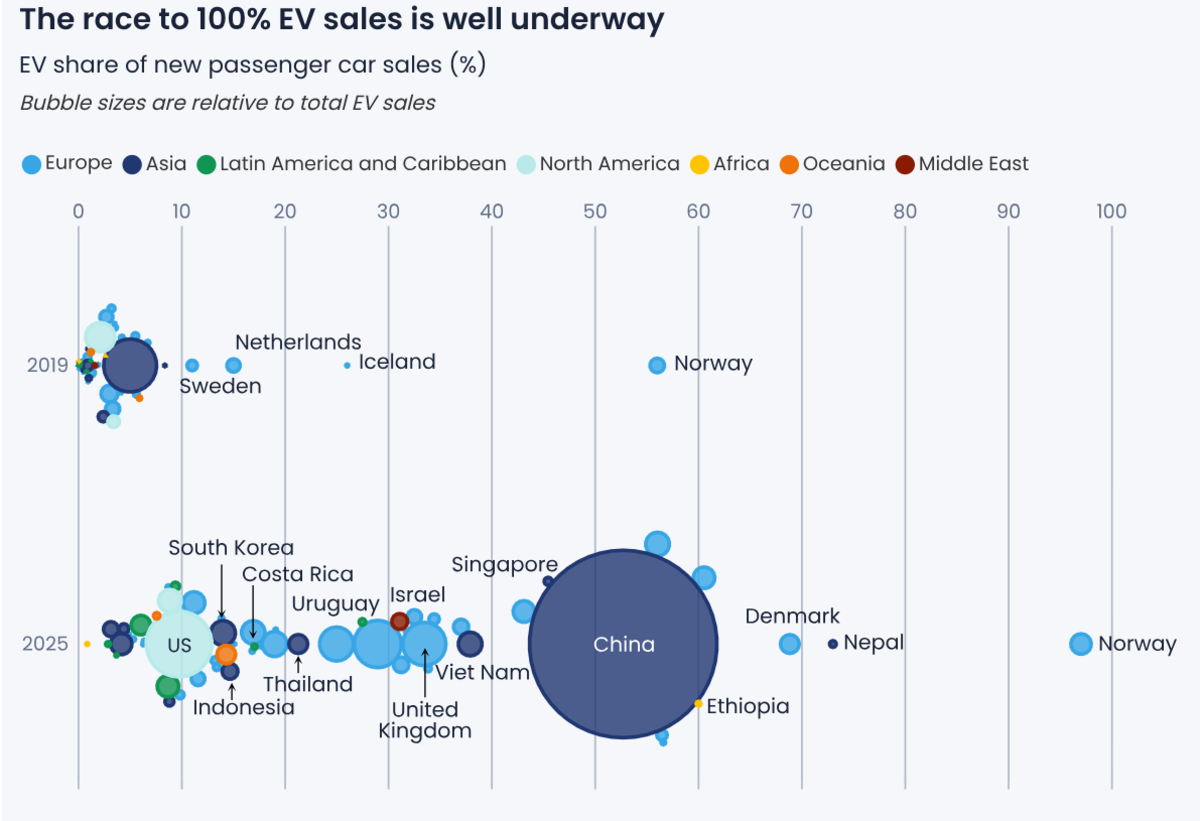
But there is good news. According to a report from Ember dated December 16, 2025, “more than a quarter of new cars sold in 2025 are electric, showing how quickly the global car market is shifting. This growth is increasingly driven by emerging markets that only a few years ago had minimal uptake of electric vehicles.” Translation — EVs are surging in countries that do not have domestic manufacturers that need protection from market forces.
The report continues: “The analysis shows that the EV race has gone truly worldwide. There are now 39 countries where EVs make up more than 10 percent of new car sales, compared with just four in 2019. Much of the fastest growth is now happening outside Europe…. The Association of Southeast Asian Nations has become a major force in global EV adoption in 2025. Singapore and Vietnam have reached EV sales shares around 40 percent, overtaking levels seen in the UK and the EU.”
Sharp-eyed readers will note that most of those cars in the ASEAN region are made by Chinese manufacturers. Although, Vietnam does have one major EV supplier, VinFast. Here is a graphic from the Ember report that makes it crystal clear how the world of EVs has changed since 2019:
Ember analyst Euan Graham said, “This is a major turning point. In 2025, the center of gravity has moved. Emerging markets are no longer catching up, they are leading the shift to electric mobility. These countries see the strategic advantages of EVs, from cleaner air to reduced fossil fuel imports. The assumption that EV growth will stall outside Europe and China is already outdated. Emerging markets will shape the future of the global car market. The choices made now on charging infrastructure and early support will determine how fast this momentum continues.”
Europe Steps Back
The European Union, under heavy pressure from automakers, has relaxed its policy of requiring all new cars to have zero emissions by 2035. “The European step back follows a global pullback from green policies as economic realities of major transformations set in,” Bloomberg says. “Mounting trade tensions with the US and China are pushing Europe to further prioritize shoring up its own industry. Although the bloc is legally bound to reach climate neutrality by 2050, governments and companies are intensifying calls for more flexibility, warning that rigid targets could jeopardize economic stability.”
But there is a silver lining even to this news. Whereas the former policy was for a total elimination of greenhouse gas emissions from passenger cars, the new policy still requires a 90 percent reduction in those emissions. That is different from the US, which wants a big thirsty Hemi in every car sold.
The policy change will permit plug-in hybrids and so-called extended range EVs to be sold after 2035, provided they compensate for the additional pollution by using low-carbon or renewable fuels or locally produced green steel. So it is not a total capitulation to the fossil fuel lobby as in the US. We must take our victories where we find them.
EREVs To The Rescue
The extended range electric vehicle (EREV) is not a new category, but it has found new life among Chinese manufacturers. The cars are essentially plug-in hybrids with bigger batteries so that they can travel further on battery power alone. In theory, the onboard gasoline engine is only there to charge the battery, not to power the wheels.
European automakers have been playing fast and loose with the term “plug-in hybrid” for years by building cars with small batteries that rely on gasoline engines most of the time. Those cars actually have higher tailpipe emissions than conventional cars in many cases (where drivers don’t plug the cars in enough), so it’s widely argued the EU needs to crack down on those deceptive practices.
Why Now?
We must give credit where credit is due. In late 2011, Tesla unleashed the Model S on the world. Some of the early cars were equipped with battery packs as small as 40 kWh, but people didn’t want them, opting for the options with more range.
What few people realize is that Tesla started two revolutions at once. The first was convincing people that an electric car was more than a gloried golf cart. The second was the idea that a car should be a computer on wheels. It can be argued that it is the second part that has led to many of the setbacks suffered by the EV revolution.
Think of the turmoil at Volkswagen ever since production of the ID.3 began. The car was fine but the software didn’t work. Those technical glitches led to Herbert Diess being tossed overboard and Volkswagen spending billions trying to get its CARIAD division functioning. Now it has spent nearly $6 billion to get Rivian to help get its digital house in order.
Imagine for a moment what would have happened if Volkswagen decided to build electric cars but ignored the whole “car as computer” craze? There really is nothing that says an ID.3 needs to be connected to the internet at all times if a standard VW Golf does not, is there?
The manufacturers all moan about how expensive electric cars are to build, but how much of that cost is due to the actual assembly process and how much is due to getting the computerized doodads to play nice with each other? We don’t know the answer, but it’s worth pondering how much the digital part of the equation has held back the transition to electric cars during a critical part of the journey up the S curve.
Creative Destruction
It is perfectly understandable that governments want to protect their domestic industries. The car business employs a lot of folks and they pay a lot of taxes that support federal and local budgets. But creative destruction is a central tenet of the capitalist system. The new is supposed to push out the old on a regular basis, but governments often stand in the way of that process. They pay lip service to the tenets of capitalism, but then pull every lever they can find to protect business from the results.
Those who scream the loudest about the mythical “level playing field” are those who fight the hardest to tilt the playing field in their favor. Jim Farley, the CEO of Ford, says the Chinese are an existential threat to US and European automakers. He may be right, but saying that won’t make them go away.
Tariffs and friendly regulations can only go so far. To survive, those traditional automakers will need to figure out how to make electric cars people can actually afford. Renault is doing so in Europe. Volkswagen is about to launch a new ID. Polo and has several smaller and less expensive electric models in the works.
There is a sense that convergence in the EV market is beginning to happen. In the final analysis, consumers will buy whichever cars are the most affordable. EV makers have been chasing the high end of the market since day one. Now they need to focus on bringing models to market that fit family budgets in tough financial times.
Mandates don’t sell cars, affordability sells cars. The word is starting to filter out that EVs cost less to own and are more durable than gas cars. If we hope to see EVs start up the S curve again, affordability will be the key.
Sign up for CleanTechnica’s Weekly Substack for Zach and Scott’s in-depth analyses and high level summaries, sign up for our daily newsletter, and follow us on Google News!
Have a tip for CleanTechnica? Want to advertise? Want to suggest a guest for our CleanTech Talk podcast? Contact us here.
Sign up for our daily newsletter for 15 new cleantech stories a day. Or sign up for our weekly one on top stories of the week if daily is too frequent.
CleanTechnica uses affiliate links. See our policy here.
CleanTechnica’s Comment Policy