


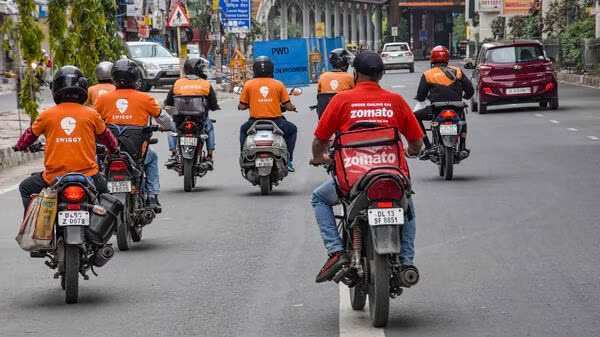
The country’s food delivery sector has nearly doubled in size over the past two years, emerging as one of the fastest-growing engines of employment and economic activity in the country, according to a study conducted by the National Council of Applied Economic Research (NCAER) in partnership with Prosus.
The study revealed that food delivery platforms generated Rs 1.2 lakh crore in gross output in 2023-24, with direct employment of 1.37 million workers during the year, up from 1.08 million in 2021-22.
Beyond direct employment, the research also showed that each platform-linked job supports more than 2.7 additional jobs across the wider economy, spanning restaurants, agriculture, logistics, packaging, payments and technology. This places food delivery among the highest employment-multiplier sectors within India’s services industry.
The findings are based on a detailed input-output analysis covering 640 restaurants across 28 Tier I, Tier II and Tier III cities, and form part of a three-year research programme on India’s food delivery platform economy.
At the restaurant level, the study showed that platform participation has significantly expanded market access and business activity. As much as 59% of restaurant owners reported reaching new customers, while over 50.4% saw a rise in overall footfall and orders. On the other hand, 52.4% added new menu items, highlighting greater experimentation and demand visibility.
The report also highlights that the share of restaurant revenues coming from food delivery platforms increased from 22% in 2019 to 29% by 2023, highlighting the growing dependence of restaurants on digital ordering channels.
The research also points to a broader structural shift in the sector, with platforms acting as enablers of formalisation. Small and home-based kitchens gained access to digital tools such as onboarding support, menu optimisation, advertising, training and accounting systems, capabilities many did not possess before joining the platform ecosystem. This has led to higher compliance and improved operational efficiency, particularly among MSMEs.
From a policy perspective, the studies underline the need to recognise food delivery platforms as a distinct and rapidly expanding services segment. NCAER notes that integrating platform-sector metrics into national statistical and labour monitoring frameworks would enhance the tracking of employment, output, and tax contributions.
Given the sector’s scale and its million-plus workforce, the research also flags the importance of enhancing the portability of social protections for platform-linked workers, while maintaining operational flexibility. At the same time, it calls for balanced regulation that supports innovation, ease of entry and predictable business conditions for small restaurants, especially in Tier II and Tier III cities.
Adding industry perspective, Sehraj Singh, Managing Director, India & VP-Group Public Policy and Corporate Affairs, Prosus, noted, “The findings of these studies reflect what millions of small restaurants and platform workers experience every day. Platforms have become an essential bridge to demand, enabling restaurants to reach customers far beyond their immediate surroundings and giving many of them their first exposure to digital visibility, regulatory compliance and data-driven decision-making. The sector’s million-plus workers, supported by India’s growing digital infrastructure, represent one of the most dynamic labour segments in the country.”
By quantifying both the economy-wide impact and restaurant-level outcomes, the studies position food delivery platforms as a central pillar of India’s evolving digital service economy, with implications for MSME growth, urban consumption patterns and employment generation.
Commenting on the key finding, Bornali Bhandari, Professor, NCAER, shared: “These studies offer a comprehensive empirical picture of how digital food delivery platforms are intersecting with India’s economy. The sector’s contribution to output, employment and indirect taxes is not only measurable but growing at a pace far exceeding that of the broader economy. At the restaurant level, the evidence of expanded market access, higher compliance and improved operational capabilities points to a structural shift in how food services businesses participate in the economy. This research aims to equip policymakers with credible data on a sector that has scaled rapidly and is now deeply woven into India’s digital and economic fabric.”
