


Support CleanTechnica’s work through a Substack subscription or on Stripe.
Hawaiʻi’s LNG turn was sold as a practical answer to a practical problem. The state has high electricity prices, aging oil-fired generation, isolated island grids, and political pressure to cut bills without creating reliability problems. HSEO’s January 2025 alternative fuels study was built around that frame. It was focused on the combustion power plant, or firm generation, component of the electric grid, particularly on Oʻahu. Within that narrow frame, the study argued that an interim transition to LNG could reduce costs and emissions while supporting reliability.
In its key Alternative 1A case—the only net positive remaining after their preferred case was found to have serious modeling errors—HSEO said the benefits of an interim transition to natural gas exceeded the costs, with a net present value of about $150 million and levelized savings of $10.2/MWh. Governor Green’s office and JERA then built on that logic, with JERA proposing about $2 billion of investment for a roughly 500 MW gas-fired plant and offshore LNG import infrastructure to address what it called Oʻahu’s affordability, sustainability, and reliability trilemma.
That is a real case, not a straw man. But it is not the question Hawaiʻi actually needs answered now. The real question is not whether LNG can look better than continued oil burn in a calm spreadsheet. The real question is whether LNG still looks prudent for Hawaiʻi after the energy shocks of 2022 and 2026, after scrutiny of the HSEO methodology, after looking hard at the JERA proposal as a deliverable project instead of a concept, and after seeing how long-term LNG contracts behave when physical supply breaks. Once the question is framed that way, the LNG case weakens because the things Hawaiʻi says it wants from LNG—lower bills, lower risk, and a cleaner bridge to the future—are much less secure than the public sales pitch suggests.
The biggest analytical problem is that HSEO’s study was not built for crisis-era fuel economics. The study says its sensitivity analyses changed one variable at a time while all others remained constant. It explicitly acknowledges that in practice several variables would likely change at the same time, like LSFO prices and natural gas prices, which historically have shown correlation. HSEO later said the study excluded fuel-price volatility by using average fuel-cost estimates for LSFO and LNG. That matters because a volatility-free model can be directionally useful for a screening exercise, but it is not enough for a state considering long-lived import infrastructure in a world where fuel shocks have become a repeated feature of the last few years.
The International Energy Agency provides a useful historical anchor for this. Since 1973 there have been 13 episodes of sharp or sustained oil price increases, with the frequency of these events rising slightly since 2000. That works out to roughly one major price shock every four years over the full period, not as a predictable cycle but as a recurring feature of the fossil fuel system. The IEA also notes that these spikes tend to emerge when spare capacity is thin and are triggered by a combination of demand growth, supply disruption, and geopolitical events. That pattern matters for Hawaiʻi because it shows that large price shocks are not rare anomalies. They are a normal condition of globally traded fuels, and any model that relies on average prices without representing those episodes is systematically understating risk.
My hypothesis is that the long transition away from fossil fuels will not produce a smooth decline in prices. It will produce a more unstable market. As global demand growth slows and then falls, there will be deflationary pressure on average prices, but large producers and cartels such as OPEC+ have both the incentive and the history of withholding supply to defend revenue and margins when markets soften. At the same time, lower expected long-run demand and higher capital risk will make marginal projects uneconomic, shrinking the set of producers willing to invest in spare capacity and making the system more brittle. Capacity will shut down rather than be refurbished when major new capital expenditures are required. The result is likely to be a fossil fuel system with softer average pricing pressure over time but sharper and more frequent bouts of volatility, because fewer profitable barrels and molecules at the margin mean less cushion when war, sanctions, outages, or cartel discipline take supply off the market.
The weakness is not abstract. HSEO’s own report says Alternative 1A only generates cost savings if LNG prices do not increase by more than 10%. That is a very small margin. Asian LNG prices have risen 143% in the 2026 Iran war and Hormuz disruption, reaching about $25.30 per mmBtu, and that was the second major spike in four years after Russia’s invasion of Ukraine. In early March 2022, Asian LNG prices were around $40.50 per mmBtu as Europe and other richer buyers crowded poorer Asian buyers out of the market. If a 2026-style event of +143% lasted for 12 months during a 15-year 2030 to 2045 horizon, simple arithmetic implies an average price uplift of about 9.5% over the full period. At 18 months, it rises to about 14.3%. Even one medium-length crisis of the sort already observed can therefore erase most or all of HSEO’s entire 10% LNG-price tolerance. A 2022-style event is worse. A 6-month period at roughly +289% relative to a $10.40 baseline implies an average uplift of about 9.6% over 15 years. That is almost the full margin gone from one half-year shock.
That does not mean Hawaiʻi would buy every cargo at full spot prices. A large portfolio player can soften some of the blow. But that is exactly why the absence of stochastic crisis-state modeling is serious. A proper forward model would not assume full spot pass-through or zero pass-through. It would model a range of outcomes using Monte Carlo simulation. If one-third of a 2026-style 12-month crisis premium passed through to Hawaiʻi’s delivered LNG cost, one event would add about 3.2% to average LNG cost over 15 years. Two such events would add about 6.4%. Three would add about 9.5%, and with events occurring every four years on average, that’s a likely number of fuel price shocks. If half the premium passed through, two such events would add about 9.5%, which is again most of the HSEO margin. The right conclusion is not that the state’s numbers are certainly wrong by a fixed amount. It is that the hidden risk inside them is large enough to flip the sign of the result, and HSEO’s own methodological choices make that risk hard to see. The modeling HDR did on behalf of HSEO was simplistic and suitable to see if further study was even warranted and did that, barring the major errors, but it’s far from the basis for any investment decisions except in a proper study.
The next fallback argument is that long-term contracts would protect Hawaiʻi. That also turns out to be less comforting than it sounds. Long-term contracts reduce normal market noise. They do not make LNG behave like a local resilience asset when physical supply is damaged or blocked. QatarEnergy said in March 2026 that it had determined it needed to declare force majeure on some affected long-term LNG contracts. Some traders passed those disruptions through, while others honored contracts only by leaning on broader portfolios. That is the real lesson. Contract structure matters, but portfolio depth matters more once the molecules stop moving. In a true system shock, a long-term contract does not guarantee that the buyer avoids either volume disruption or price pain. It mostly determines who absorbs the first layer of the shock.
That distinction matters for Hawaiʻi because the islands would not be buying domestic resilience. They would be buying access to a managed global portfolio. JERA is a serious company, but its Hawaiʻi proposal remains subject to further discussions with the state. Its executives have said the company has secured LNG needed for the early 2030s and can hedge a substantial portion of its expected volumes, yet it does not aim to become a U.S. gas producer. In other words, JERA is a large and capable portfolio manager, not a local or upstream fuel source for Hawaiʻi. That can lower counterparty-management risk. It does not remove Hawaiʻi’s exposure to global scarcity, global repricing, or cargo competition in a crisis. A trader is not a fuel source. It is an intermediary in the same stressed market.
The geographic logic makes that worse, not better. Hawaiʻi cannot simply say it will take U.S. LNG and avoid global disruption. Direct U.S. LNG supply to Hawaiʻi is constrained by Jones Act vessel availability. That pushes any serious Hawaiʻi LNG strategy toward foreign-flag routes, non-U.S. export points, or portfolio intermediaries. JERA’s answer to that problem is scale and global sourcing. That may be the least bad way to buy LNG. It is still a way of staying inside the global LNG system rather than stepping out of it. When a large share of global LNG supply is disrupted, the fact that Hawaiʻi’s supplier is sophisticated does not change the fact that the market itself is short.
The effort to rebuild American shipbuilding is facing structural headwinds that are not easily overcome with policy alone. As I argued in my analysis of the Maritime Action Plan, the United States is attempting to restore competitiveness using a 20th century framework in a market that has already shifted to new cost structures and energy architectures. Domestic commercial shipbuilding has withered to 0.1% of global output, with only a handful of yards capable of building large oceangoing vessels, while leading Asian yards benefit from continuous production, dense supplier ecosystems, and automation that deliver ships at a fraction of U.S. cost. Even where policy proposes tariffs, cargo preference, or funding mechanisms, these do not address the underlying productivity gap, which can be 2x to 4x on comparable vessels. At the same time, the global shipping market is rapidly changing under carbon constraints, electrification, and hybridization, with lifecycle operating costs increasingly tied to energy architecture rather than just build origin. The current U.S. approach largely treats energy as a secondary consideration instead of a core competitiveness lever, while also avoiding direct engagement with structural constraints like the Jones Act. In fact, the entire document is completely silent on the Jones Act, a remarkable omission. The result is a strategy that may rebuild some capacity over time but risks doing so in a way that is misaligned with where global shipping economics are heading, making it unlikely to materially change LNG shipping availability or cost in any timeframe relevant to Hawaiʻi.
The JERA proposal itself should be understood in that light. The company is proposing a pathway, not a settled project. The proposal remains subject to further discussions, approvals, engineering choices, interconnection work, and final investment decisions. That matters because one of the things Hawaiʻi is being offered is certainty, or at least a visible centralized answer. In reality, the proposal still depends on multiple layers of execution that have not yet been resolved. A serious company offering a serious proposal is not the same thing as a de-risked state solution.
The deeper issue is that Hawaiʻi is not just being asked to buy LNG. It is being asked to buy into a specific energy worldview. HSEO’s favorable case assumes reuse of LNG infrastructure for a hydrogen transition in 2045. JERA’s strategy rests on the idea that thermal infrastructure can be preserved and decarbonized later with hydrogen and ammonia. That is not a marginal technical detail. It is the economic foundation of the bridge argument.
My own analysis of green hydrogen, hydrogen shipping, and ammonia imports for energy points to a consistent conclusion: these pathways remain structurally expensive and retain the same exposure to global energy markets that Hawaiʻi is trying to reduce. Even under optimistic assumptions, green hydrogen produced in high-resource regions tends to land well above the cost of direct electricity, and once it is converted to ammonia, shipped thousands of kilometers, cracked or burned, and turned back into usable energy, the effective cost multiplies. Shipping ammonia or hydrogen carriers adds both capital and energy penalties, and those costs are tied to the same global shipping, insurance, and geopolitical risks that affect LNG. The round-trip efficiency losses are also large, often leaving only 30% to 50% of the original renewable energy available at the point of use. That means Hawaiʻi would be paying for several units of energy upstream to get one unit delivered locally. In practice, imported hydrogen or ammonia is not a cheap or stable substitute for LNG.
For Hawaiʻi, that matters because hydrogen and ammonia do not solve the exposure problem. They persist it. Many of the jurisdictions planning large-scale hydrogen export are in the Gulf. Saudi Arabia and Oman are advancing multi-billion-dollar hydrogen and ammonia export projects aimed at global markets. If Hawaiʻi moves from LNG to imported ammonia or hydrogen, it is not escaping globally traded fuel risk. It is recreating it in another form.
The 2026 war made that plain because it was not only an energy crisis. It was also an ammonia fertilizer crisis. The Strait of Hormuz carries a large share of globally traded fertilizers. Gulf producers are major suppliers of ammonia and urea, and prices rose sharply during the conflict. Fertilizer plants in the Middle East shut down or reduced output, and shipping disruptions constrained global flows. At the same time, Russia, another major supplier, suspended ammonium nitrate exports. A significant share of global ammonia trade moves through the same chokepoint. For Hawaiʻi that is a strategic warning. A fuel strategy centered on imported ammonia or hydrogen carriers remains entangled with the same geopolitical systems that produced the LNG shock.
This is where Hawaiʻi’s own modeling choices matter most. HSEO was doing a simplistic preliminary screen, not a full state economic risk model. It did not use stochastic crisis-state fuel modeling. It did not model multiple correlated shocks. It did not ask how an LNG chain behaves when fuel prices, shipping costs, insurance, construction inputs, and delivery delays all move together. It did not model how long-term contracts can weaken when force majeure hits physical supply. It did not compare LNG against a robust non-LNG bridge portfolio using downside risk rather than average cost alone. HSEO’s methodology would have been defensible as a first pass if they had not attempted to push through major political and economic decisions based on it. It definitely cannot be defended as enough analytical rigor for committing Hawaiʻi to a new imported-fuel chain in a world where two major shocks have hit in four years.
A more serious forward model for Hawaiʻi would treat LNG as a traded-risk package, not as a cheaper fuel. It would compare an LNG path, a non-LNG bridge built around storage, distributed energy, flexible demand, and targeted firming, and a mixed path. It would ask not only which path has the lowest expected cost, but which has the lowest 95th percentile bill shock, the lowest cumulative cash leakage from the islands, the lowest stranded-asset risk after 2045, and the lowest chance of forcing Hawaiʻi to choose between reliability and affordability in the next global emergency. After 2022 and 2026, that is the right test. Average fuel cost is no longer enough. Tail risk is part of the cost.
The practical implication is straightforward. Hawaiʻi does not need to decide that LNG is impossible. It needs to admit that the burden of proof has changed. The state wanted lower bills, better reliability, and less exposure to imported-fuel shocks. The evidence from 2022 and 2026 shows that LNG does not reliably deliver the third of those goals, and may deliver the first only under assumptions that recent history has already made hard to defend. The same evidence shows that hydrogen and ammonia do not cleanly solve the problem later. They carry many of the same exposure risks into the future because the Gulf and Russia remain central to ammonia and fertilizer trade, and the Gulf is also central to many of the world’s planned hydrogen export ambitions.
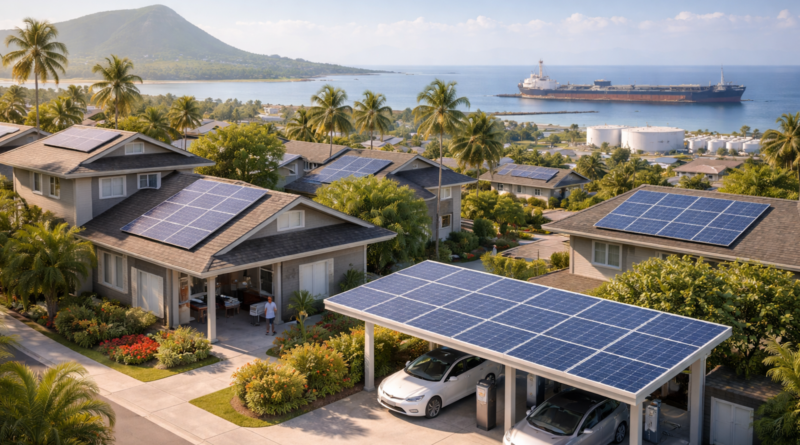
Hawaiʻi’s strategic advantage lies elsewhere. It lies in building its system around local solar, local storage, local load flexibility, and grid modernization that global fuel wars cannot price the same way.
Sign up for CleanTechnica’s Weekly Substack for Zach and Scott’s in-depth analyses and high level summaries, sign up for our daily newsletter, and follow us on Google News!
Have a tip for CleanTechnica? Want to advertise? Want to suggest a guest for our CleanTech Talk podcast? Contact us here.
Sign up for our daily newsletter for 15 new cleantech stories a day. Or sign up for our weekly one on top stories of the week if daily is too frequent.
CleanTechnica uses affiliate links. See our policy here.
CleanTechnica’s Comment Policy
