


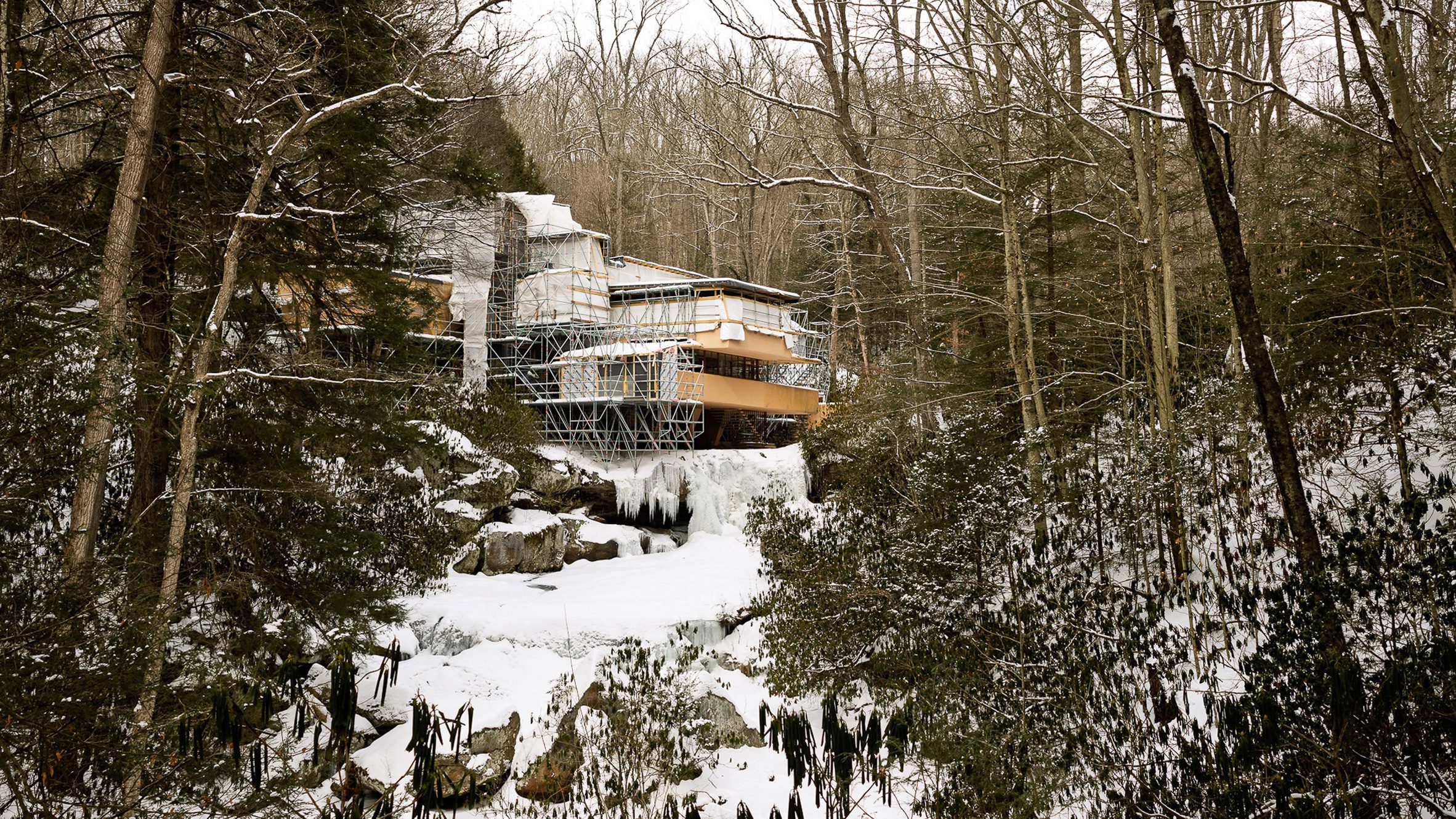
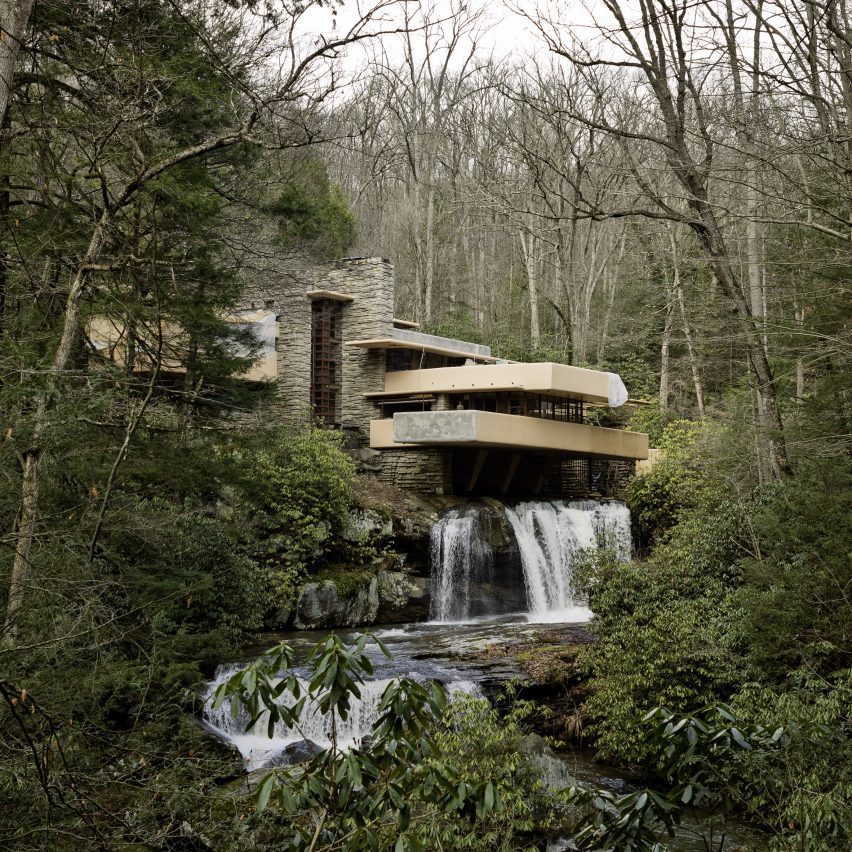
The Western Pennsylvania Conservancy has announced the completion of a three-year Fallingwater conservancy plan led by New York-based Architectural Preservation Studio.
The house American architect Frank Lloyd Wright designed in the mid-1930s for Pittsburgh-area retail magnate Edgar J Kaufmann was beset by water damage and other problems.
Despite several previous conservation campaigns, a carefully executed programme of works targeting its roofing, glazing systems, and masonry envelope was necessary.
Located in Mill Run, Pennsylvania, Fallingwater’s well-known flaws included recurring leaks, material degradation, failures in the building envelope, and moisture-sensitive original interior finishes.
“One of the biggest challenges was Wright’s decision not to install through-wall flashing,” Architectural Preservation Studio president Pamela Jerome told Dezeen.
“Another issue was Wright’s use of river pebbles instead of broken stone for concrete aggregate.”
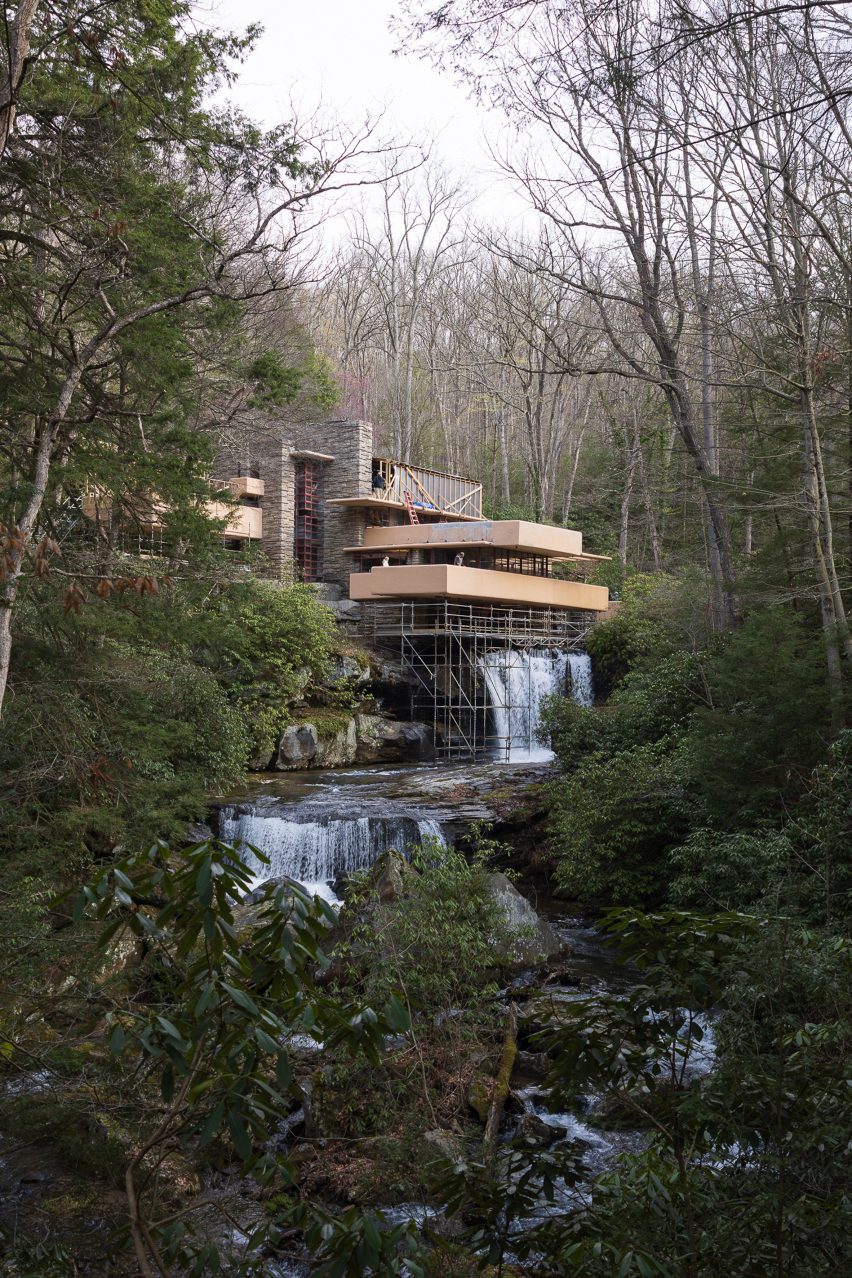
“This choice caused debonding,” continued Jerome, referring to the lessening of bonding cement to round aggregate, “and led to alkali-silica reaction (or ASR).”
Now a popular tourist attraction, Fallingwater was added to the list of UNESCO World Heritage Sites in 2019, joining the Guggenheim Museum in a selection of eight total Wright designs completed before his death in April 1959.
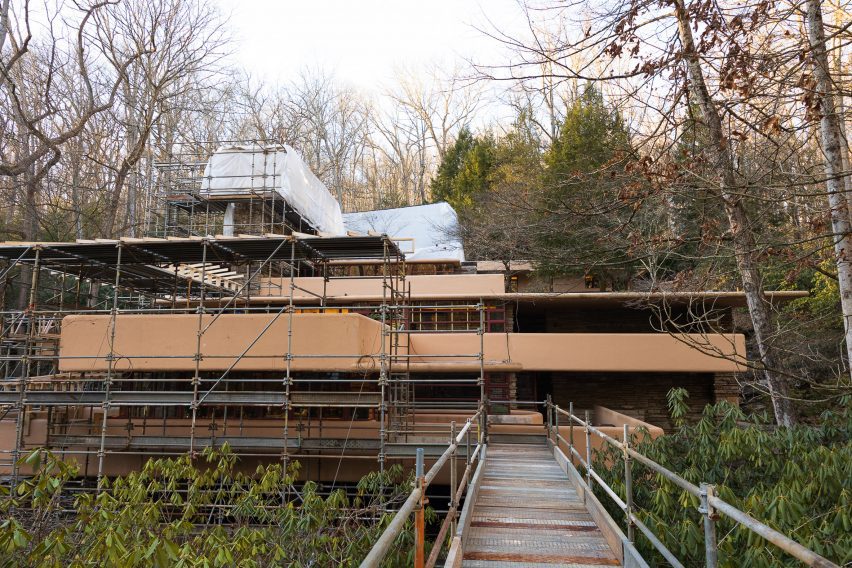
The Western Pennsylvania Conservancy has maintained Fallingwater since it was donated to the charity by the Kauffman family in 1963. But upkeep has remained an issue.
“Leaks were mostly coming through the stone walls, as there is no through-wall flashing wherever a stone wall meets a roof or terrace,” Jerome said.
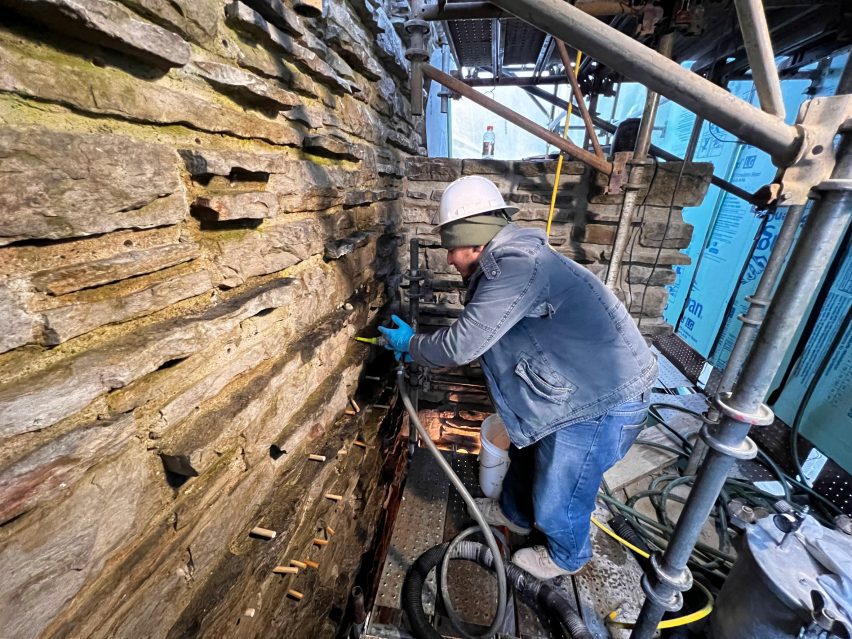
“Some of the original structural engineering design was also problematic and required remedial intervention. The roofs and terraces were also re-waterproofed during this campaign.”
In response to these conditions, Jerome’s team filled gaps in the stone walls, repaired and sealed vulnerable joints, fixed and replaced windows and doors, and upgraded the roofs and terraces to finally remove leaks as an existential threat to the architectural treasure.
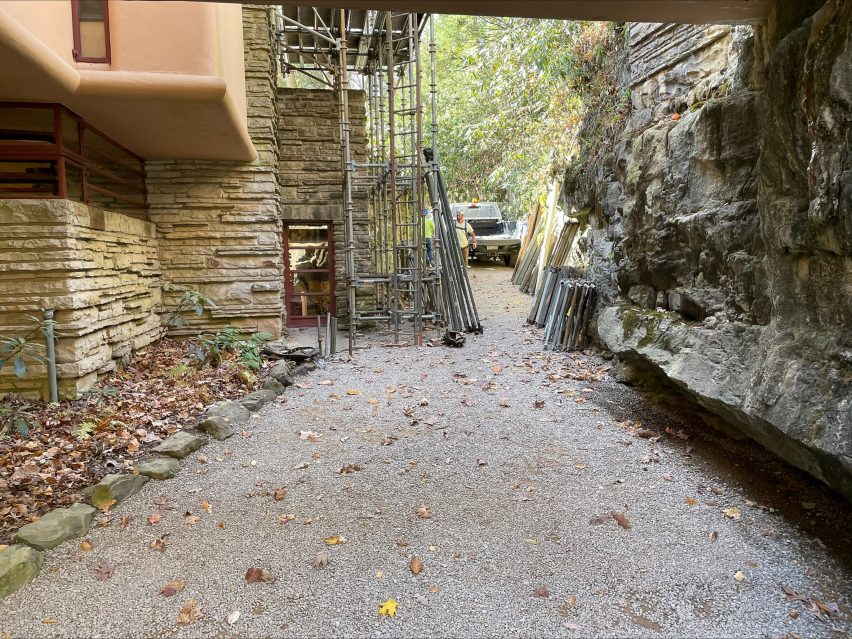
“Some of the leaks were being caused by waterproofing membranes having reached the end of their service life, having been compromised by leaks from the stone walls,” said Jerome.
“Since through-wall flashing could not be remedially inserted, the stone walls were instead grouted wherever known leaks were occurring, as well as repointed. At the top of the stone walls, coping stones were lifted and through-wall flashing inserted below.”
The $7 million conservation program was considered vital to its continuance, as the remote attraction routinely draws nearly 150,000 visitors a year, according to its stewards.
“The team was already familiar with the history of the house and its interventions,” said Jerome, citing a previous effort from the office that was completed in 2004.
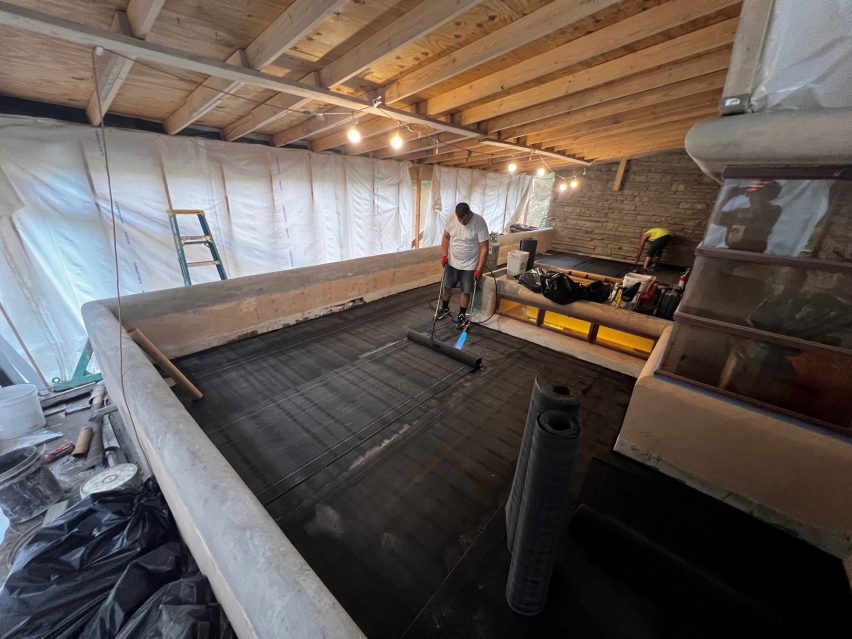
“Not only was there the institutional knowledge from previous projects, but also the ability to evaluate what worked and what didn’t from earlier work and refine the interventions accordingly.”
Final touches on Fallingwater’s main facility will be completed next month in unison with its 90th anniversary, as the scaffolding continues to be removed. Documentation of the completed work is forthcoming.
A renovation and the introduction of ancillary structures at Fallingwater were carried out by the American studio Bohlin Cywinski Jackson in 2017 and 2019.
The Frank Lloyd Wright Building Conservancy recently updated its visual identity to symbolically reflect the loss of heritage.
Elsewhere, the architect was named as one of the 15 most influential design minds in America’s 250-year lifespan by the Cooper Hewitt, Smithsonian Design Museum.
The photography is courtesy of Western Pennsylvania Conservancy
