


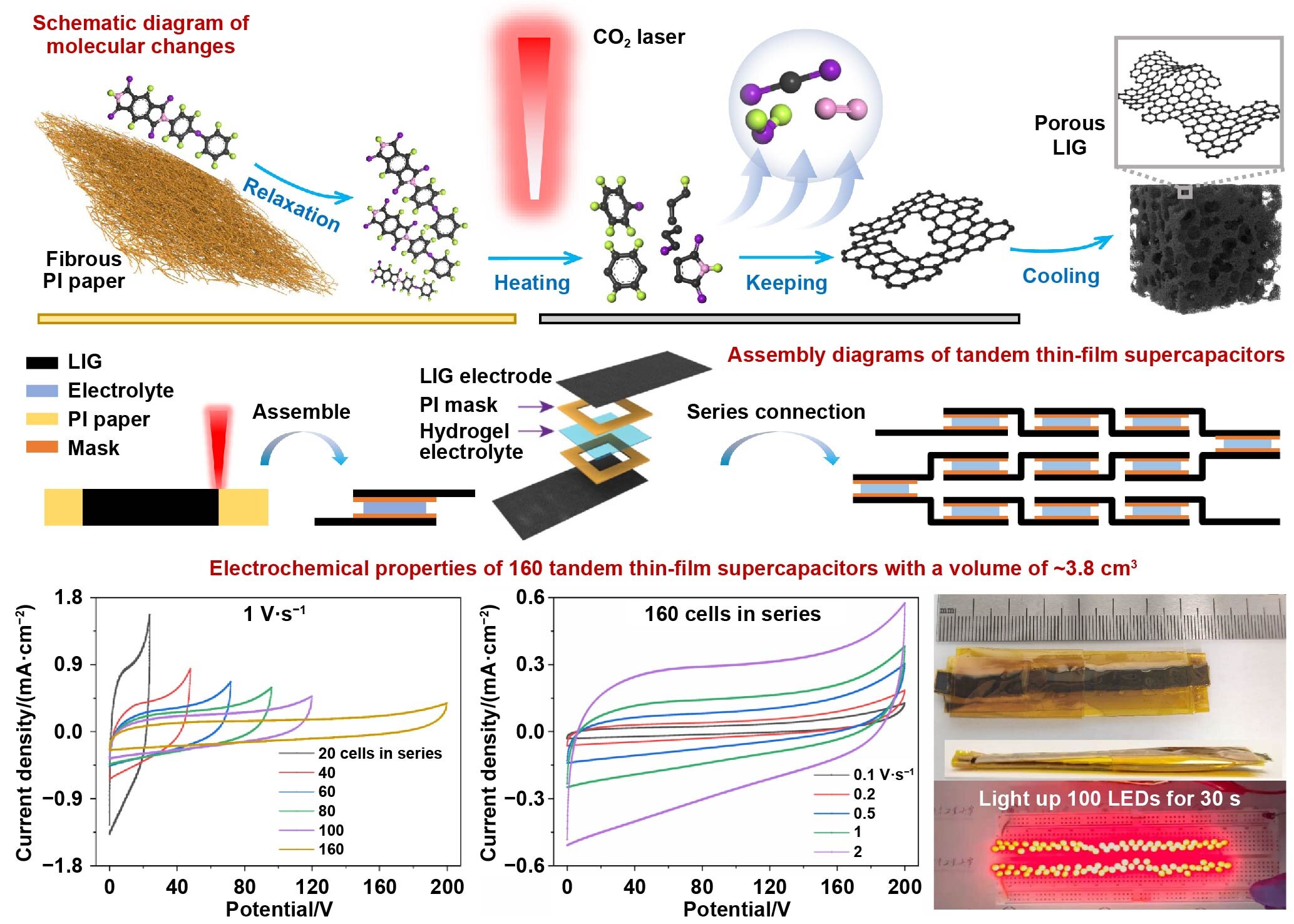
Researchers at Guangdong University of Technology have developed a new method to build powerful, compact energy storage devices—called thin-film supercapacitors (TFSCs)—without using metal parts or traditional separators. Their tiny 3.8 cm³ device is even capable of outputting 200 volts—enough to light 100 LEDs for 30 seconds or a 3-watt bulb for 7 seconds.
The method, detailed in an article published in the International Journal of Extreme Manufacturing, could help power next-generation microelectronic devices, especially those used in harsh or space-constrained environments.
At the heart of the technology is a simple but effective laser process. The researchers used a CO₂ laser to transform sheets of commercial polyimide (PI) paper into 3D graphene—an excellent material for storing and conducting electricity. This graphene paper plays multiple roles: it acts as the energy-storing electrode, the electrical connector, and the structural support, all at once.
“Traditional supercapacitors rely on bulky metal components and complex wiring to connect many cells together,” said Prof. Huilong Liu, corresponding author on the paper and associate professor in GDUT’s State Key Laboratory of Precision Electronic Manufacturing Technology and Equipment. “Our method simplifies the materials and the design while still achieving high voltage and stable performance.”
The researchers carefully studied how laser parameters—such as scan density, power, and speed—affect the graphene’s structure and conductivity. With these optimizations, they were able to consistently produce graphene sheets with low electrical resistance and strong electrochemical properties.
In the new design, the hydrogel electrolyte doubles as a separator, and the PI paper itself defines the shape of each cell. The self-supporting graphene layers allow all components to be stacked tightly, making the device compact without sacrificing performance. Importantly, all the TFSCs—from a single cell to the full 160-cell stack—showed consistent performance.
“The biggest advantage is that we don’t need metal current collectors or external connectors,” said co-author Prof. Yun Chen. “By removing unnecessary materials and simplifying assembly, we can scale up to high-voltage outputs while keeping the device ultra-compact.”
The team plans to continue improving the energy density and voltage range of these devices. They hope the technology can one day power wearable sensors, flexible electronics, and other small-scale systems that need reliable energy in harsh or space-limited conditions.
More information:
Huilong Liu et al, 3D graphene paper-based tandem metal-free thin-film supercapacitors with integrated 200 V output, International Journal of Extreme Manufacturing (2025). DOI: 10.1088/2631-7990/add227
Provided by
International Journal of Extreme Manufacturing
Citation:
Metal-free supercapacitor stack delivers 200 volts from just 3.8 cm³ (2025, July 23)
retrieved 23 July 2025
from https://techxplore.com/news/2025-07-metal-free-supercapacitor-stack-volts.html
This document is subject to copyright. Apart from any fair dealing for the purpose of private study or research, no
part may be reproduced without the written permission. The content is provided for information purposes only.
