


Support CleanTechnica’s work through a Substack subscription or on Stripe.
Or support our Kickstarter campaign!
When the idea of launching data centers into space hit the CleanTechnica radar back in 2024, the idea seemed weirdly futuristic but worthy of further exploration, considering the advantages of 24/7 solar power and ambient cooling. Just two years later, the kook factor has dissolved under a growing tide of investor interest and academic research. The latest proposal tackles the challenge of scalability, by deploying data centers in the form of orbiting, kilometers-long spikes festooned with solar panels.
Orbiting Data Centers & The Tether Solution
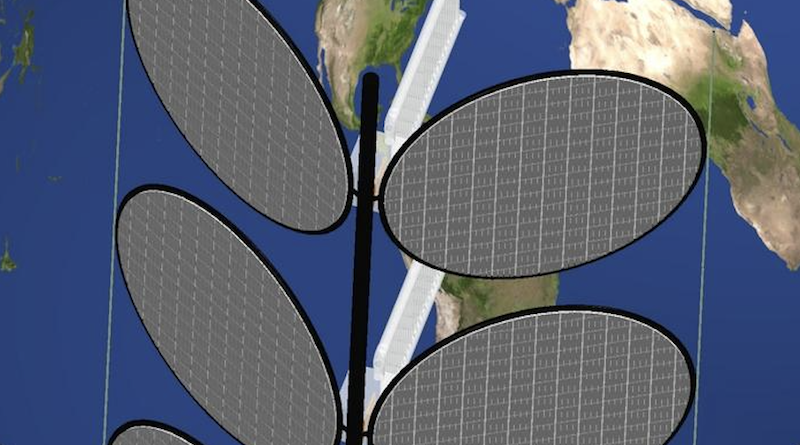
The “spikes” are actually cables called tethers, which have been widely used in space applications for decades. A team of researchers at the University of Pennsylvania developed the design as they searched for a way to scale up orbiting data centers. In their design, the tethers are made up of thousands of individual computer nodes, like beads on a string.
That’s a sharp contrast with the state of play in the orbiting data center field. Some designs fall squarely into the futuristic slot, involving massive, robot-constructed installations and new manufacturing systems that don’t exist yet. More typically, they are designed as constellations of networked satellites.
“The problem is that these designs are challenging to scale,” explains Igor Bargatin, head of the UPenn research team. Bargatin, who holds the post of Associate Professor in Mechanical Engineering and Applied Mechanics, is also the senior author of a paper presented at the 2026 American Institute of Aeronautics and Astronautics SciTech Forum under the title, “Tether-Based Architecture for Solar-Powered Orbital Data Center.”
“If you rely on constellations of individual satellites flying independently, you would need millions of them to make a real difference,” Bargatin adds, with difference referring to the goal of saving energy and water.
Others may differ, but the tether solution has a number advantages, according to the researchers. One factor is the predictability of tether behavior in space, without the need for human adjustment.
“Because the design relies on tethers — an existing, well-studied technology — we can realistically think about scaling orbital data centers to the size needed to meaningfully reduce the energy and water demands of data centers on Earth,” Bargatin emphasizes.
How It Works
The UPenn communications team provides a handy summary of the passive behavior of tethers. “Unlike prior designs, which typically require constant adjustments to keep solar panels pointed toward the sun, the new system is largely passive, its orientation maintained by natural forces acting on objects in orbit,” UPenn explains.
“By relying on these stabilizing effects, the design reduces weight, power consumption and overall complexity, making large-scale deployment more feasible,” they add.
While the tethers are flexible, they don’t curl or bend in space. Made up of thousands of individual computing nodes, the tethers are stretched out by the force of gravity interacting with the motion of their orbit, forming a straight line pointing from the Earth to space. Scale-up is a matter of adding more nodes.
In simulations described in the team’s paper, a single tethered system could stretch for kilometers into space, hosting thousands of computing nodes and supporting up to 20 megawatts of computing power.
Two Roles For Solar Power
Another focus of the research effort was reducing the cost and complexity of the system. Each computer node is equipped with its own lightweight radiator to shed heat, and its own solar panels to harvest solar energy.
The solar panels also serve another key function, acting as receivers for minute doses of pressure from sunlight, keeping themselves properly aligned to the sun without the need for external power systems. “The gentle but constant pressure exerted by the sun’s rays acts much like wind on a weather vane, keeping the panels oriented without motors or thrusters,” UPenn explains.
As for hardiness, a long, slim design may seem at risk from the constant pounding of micrometeoroids, but the researchers found significant evidence of resiliency. Modeling the tether’s reaction to the barrage of dust and debris fragments, the team found that the structure may wobble or rotate slightly, but the motion spreads outward and eventually dissipates, like ripples in a pond. The system is also designed around multiple tethers, enabled nodes to continue functioning if an impact is strong enough to damage or sever a tether.
Next Steps For Data Centers In Space
The next steps for the research team include building and testing a scaled-down prototype. If all goes according to plan, the result will be a space-based data center equivalent to a medium-sized system on Earth, transmitting data via laser-based optical links.
Bargatin explains that a laser system is probably not speedy enough to handle AI training in space, but it is compatible with AI queries, where demand is growing faster.
Meanwhile, startups are already anticipating a role for data centers in space. One recent example comes from the Singapore firm OrbitAI, which has hooked up with Canada’s PowerBank in a constellation-style design.
“Orbit AI is developing DeStarlink, the first decentralized low-Earth-orbit network for global connectivity, and DeStarAI, a suite of orbital AI data centers powered by solar arrays and naturally cooled in space,” PowerBank explains.
Another startup to watch is the US firm Aetherflux. The company nailed down $50 million in Series A funding last March. In December, the company dropped word on Medium about its next steps, which are right around the corner.
“Aetherflux announced a Q1 2027 target for its first orbital data center satellite, which leverages solar power in space to address the massive energy needs for artificial intelligence,” Aetherflux explained.
The project, dubbed ‘Galactic Brain,’ offers a bypass to the current five-to-eight year time horizon for data centers to be built on Earth,” they added.
In the meantime, researchers are also hammering away at another, different approach to space-based solar, consisting of vast, orbiting solar arrays that beam energy down to receivers on Earth (see lots more space solar background here).
Note: Yes, it’s difficult to focus on the future at a time when the President of the United States preoccupies himself with launching vicious screeds against the Chairman of the Federal Reserve (the who?) even as his personal, taxpayer-funded army of masked thugs runs amok, murdering US citizens, terrorizing whole cities, and sending thousands to concentration camps (got a better word for them?).
If you have any thoughts about that, drop a note in the comment thread. Better yet, find your representatives in Congress and let them know what you think.
Image: “A schematic of the proposed orbital data center design, which resembles a leafy plant, with solar panels branching out from long columns that hold computing hardware (credit: Igor Bargatin, Dengge Jin, Zaini Alansari, Jordan R. Raney).
Support CleanTechnica via Kickstarter

Sign up for CleanTechnica’s Weekly Substack for Zach and Scott’s in-depth analyses and high level summaries, sign up for our daily newsletter, and follow us on Google News!
Have a tip for CleanTechnica? Want to advertise? Want to suggest a guest for our CleanTech Talk podcast? Contact us here.
Sign up for our daily newsletter for 15 new cleantech stories a day. Or sign up for our weekly one on top stories of the week if daily is too frequent.
CleanTechnica uses affiliate links. See our policy here.
CleanTechnica’s Comment Policy
