


Support CleanTechnica’s work through a Substack subscription or on Stripe.
Or support our Kickstarter campaign!
Even with the full support of US President Donald Trump, the domestic hydropower industry will have a tough time building new dams. Maybe they don’t particularly want to, either. For the past 50 years, the focus has been upgrading and retrofitting existing dams. New opportunities are also rising in the related field of pumped hydro energy storage, and a UK startup has come up with a solution that can open up more suitable sites for new pumped hydro systems.
Wait, Full Support From The Trump Administration?
You heard that right. Full support. President Trump has loudly, and repeatedly, declared his affection for fossil fuels. However, the “energy emergency” that he declared upon taking office last year embraces hydropower along with biofuels and geothermal energy, three domestic resources that can compete with fossil fuels for power generation.
To make the case for supporting hydropower, biofuels, and geothermal energy, Trump and his appointees underscore the need for the kind of baseload, weather-agnostic, 24/7 power generation delivered by fossil fuels and nuclear energy — which, they incorrectly claim, wind and solar cannot provide. And yet, to make the case against wind and solar, various Trump officials have expressed the idea that energy storage is not a thing that exists in space and time (here’s another example), skipping right over the fact that the hydropower industry has energy storage built into its DNA.
Pumped energy storage has been used for power generation in the US for almost 100 years. It can function under a fossil fuel scenario, but today’s wind and solar resources offer a more economical and sustainable solution. The basic concept is simple. During periods of low electricity demand, the excess output from from wind turbines or solar panels is deployed to pump water to a reservoir at a higher elevation, where it can be stored indefinitely. When needed, the stored water is let loose to run downhill to a generating station, with the natural force of gravity doing the work.
The Elevation Problem
The pumped storage angle undermines the ostensible reasoning behind the exclusion of wind and solar from support under the so-called energy emergency. Or, perhaps the emergency declaration is nothing more than a fiction aimed at pulling the rug out from under the US wind industry, with solar stakeholders falling under the chopper as collateral damage.
If you have any thoughts about that, drop a note in the comment thread. Meanwhile, federal energy aside, the pumped storage field does offer new opportunities for squeezing more clean kilowatts from water resources, while avoiding the impacts that attend conventional, river-disrupting hydropower dams.
In Washington State, for example, the firm Rye Development has just won a permit to build a pumped storage project on the grounds of a former aluminum plant, and a giant “water battery” is taking shape at a former coal field in Kentucky.
Despite opportunities like these, one obstacle is the elevation required for a gravity-based system to function efficiently. Conventional pumped storage facilities require a mountain-level site for the upper reservoir and a steep downhill slope to achieve the water pressure needed to run the turbines.
No-Mountain Pumped Hydropower Energy Storage Solutions
One interesting workaround is offered up by the US startup Quidnet, which is developing a hybrid facility based on reservoirs in underground rock formations. Last summer the company reported a successful demonstration of the system.
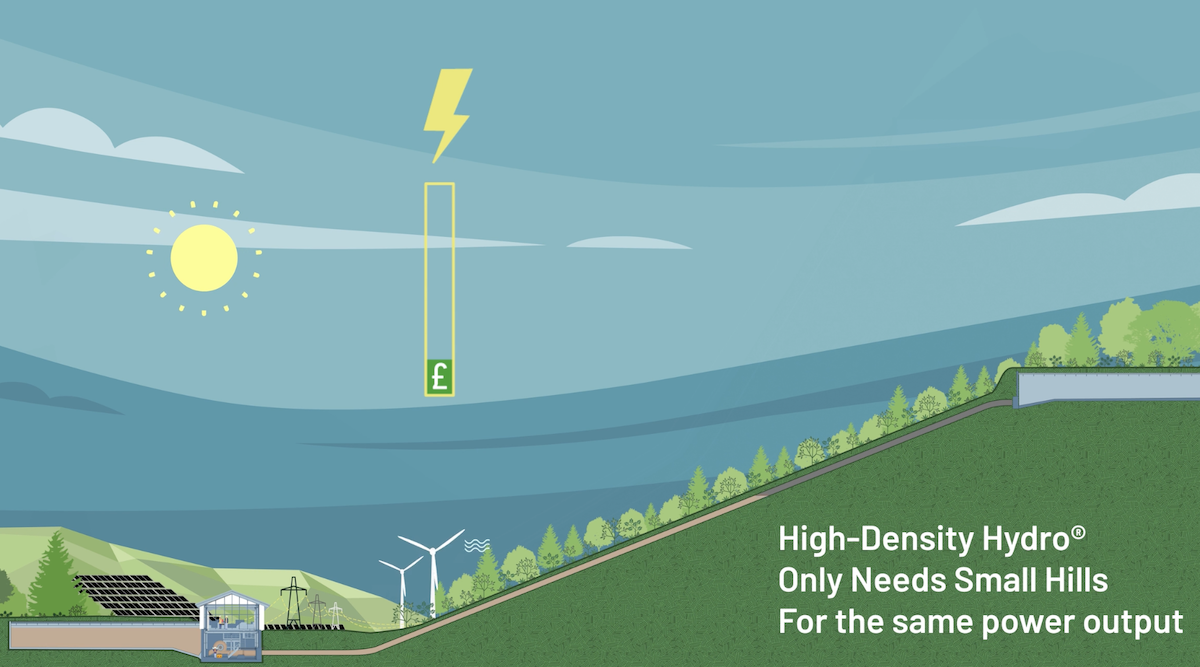
Another solution to the elevation problem comes from the UK, where the startup RheEnergise has come up with a compact system it calls HD Hydro. Short for High-Density Hydropower, it can be located on low, hilly terrain, without the need for high, steep slopes.
RheEnergise is scouting the US and Canada for potential locations, among other parts of the world. The company states that it has identified 6,278 potential sites in Texas alone. Even if only 5% of these sites are amenable to development, the amount of storage would total 23.5 gigawatts at an average size of 75 megawatts, ReEnergise calculates.
“At 8-hour duration, HD Hydro is half the cost of a lithium-ion battery system, (levelised cost of storage basis), without the fire risks and environmental concerns that batteries present,” they add, with levelized referring to a calculation that enables cost comparisons between different energy storage systems.
HD Hydro is a closed-loop storage system, meaning that it recycles water by pipeline between an upper reservoir and a lower reservoir. Because the HD Hydro system is compact, there is an opportunity to bury one or both of the reservoirs underground, conserving the land above for other purposes.
How It Works
On January 27, RheEnergise reported that it has achieved full power at its first energy storage project. Located in Devon, UK in Cornwood, near Plymouth, the new facility represents a key milestone on the company’s journey to the mainstream energy storage market. “RheEnergise’s de-risking of its innovative High-Density Hydro® energy storage system is the trigger for commercial-scale projects to be developed, financed and built,” the company says of itself.
HD Hydro deploys a dense, mineral-rich fluid to scale down the system while achieving the same output as a much larger facility using plain water. “RheEnergise’s HD Hydro energy storage system uses a specially formulated, low-viscosity, denser-than-water fluid which enables smaller, flexible and powerful hydro installations to be built on hills rather than in mountains,” the company elaborates.
“The Long Duration Energy Storage system offers flexibility and security to high energy users and national energy systems and, along with the speed of its construction, facilitates the transition to low carbon energy generation,” they emphasize.
The Cornwood project is located at a kaolin mine operated by the firm Sibelco, providing an extra jolt of electricity during periods of peak demand (kaolin is a rock commonly used in the manufacture of ceramics, among other produces).
Er, Make That Full-Ish Support
Meanwhile back in the USA, the US hydropower industry is not out of the woods. Even within the protective embrace of Trump’s energy emergency declaration, there are still some legislative matters to clear up before the promise can be kept.
In a post on LinkedIn last week, the National Hydropower Association announced that one crucial step was achieved in January, when the House Energy and Commerce Committee voted unanimously to send the new “Build More Hydro” bill (aka HR 2072) to the full House for a vote. The Senate has already greenlighted the legislation.
“The legislation…extends construction deadlines for around three dozen hydropower projects delayed by the COVID-19 pandemic, supply chain shortages, and other unique hurdles that threaten their completion,” NHA explains, noting that the projects total 2.6 gigawatts all together.
If all goes according to plan it will soon land on the President’s desk, where presumably he will sign it with or without the assist of an autopen. Or, maybe not. Fingers crossed…
Image (cropped): A new, compact pumped hydro energy storage system uses lower elevations and sloping hills, avoiding the cost and environmental impacts of mountain-based storage systems (courtesy of RheEnergise).
Support CleanTechnica via Kickstarter

Sign up for CleanTechnica’s Weekly Substack for Zach and Scott’s in-depth analyses and high level summaries, sign up for our daily newsletter, and follow us on Google News!
Have a tip for CleanTechnica? Want to advertise? Want to suggest a guest for our CleanTech Talk podcast? Contact us here.
Sign up for our daily newsletter for 15 new cleantech stories a day. Or sign up for our weekly one on top stories of the week if daily is too frequent.
CleanTechnica uses affiliate links. See our policy here.
CleanTechnica’s Comment Policy
