


What if windows could clean themselves at the flick of a switch? We’re not quite there yet, but we are getting closer. Researchers in China have developed a transparent, easy-to-produce self-cleaning glass that can remove particles in just 10 seconds using an electric field.
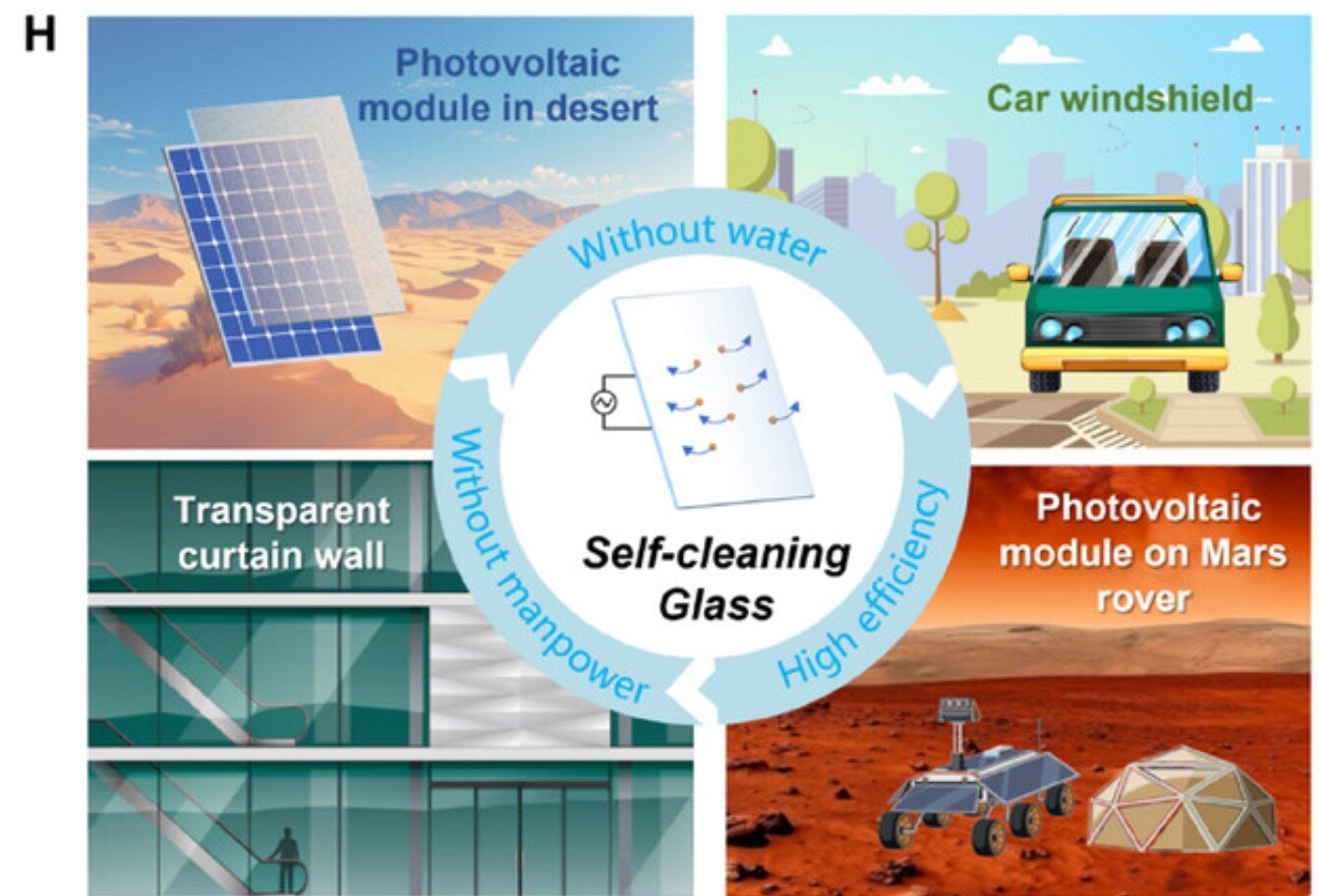
This innovative solution offers a water-free and sustainable alternative to traditional cleaning methods that can be applied to not only terrestrial vehicles and buildings but also solar panels on probes driving across the surface of Mars.
According to the findings, published in Advanced Science, glass was able to achieve self-cleaning of both organic and inorganic particles and showed self-cleaning efficiency of more than 95% within seconds.
Dust is everywhere and always finds a way to settle onto surfaces, no matter how many times you clean them. Geological (wind erosion, pulverized rocks) and biological (pollen, spores) sources along with anthropogenic sources (construction, mining) create surface particle pollution that can often reduce the visibility of window panels and the performance of photovoltaic cells by obstructing the sunlight-harnessing components.
The conventional water and detergent cleaning method is a resource-intensive, environmentally polluting process that comes with its share of concerns regarding the safety of manual cleaners, in the case of tall buildings.
Nature has great examples of self-cleaning surfaces like lotus leaves and cicada wings, where the superhydrophobic nature of the surfaces and water droplets work together to remove dust and debris from surfaces.
Scientists have mimicked these properties of biological materials to create self-cleaning surfaces but their efficacy relies on weather conditions like humidity, limiting their application in waterless environments.
While electrostatic methods which use electric fields to drive the movement of particles have shown promising results in removing airborne particles, they often struggle with particles that are clung to a surface.
The transparent, coverable self-cleaning glass designed by the researchers overcame the existing problems exhibited removal of 97.79 g/m2 of particles in 10 seconds with 97.5% efficiency using a square wave electrical signal (5 kV, 10 Hz). The glass also exhibited a particle shielding effect which prevented moving particles from depositing onto the clean surface after the electric field was turned on.
-

Application of coverable transparent self-cleaning glass.Credit: Adv. Sci. (2025). DOI: 10.1002/advs.202509404
-
![Self-cleaning glass uses electric field to remove dust particles within seconds]()
Abnormal transport and jump behaviors of charged particles and the design of transparent self-cleaning glass.Credit: Adv. Sci. (2025). DOI: 10.1002/advs.202509404

The self-cleaning glass featured a sandwich-like structure with the base layer consisting of quartz glass. Indium tin oxide (ITO) electrode/electrodes were applied on the glass layer laser etching. Finally, a polyethylene glycol terephthalate (PET) film was placed as an insulating dielectric layer over the ITO electrodes.
The researchers believe that understanding how these particles move and detach under electric fields holds the key to developing a self-cleaning surface that functions well in waterless and harsh conditions on Earth and outer space.
With the help of experimental observation and theoretical modeling, they investigated the same for the self-cleaning glass and found two main mechanisms in charged particles under applied electric field: abnormal reverse lateral transport and jump behaviors.
The team also analyzed the push and pull forces (Coulomb force, dielectrophoretic force) that drive particle movement, and the sticky forces (van der Waals force) that resist particle movement on a surface.
The study presents a self-cleaning glass that can not only be applied to a wide range of surfaces without interfering with its original function or light transmittance, but can also be maintained via a sustainable and chemical-free process.
Written for you by our author Sanjukta Mondal,
edited by Sadie Harley, and fact-checked and reviewed by Robert Egan—this article is the result of careful human work. We rely on readers like you to keep independent science journalism alive.
If this reporting matters to you,
please consider a donation (especially monthly).
You’ll get an ad-free account as a thank-you.
More information:
Meng Yang et al, Coverable Self‐Cleaning Glass via Abnormal Transport and Jump of Charged Particles, Advanced Science (2025). DOI: 10.1002/advs.202509404
© 2025 Science X Network
Citation:
Self-cleaning glass uses electric field to remove dust particles within seconds (2025, August 7)
retrieved 7 August 2025
from https://techxplore.com/news/2025-08-glass-electric-field-particles-seconds.html
This document is subject to copyright. Apart from any fair dealing for the purpose of private study or research, no
part may be reproduced without the written permission. The content is provided for information purposes only.
