


At Super Terminal Expo 2025, International Airport Review Editor Holly moderated a panel discussion that explored innovative approaches to creating environmentally responsible and efficient airport facilities. This article explores the findings.
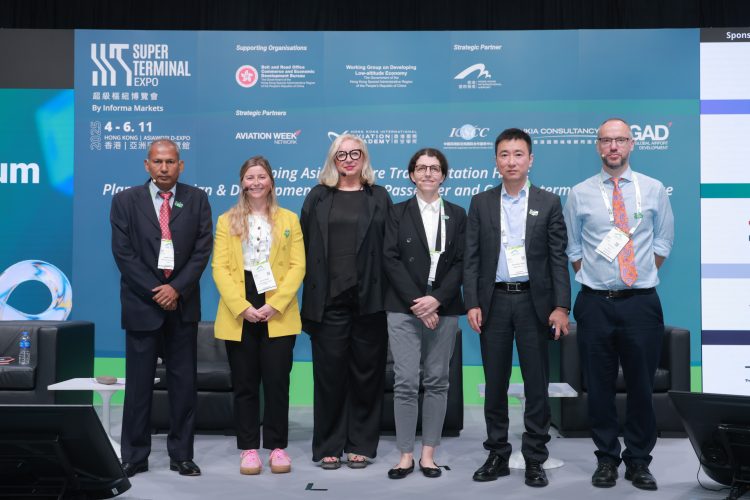
(L-R) Subir Hazra, Sector Head – Stakeholders Compliances, GMR Airport Limited; Holly Miles, Editor of International Airport Review; Antoinette Nassopoulos-Erickson, Senior Partner, Foster + Partners; Daphné Erussard, General Manager Asia-Pacific, Artelia Airports; Roy-Rong Yang, Vice President, Smart Building, ABB China; and Jim Peacock, Principal and Aviation Leader, ARUP. Credit: Super Terminal Expo.
At Super Terminal Expo 2025 in Hong Kong, International Airport Review Editor Holly Miles moderated a panel discussion on designing the sustainable airport of the future. She was joined by experts from Foster + Partners, GMR Airports Limited, Artelia Airports, ABB China and Arup who discussed innovative ways to build eco-conscious, high-efficiency airport facilities. The panel delved into cutting-edge design principles, green tech and intentional design that put sustainability at the forefront.
The current landscape
In the contemporary aviation landscape, airports face a triple challenge: expanding capacity, enhancing passenger experience, and delivering on ambitious net-zero goals simultaneously.
As the industry moves forward, the consensus among global experts in architecture, engineering, and operations is that sustainability has shifted from a “parallel workstream” to an integrated core necessity. Designing the sustainable airport of the future requires a holistic approach that transcends simple carbon metrics to embrace economic viability, social responsibility, and long-term resilience.
A holistic and integrated vision
Sustainability in airport design is no longer viewed as an isolated environmental concern. Instead, it is defined as a holistic framework encompassing community issues, green mobility, resiliency, and corporate governance. Experts suggest that the most significant shift in the last five years is the move toward integrated design, where sustainability, operations, and passenger experience are considered from the project’s outset to ensure economic viability.
This integration is vital because sustainability is a must, not an option. By embedding these considerations early, designers can avoid the “unsustainable pathways” seen in older, organically grown airports where inefficient layouts, such as the historical configuration of Heathrow, lead to unnecessary fuel burn during aircraft taxiing.
Design levers: Building less to achieve more
One of the most effective levers for sustainable design is, paradoxically, the decision not to build new infrastructure when refurbishment is possible. Retaining and optimising existing facilities, as seen in projects like Marseille, significantly reduces embodied carbon compared to demolition and reconstruction.
When new construction is necessary, right-sizing infrastructure based on demand is the priority. Historically, many hubs over-designed facilities to meet “Level of Service A” standards, resulting in oversized, energy-inefficient terminals. Modern designers now advocate for using IATA levels of service to size facilities accurately, focusing on “passive design”. This includes:
- Optimising orientation and shading to reduce reliance on mechanical systems.
- Utilising natural lighting to decrease energy consumption.
- Selecting sustainable materials, such as glulam timber used in Mactan-Cebu, which offers long-span capability while being cheaper and having less embodied carbon than structural steel.
However, the general trend of passenger growth is upwards, so airports who foresee that they may need to expand in the future, can do so via modular construction where modules are built off-site and then craned into place. It significantly speeds up construction by 20-50% compared to traditional methods and creates 90% less waste. Queen Alia Airport in the Middle East has been extended three times now since its first opening. Other modular airports include London Stansted Airport and Hong Kong Airport, all designed by Foster + Partners. This methods allows airports to flex and expand only when they need to, rather than operating large buildings that are currently surplus to their needs and which may become outdated by the time they come into use.
The role of smart technology and electrification in sustainable airport design
Technology serves as a critical enabler for balancing energy efficiency with passenger comfort. Smart building systems and automation can now improve energy efficiency by up to 30%. Promising technologies include:
- Flight-linked intelligent lighting: Systems integrated with flight databases (APIs) can dim or brighten areas based on actual flight status and passenger movement, reducing nighttime energy use significantly.
- Adaptive dimming: Sensors monitor natural light intensity and adjust indoor fixtures in real-time to maintain constant optimal illuminance.
- Intelligent scene switching: Automatically switching between daily, energy-saving, and emergency modes based on functional requirements.
Interestingly, maintaining optimal terminal climates is not just an environmental issue; it has direct commercial benefits. Research indicates that optimal climate control can increase passenger transaction values by 12% to 18%, thereby supporting the airport’s economic sustainability. To ensure these technologies remain relevant, designers must utilise open software systems and modular hardware that can be upgraded via remote OTA (Over-The-Air) updates as new innovations emerge.
The challenge of scale
In high-growth markets like China, airports are reaching unprecedented scales, with single terminal buildings like Shanghai Pudong’s T3 planned at 900,000 square meters. These facilities are evolving into multi-modal transportation hubs, seamlessly integrating high-speed rail, light rail, and metro systems. However, this scale introduces significant complexity, particularly in managing multi-generational electrical systems where different terminals built across decades operate with inconsistent equipment parameters and protocols. Ensuring operational continuity is paramount, as even a millisecond voltage sag can crash a baggage handling system.
Operations and the energy ecosystem
The sustainable airport of the future is accelerating the energy revolution by evolving into a clean energy hub. Some leading facilities already source 100% of their power from renewable sources, such as hydroelectricity and on-site solar panels. Master planning now includes safeguarding land for future fuel ecosystems, such as Sustainable Aviation Fuel (SAF), hydrogen infrastructure, and widespread electrification.
The ultimate “stretch goal” is the development of net-positive airports—facilities that put more back into the environment than they take out. This includes not only generating clean energy but also improving biodiversity, such as protecting wetlands. Furthermore, airports are beginning to see themselves as energy providers for their surrounding communities, potentially producing hydrogen to fuel local buses and transport networks.
Navigating economic and regulatory challenges
A major hurdle remains the perceived conflict between capital expenditure (CAPEX) and sustainability goals. However, the industry is shifting toward the total cost of ownership (TCO). While sustainable solutions may be more expensive initially, they lead to reduced operational expenditure (OPEX) through lower energy consumption and easier maintenance.
This shift requires patience and regulatory support. Because the “gestation period” for these investments is long, regulators must allow operators to recover costs over extended periods. A data-driven approach with a “single source of truth” (SST) is essential to ensure all stakeholders, from airlines to government agencies, are aligned on these long-term goals.
The necessity of collaboration for the sustainable airport of the future
The overarching theme for delivering truly sustainable terminals is collaboration. The design process must involve regular communication between architects, engineers, technology suppliers, and airport owners from the earliest stages. Listening to stakeholders and fostering a multi-disciplinary environment allows constraints to become sources of creativity rather than points of friction. By integrating data, innovative materials, and smart technology, the aviation sector can create infrastructure that is not only functional and beautiful but also a proactive contributor to a greener planet.
Super Terminal Expo takes place on 3-5 November 2026 in Hong Kong.
