


Steel Knight focused on contested maritime operations, with assets operating from far-off Forward Arming and Refueling Points and Air-Delivered Ground Refueling nodes in the ‘hub-and-spoke’ concept.
The U.S. Marine Corps’ Steel Knight 25 exercise saw the I Marine Expeditionary Force’s (I MEF) 3rd Marine Aircraft Wing (3rd MAW) and its subordinate Marine Aircraft Group 13 (MAG 13) execute aviation power projection, simulated strikes, defensive counter-air, distributed ‘hub-and-spoke’ operations, maritime attack and close air support operations.
Held from Dec. 1 to Dec. 13, 2025, across California’s seaboard and large parts of western U.S., the exercise involved Marine F-35C Lightning IIs, F/A-18C Hornets, AH-1Z Vipers, CH-53E Super Stallions, MV-22B Ospreys, KC-130J Super Hercules. Air Force KC-135 Stratotankers, C-130J Super Hercules, A-10 Thunderbolt IIs, HH-60 Jolly Green II search-and-rescue helicopters and B-1B Lancer bombers also participated in the maneuvers.
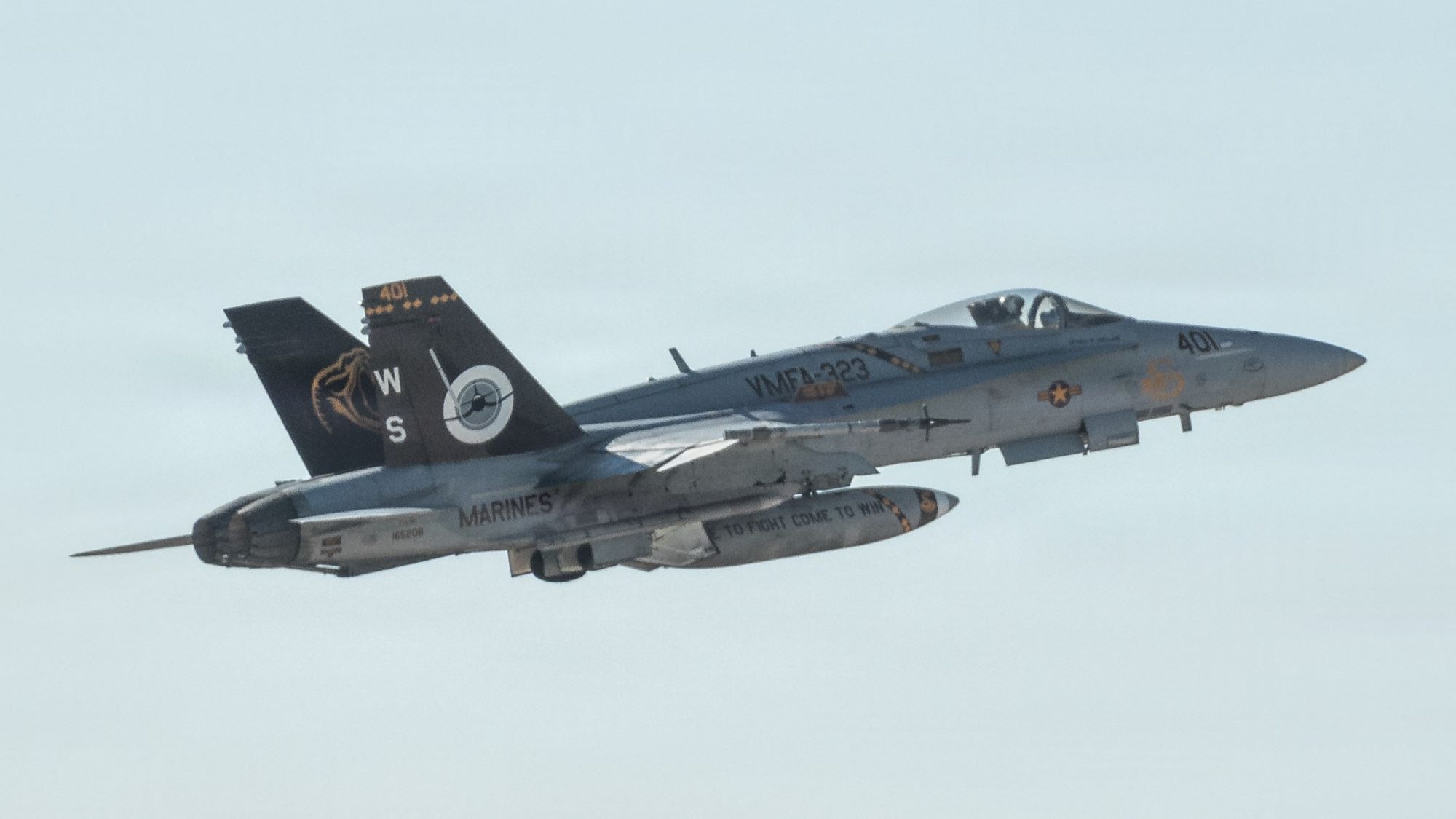
Steel Knight was centered around overall joint Air Force and Navy MARSTRIKE (Maritime Strike) scenarios and supplementary refueling and re-arming from distributed locations in forward zones. CAS operations with AGM-179 JAGM fires from the AH-1Z Viper were also part of the scenarios.
The exercise included ADGR (Air Delivered Ground Refueling) and FARP (Forward Arming and Refueling Point) nodes to support the F-35C Lightning IIs, F/A-18C Hornets and the AH-1Z Vipers. More than 400 Marines and Sailors operated across six locations from San Diego to 29 Palms to Sacramento, using technology like the Marine Air-Ground Tablets (MAGTAB) for command and control.
FARP Ops ♠️🐍
MWSS-373 and the MWSS-372 supported FARPs at San Clemente Island and Sacramento Mather Airport during exercise Steel Knight 25, delivering refueling and rearming for aircraft and extending their reach.
📸 LCpl. Samantha Devine & Sgt. Brian Stippey pic.twitter.com/dwhJ17flVP
— 3rd Marine Aircraft Wing (@3rdmaw) December 14, 2025
Distributed Maritime Strike
For the Distributed Maritime Strike role, 3rd MAW partnered with the U.S. Navy and U.S. Air Force for a “joint, simulated maritime strike” on Dec. 10, 2025, “demonstrating the Marine Corps’ ability to project aviation power across the contested maritime domain.”
The MARSTRIKE saw fourth and fifth-generation aircraft, joint aviation assets and “contracted simulated adversary forces” rehearsing “long-range detection, targeting, and simulated engagement of maritime threats.” U.S. Air Force KC-135s, HH-60Ws and B-1Bs supported MARSTRIKE alongside the contracted “Red Air” replicating realistic adversary actions.
The contracted Red Air mention refers to private companies like ATAC or Top Aces providing ADAIR (Adversary Air) services. This is nowadays a constant of such complex exercises, as the contracted Red Air allows for more simulated enemies to be present during the scenarios.
The MARSTRIKE employed an “hub-spoke-node framework,” connecting “centralized command, control and sustainment” (hubs) supporting “extended communications and logistics forward” (spokes) to “enable distributed aviation operations.” FARP and ADGR nodes “operate at the tactical edge for limited durations, allowing aviation units to refuel, rearm and maneuver before displacing, within 72-96 hours, to avoid detection,” the press release explained.
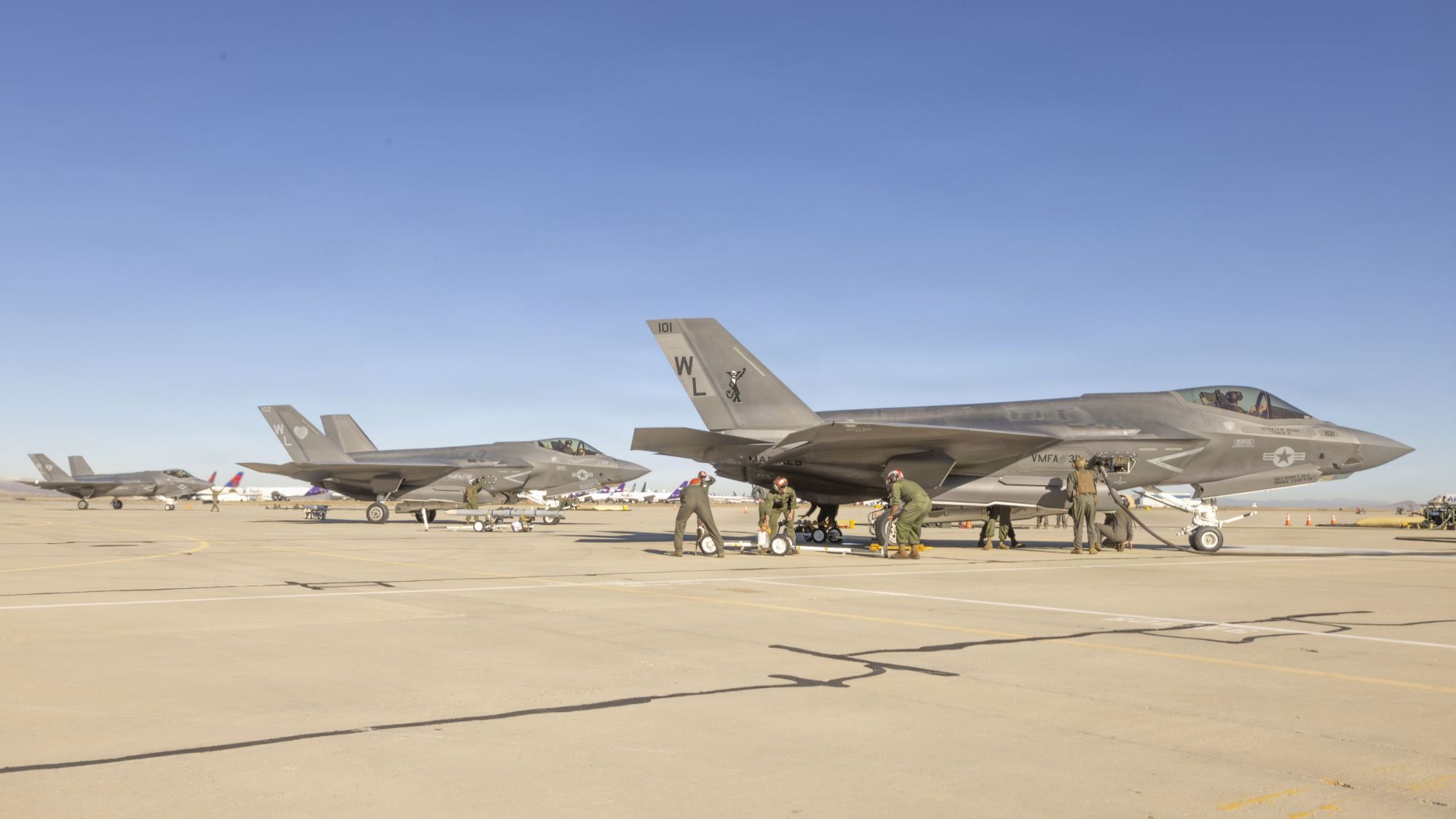
F-35Bs from the 3rd MAW/MAG 13’s Marine Fighter Attack Squadron 214 (VMFA-214) launched from “hub” MCAS (Marine Corps Air Station) Yuma, while VMFA-311’s F-35C Lightning IIs and VMFA-323’s F/A-18C Hornets departed one of the “spokes”, MCAS Miramar. The MARSTRIKE also showcased how fifth generation F-35s and fourth generation legacy Hornets “combine survivability, sensor fusion and maneuver to complicate an adversary’s targeting while maintaining persistent pressure across the battlespace.”

Navy and Air Force command-and-control elements provided “maritime intelligence to synchronize fires and maintain situational awareness” to Marine aviators. Following the MARSTRIKE, 3rd MAW aircraft executed a series of defensive counterair and offensive counterair missions.
FARP and ADGR
The service said a key element of the exercise was a Forward Arming and Refueling Point (FARP) node at Mather airfield in Sacramento, California, established by the Marine Wing Support Squadron 372 (MWSS-372) “Diamondbacks.” The press release noted the FARP node was 400 miles from one of the spokes, Marine Corps Base Camp Pendleton, demonstrating the squadron’s “ability to extend aviation sustainment far beyond traditional support ranges.”
“U.S. Marines established and operated a forward arming and refueling point (FARP) at Sacramento Mather Airport, California, Dec. 8, 2025, where they continue to sustain forward aviation operations for Steel Knight 25.” https://t.co/53yH9Ff1hI pic.twitter.com/baIn6q8A86
— Alex 🌻 (@alexgarcialonso) December 13, 2025
Throughout the exercise, various fixed-wing aircraft departed their home stations, including MCAS Miramar, MCAS Yuma and Air Force bases across California, to utilize the FARP at Mather. MWSS-372 employed its Tactical Aviation Ground Refueling System (TAGRS) that it uses in “austere environments.”
Through TAGRS, F-35Cs from VMFA-311 “received fuel prior to a simulated Maritime Strike.” The F-35C’s internal fuel capacity is approximately 19,200 pounds, giving it a flight range of more than 1,200 nautical miles, further extended during Steel Knight thanks to the FARP.
MWSS-372 also set up four-point FARPs at the Southern California Logistics Airport, Victorville and San Clemente Island. The San Clemente FARP supported AH-1 Vipers, CH-53E Super Stallions and MV-22B Ospreys for “sea denial and close air support operations.”
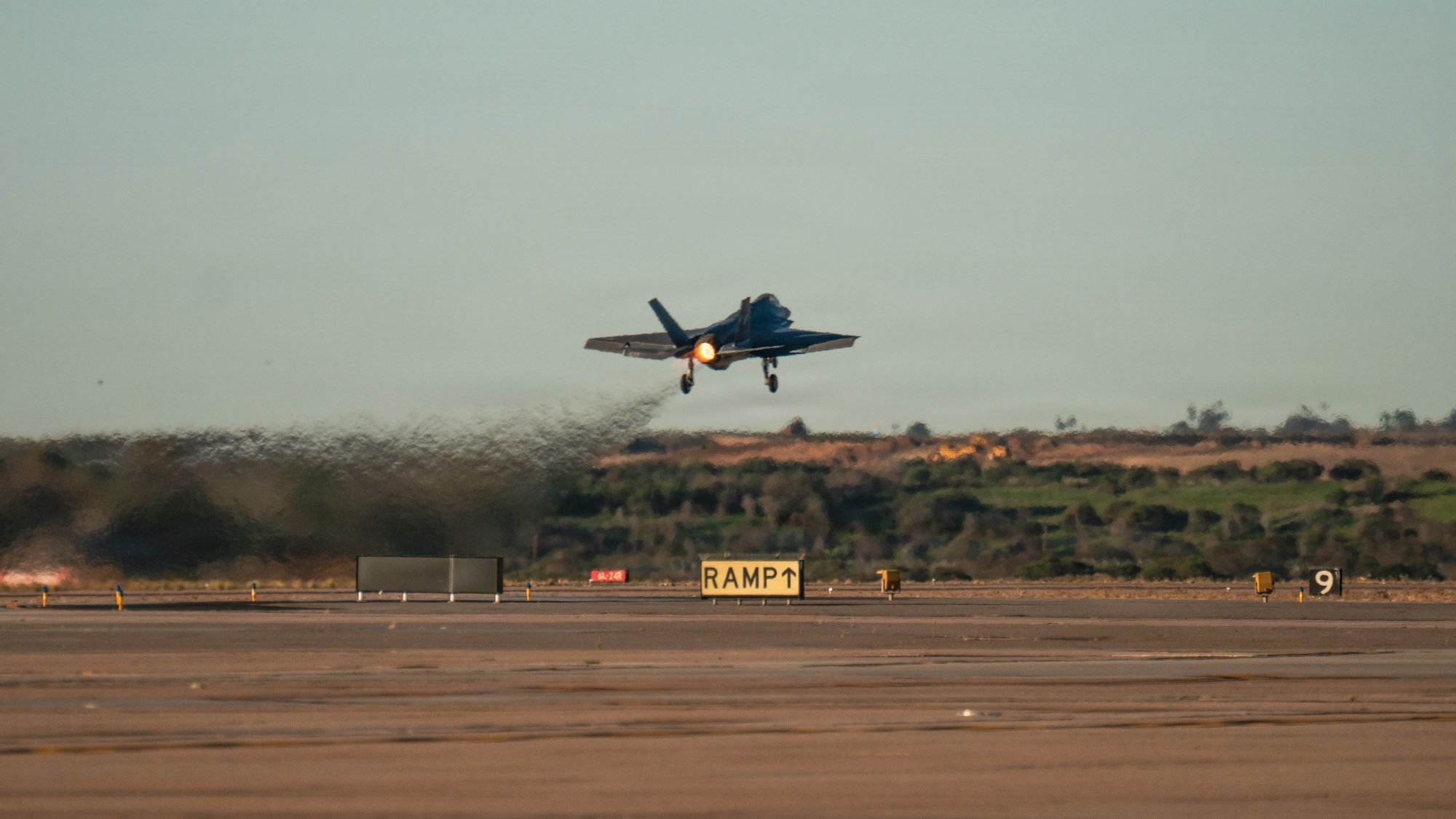
Victorville also saw the Marine Aerial Refueler Transport Squadron (VMGR) 352 employing a KC-130J Super Hercules to provide an ADGR node on Dec. 12. The ADGR supported multiple F-35Bs from VMFA 214, allowing the STOVL jet to operate from “separate bases and sustain at a forward location […] remaining engaged deeper into the battlespace.”
Because of this, the jets had “extended time on station, increased range, and follow-on missions without returning to a main operating base.” The two-point ADGR from the KC-130J sent up the F-35s within 40 minutes of landing.
In total, the F-35Bs received over 8,000 pounds of fuel, nearly 60% of its internal fuel capacity. The F-35B can carry approximately 13,000 pounds of fuel internally, and has a combat radius of 505 nautical miles.
The Corps called this dispersed hub-and-spoke concept as Distributed Aviation Operations (DAO).
A 305th Rescue Squadron HH-60W Jolly Green II receives fuel from a 39th RQS HC-130J Combat King II aircraft during a helicopter air-to-air refueling off the coast of California during Exercise Steel Knight 25 … https://t.co/SmR1CMRhcD #AirForce
— DVIDSHub (@DVIDSHub) December 13, 2025
CAS and JAGM fire from AH-1Z Viper
The Marine Light Attack Helicopter Squadron (HMLA) 267, part of 3rd MAW’s MAG 39, Viper fired an AGM-179 Joint Air-to-Ground Missile (JAGM) on Dec. 11 while flying the AH-1Z in a “sea-denial mission” over Californian waters. Two Vipers are seen flying with at least one JAGM each, and accompanied by an UH-1Y Venom.
The JAGM can better target “higher-level threats as adversaries develop more countermeasures, allowing us to […] achieve effects on the first attempt,” said Capt. Austin White, an AH-1Z Viper pilot and future operations officer with HMLA-267. The JAGM replaces the legacy Hellfire seeker with a dual-mode guidance system, allowing it to “defeat countermeasures and engage targets that would otherwise be inaccessible in contested environments. It gives Marines the ability to deliver precise effects at range while remaining mobile and survivable in a maritime environment.”

Marine Light Attack Helicopter Squadron (HMLA) 267 and HMLA-367 also “delivered continuous close air support […] across a geographically dispersed battlespace.” From Camp Pendleton to San Clemente Island and Twentynine Palms, AH-1Z Vipers and UH-1Y Venoms provided CAS to the 1st Marine Division and joint force assets on “locate, fix, and destroy” missions enabled by joint terminal attack controllers (JTACs).
A U.S. Marine Corps AH-1Z Viper fired an AGM-179 Joint Air-to-Ground Missile during Exercise Steel Knight 25 over the Pacific on December 11. The event highlights how Marine attack aviation is adapting precision strike capabilities for maritime-focused, distributed operations. pic.twitter.com/95RbqcBT7h
— Valhalla (@ELMObrokenWings) December 13, 2025
“Marines refined their ability to coordinate airspace, deconflict fires, maintain a common operational picture [through] multi-domain operations [while] identifying targets at the tactical edge, pass targeting data beyond line of sight, and integrate with higher headquarters and shooters to close the kill chain,” explained the service.
IMAGE 6: USMC AH-1Z Vipers with HMLA 267 are staged for preflight checks for a Close Air Support mission during Steel Knight 25 at Marine Corps Air Station Camp Pendleton, California, Dec. 4, 2025. (Image credit: USMC/Sgt. Brian A. Stippey)
“The exercise emphasizes future fight conditions” for Marines to conduct the same operations from dispersed maritime and littoral positions. More complex CAS scenarios saw “kill-web targeting, and sustained pressure against simulated maritime threats.” This brings into focus the Viper’s and Marine MQ-9 Reaper’s role with the Red and Green Wolf launched effects and podded electromagnetic spectrum capabilities in the western Pacific.
