

308-Wheel ‘Mahabali’ Truck: Six Months, Guzzled ₹2 Crore Diesel and Still on the Way – Indian PSU

As the old saying goes – Look Before You Leap, in this case it could be – Think Before You Hit the Road.
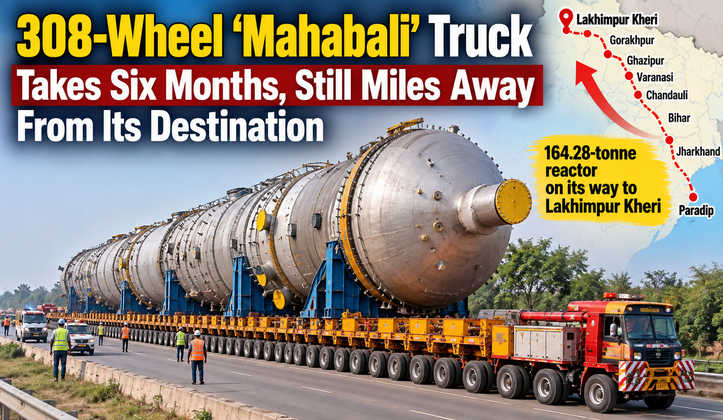
Moving a 164-tonne reactor from Paradip to Lakhimpur Kheri was never going to be a Sunday drive. But six months, 308 wheels and around ₹2 crore worth of diesel later, the ‘Mahabali’ is still making its way to its destination.
There are trucks, there are heavy-haul trucks—and then there is the 308-wheel ‘Mahabali’.
The gigantic transporter is carrying a 164.28-tonne reactor, measuring approximately 41 metres in length, from Paradip in Odisha to Kumbhi in Uttar Pradesh, where Balrampur Chini Mills is developing a biopolymer plant.
The reactor was manufactured in Belgium and shipped to Paradip Port. From there, the most challenging part of the journey began—a painstaking road movement across several states and some of the most demanding stretches imaginable for an oversized load.
The operation is being handled by J.M. Baxi Heavy, using specialised heavy-haul equipment. The transporter originally comprised 308 wheels, with hydraulic systems designed to distribute the enormous load and allow the massive structure to negotiate turns and uneven surfaces.
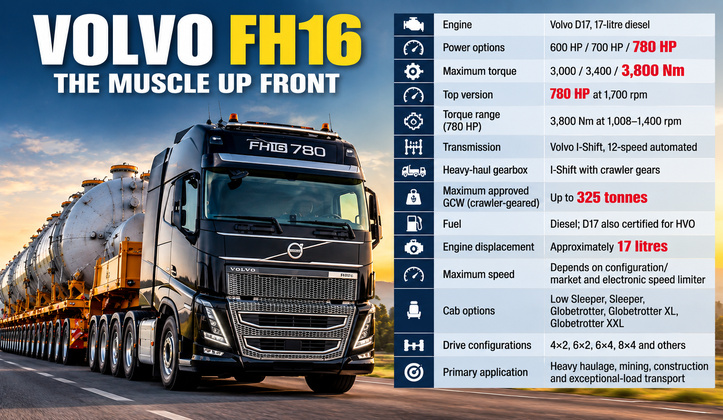
At the front is the Volvo FH16, a heavyweight prime mover designed for demanding applications. Volvo’s D17 engine is available in configurations of up to 780 HP and 3,800 Nm of torque.
That sounds like more than enough muscle. Until one remembers what is sitting behind it.
A Journey Measured in Kilometres, Not Hours
The Mahabali has reportedly covered around 1,000 km by road, but its progress has been painfully slow, averaging roughly 10–20 km a day depending on the route.
The reason is simple: this is not a vehicle that can simply follow a navigation app and keep going.
Every bridge, sharp turn, overhead cable, roadside structure, road width and clearance becomes part of the journey plan. Sections of the route have had to be examined and, in some cases, modified to allow the convoy through.
For most motorists, a narrow road means slowing down.
For the Mahabali, the road itself sometimes has to make room.
When Infrastructure Has to Adjust
The scale of the equipment became particularly evident in Chandauli, where the existing route reportedly did not provide adequate clearance for the transporter.
An alternative passage had to be prepared, with heavy machinery deployed to make the route usable.
It is one thing to transport an oversized machine.
It is quite another when the machine effectively requires a temporary infrastructure project to pass through.
For an ordinary truck, a roadblock means waiting.
For the Mahabali, a roadblock can mean rebuilding the road around it.
A Mobile Engineering Operation
The 308 wheels are only one part of the story.
The heavy-haul arrangement involves hydraulic axle modules, power units, prime movers, steering and sophisticated control systems. J.M. Baxi Heavy’s fleet information lists 308 SPMT/SPT units, 366 hydraulic axles and 31 prime movers.
The operation also requires a large technical and support team to survey routes, manage the equipment and deal with obstacles along the way.
Calling it a truck journey therefore seems somewhat inadequate.
It is closer to an engineering operation that happens to be travelling on wheels.
The ₹2-Crore Question
Then comes the fuel bill.
According to Dainik Jagran, the operation has already consumed approximately ₹2 crore worth of diesel.
That figure puts the leisurely pace of the journey into a different perspective. The reactor may be moving at only a fraction of normal highway speeds, but the expenses certainly are not travelling slowly.
And the journey is not over yet.
The final bill, once the reactor reaches Kumbhi, could therefore be one of the most interesting numbers to emerge from this extraordinary transportation exercise.
The Muscle Up Front
The Volvo FH16 deserves attention in its own right.
The latest D17 platform offers 600 HP, 700 HP and 780 HP variants, with the top version delivering up to 3,800 Nm of torque. Its heavy-haul configuration can also be equipped with crawler gears for exceptionally demanding applications.
But horsepower alone cannot solve every transportation problem.
The FH16 may have the muscle to move the load. It cannot widen a bridge, raise an overhead cable or straighten a sharp bend.
The engine provides the power. The route dictates the pace.
The Final Destination
The reactor is ultimately headed for the biopolymer plant at Kumbhi in Lakhimpur Kheri, being developed by Balrampur Chini Mills.
The remaining route is expected to take the convoy through parts of eastern Uttar Pradesh, including Ghazipur and Gorakhpur, before the final approach towards Lakhimpur Kheri.
After six months on the road, however, nobody would blame the Mahabali for taking its own sweet time.
It has already crossed state borders, negotiated difficult stretches and consumed a diesel bill large enough to make even the fuel gauge nervous.
For the moment, the giant keeps rolling—one carefully planned kilometre at a time.
And perhaps that is the real lesson from the Mahabali: when the load is this big, speed is no longer the objective. Getting there is.
This raises some pertinent questions -
- Whether such a huge vehicle is fit for Indian Roads?
- Whether the Logistics Team did not plan the route well?
- And, once the equipment reaches its final destination, how much will be the total transportation cost incurred?
