


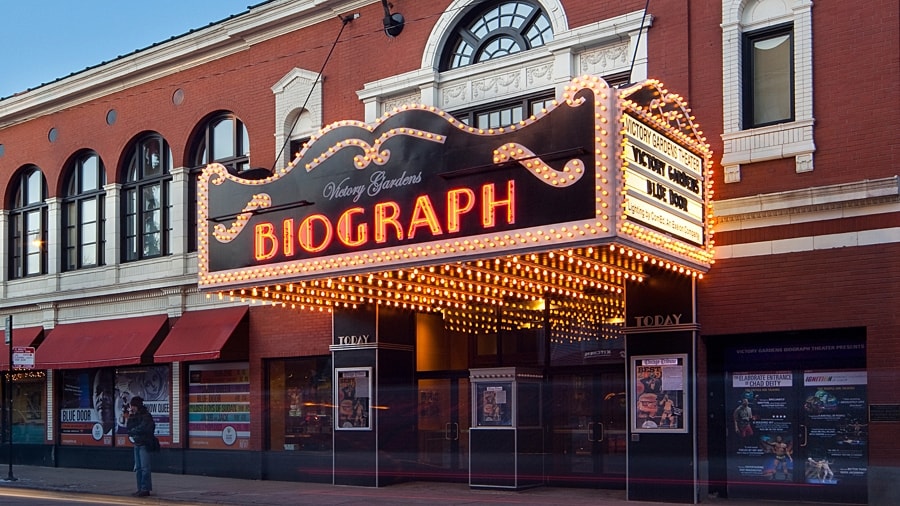
Victory Gardens’ current leaders didn’t experience this tense period firsthand. Torres’s career had taken him to New York after Chad Deity’s 2009 premiere, and he only returned to Chicago about three years ago, around the same time Vaidya moved to the city. Both acknowledge the delicacy of the situation they’ve stepped into.
“I understand why the community rejected VGT,” said Torres. “So how can we come back to the middle, maybe heal a little bit, and see how we could push it a little bit further?” He said he aims to “never forget the past, but also learn from it, use that to guide the new direction of this theatre.”
Along with new leadership, the company has a revised mission statement: “New work. Boldly.” Of course, Victory Gardens has always produced new work, and Torres noted that the current mission likely will be refined further in the future. “If I could pick up where they left off, it’d be great, but that’s not possible,” he conceded. “There are people who are not here anymore. There are people who have left the theatre, whether in good graces or not. I think it’s a rebirth of the idea of what new work should be today.”
When Torres directed Henry Johnson in the spring of 2025, some members of the local theatre community questioned the choice to program a play by Mamet, who is outspokenly right-wing. Torres, who previously spent two decades working as a criminal defense investigator in Chicago, said he was more interested in the play’s subject matter, which deals with incarceration, than in its writer’s politics. However, he acknowledged the resistance to Mamet, as well as the negative feelings that may linger about Victory Gardens.
“I understand when people protest and why they protest—I totally understand that,” said Torres. “And if you feel that you have been wronged or are being wronged, then you should…I would never want to try to shut somebody down from that point of view.”
Regarding the company’s structure moving forward, Torres said he has no plans to reestablish the Playwrights Ensemble at this point.
“I think that was a good model, and it worked back then, for a different time, both socially and politically,” he said. “I think what we want to do is not just limit it to an ensemble of writers, but to open it up to other writers in the country. That doesn’t mean that that idea won’t come back later. It just means that for now, we’re going to try and open it up to the rest of the country in terms of new-play development, and try to shepherd in, or foster, or incubate writers from everywhere.”
Though Victory Gardens is not yet in a position to announce a full season, the goal is to produce two plays, one this fall and another in early spring 2027. In the meantime, Torres and Vaidya plan to continue hosting community-oriented events, such as the recent benefit reading of An Ocean Away, and reconnect with local partners such as DePaul University.
In the near term, rebuilding the board and donor base are key priorities. While the current board list didn’t appear on the company’s revamped website as of the time of publication, Vaidya said there are seven members. This is a significant reduction from the 20 board members listed on the 990 for fiscal year 2022, the last time Victory Gardens produced a season. The following years show a steady decline with no replacements; of the board members listed on the 990 for fiscal year 2024, the latest that’s publicly available, none were new appointees. Explained Torres, “There’s a small handful that are trying to reignite the board in a way where we bring in new blood, new energy, and a different perspective on things.”
Financially, Victory Gardens reported negative net income in fiscal years 2021 through 2024, with net assets totaling $7.2 million as of June 2024. The company’s finances recently garnered fresh attention due to the March 21 publication on Facebook of an open letter by the ensemble of Congo Square Theatre Company. A Black theatre founded in 1999, Congo Square has faced its own board-ensemble tensions, culminating in the company’s dissolution in July 2025 and ongoing civil litigation. According to the open letter, Congo Square held approximately $800,000 in funds at the time of its dissolution, and while most of this amount was redistributed to funders, $240,000 was allegedly given to Victory Gardens.
Torres could not elaborate on the details of this purported transaction, which predated his time as interim artistic director. Similarly, Vaidya had not yet taken over the role of financial signatory from the previous interim executive director at the time, though her understanding is that the funds were a donation received by Victory Gardens. Attempts to reach the Victory Gardens board for comment were unsuccessful.
Given the company’s complicated history, Torres and Vaidya recognize that the path forward won’t be easy, but they remain optimistic about the future of Victory Gardens. Torres outlined his ideal vision: “To have healed from the past; to have both these theatres fully engaged and operational, both in collaborations, not just with our own selves, but with the community, too; and to engage and bring other theatre companies in here as well that could also facilitate the idea of bold new work.”
Torres said he has received several messages of support and no negative responses since the announcement of his appointment as interim artistic director. “I feel like maybe the community could be open to give this another chance,” he said. Vaidya concurred, noting that although there’s a long way to go, “With the help of the community, it will happen.”
Emily McClanathan is a Chicago-based writer whose work has appeared in the Chicago Tribune, Chicago magazine, Chicago Reader, Playbill, INTO, and more. She is a 2020 National Critics Institute Fellow.
