


A diagnosis of our stale culture sounds very familiar.
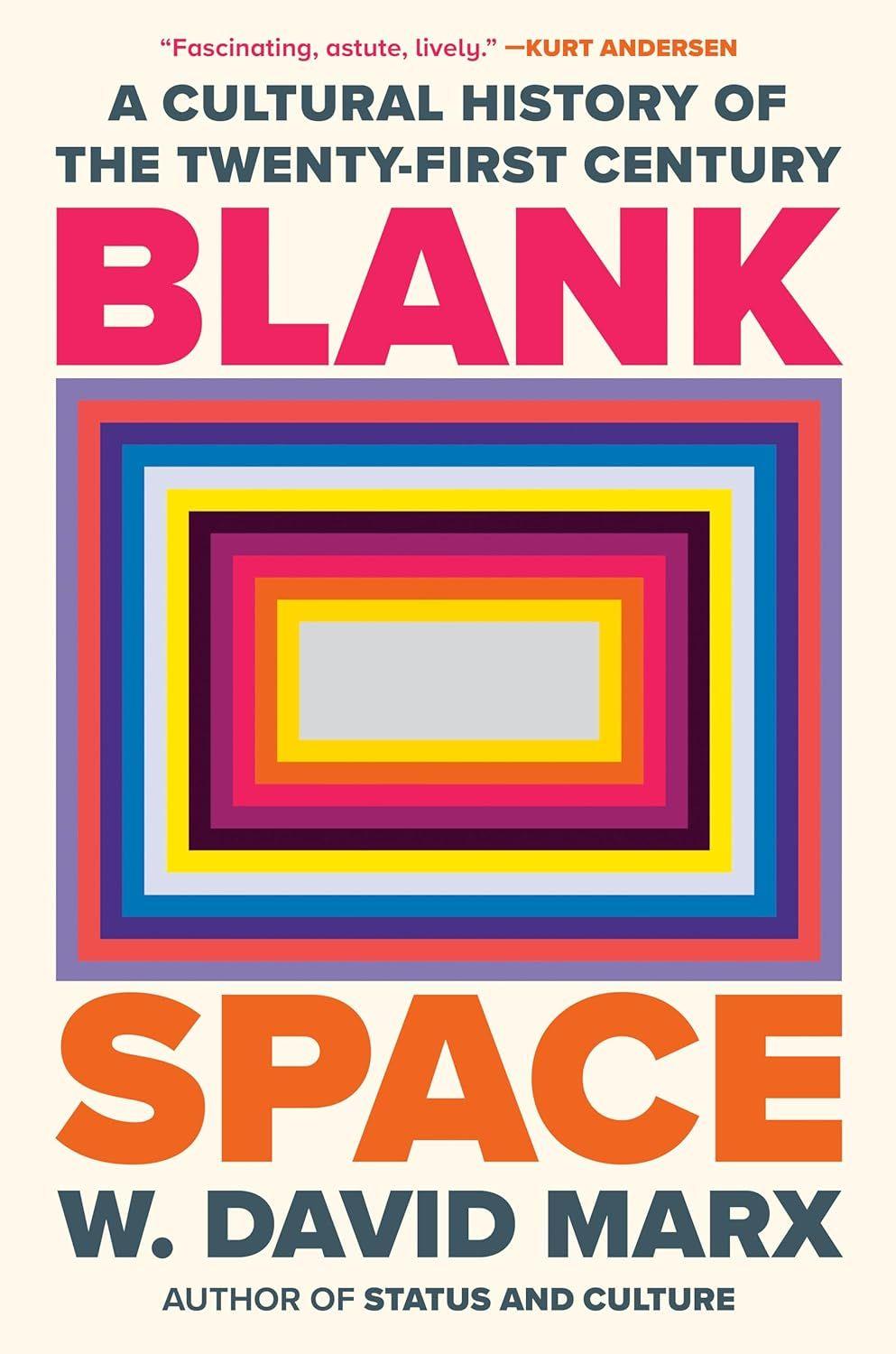
Blank Space: A Cultural History of the Twenty-First Century by W. David Marx. Viking, 2025. 384 pages.
Did you know LARB is a reader-supported nonprofit?
LARB publishes daily without a paywall as part of our mission to make rigorous, incisive, and engaging writing on every aspect of literature, culture, and the arts freely accessible to the public. Help us continue this work with your tax-deductible donation today!
IS THE PURPOSE of culture to revolutionize itself? To upend and render outmoded the paradigms of previous generations? According to W. David Marx’s Blank Space: A Cultural History of the Twenty-First Century (2025), this is the baseline criterion by which the cultural products of the last quarter century should be judged, and are accordingly found wanting.
In Marx’s view, the 20th century saw a “profundity of cultural invention” that “forged new ideas, beliefs, [and] styles” and “subverted mainstream norms” while, in sharp contrast, the current moment is stagnant and monolithic, contributing to “the widespread feeling of cultural malaise.” Marx doesn’t lay the blame on algorithms and social media, but rather with the forces of neoliberalism (a term left largely undefined and unperiodized), which have “quietly shaped the incentive structures” that guide our taste and behavior. Accompanying a turn toward extreme profit as the ultimate human ideal, he argues, was the rise of ideologies that rejected cultural hierarchy as elitist gatekeeping, such as the “poptimism” of the early aughts, which regards popularity as the ultimate “arbiter of quality.” Shameless spectacle and commercial savvy came to be lauded as democratic tools and vehicles for social justice that then became as important as creativity and talent, if not more important. As he sees it, evidence of this shift can be found everywhere from the Kardashians to Lady Gaga to the January 6 insurrection.
Marx’s corresponding claim is that the 21st century saw culture become a key tool of politics on both the left and the right. The former, he argues, abandoned the principle that art should be inventive and resist convention, and instead adopted consumerism and ironic detachment, as illustrated by the hipsterdom of the aughts. Under the guise of irony, unsavory opinions flourished, opening the door for the Far Right to take up the mantle of cultural transgression (e.g., MAGA, 4chan, Nick Fuentes), which it exploited without any genuine interest in artistic innovation. The 2016 election wasn’t a class war so much as a culture war, Marx argues, in which Donald Trump’s most devoted followers were “heartland business owners,” disgruntled that their economic success hadn’t translated into “higher cultural standing.” MAGA, which was originally fringe, swallowed the Republican Party to become its dominant contingent, with rapper Ye, formerly known as Kanye West, eventually joining its ranks.
Blank Space (both a reference to the Taylor Swift song and a comment on the lack of invention today), upholds the 1990s as the last era in which “selling out” was seen as disreputable by artists, namely musicians such as Pearl Jam, who pushed back against their commercial success, a form of resistance that Marx attributes to their roots in the punk ethos of the 1970s and ’80s. But that period also saw the rise of neoliberalism, a fact that Marx ignores. Moreover, by the alternative-rock era of the nineties, postmodernism had already firmly taken hold, and with it, a popular rejection of a top-down model of culture and an embrace of relativism, multiculturalism, and pluralism—all qualities that Marx sees as defining the 21st century.
Might we also apply Marx’s argument that culture has become flat and repetitive to criticism? Capitalism—and then late capitalism, and then late, late capitalism—has been identified as the culprit for culture’s flattening for at least a century. Marx borrows heavily from Fredric Jameson’s account of postmodernism. In the 1980s, Jameson argued that the emergent “multinational capitalism” (globalization, financialization, and deindustrialization in the capitalist core) found expression in a series of forms, gestures, and attitudes he cataloged under the postmodern. Of particular importance for Jameson was pastiche, or “the random cannibalization of all the styles of the past” adopted by cultural producers who saw no path forward, nowhere left to turn, creating a “blank parody” of earlier idiosyncrasies and innovations—a “dead language” that had become the inescapable social code that we lived inside.
Marx’s stand-in for multinational capitalism is neoliberalism, which he loosely characterizes as a “hypercapitalist economic system” that guides culture and determines everything from what gets made to “how we feel about that process.” In place of pastiche, Marx discusses “fusion,” the merging of distinct styles and industries (e.g. trap music and country, streetwear and the visual arts) that enabled a “cultural omnivorism” that levels all styles, genres, and tastes. According to Marx’s narrative, where there were once myriad subcultures that fed and renewed the mainstream, there is now a “pluralistic monoculture” that we all live under. One way to think of Marx’s term “blank space” might be as a blank parody of Jameson’s “blank parody.”
In Marx’s discussion of omnivorous monoculture, it’s difficult to differentiate between mainstream appropriation of emerging styles, which he denigrates, and subcultures spurring change on a “macro level,” which he claims has become too infrequent this century. For instance, he identifies drag as one of the few 21st-century subcultures that has profoundly shaped the mainstream: The slang of Black and Latina drag queens has been incorporated into the common American vernacular (yas queen, mother, serving cunt, etc.). This crossover represented a cultural phenomenon that, according to Marx, “carried power because there were still stakes to the community’s transgression.” Gen Z, however, promotes itself as the most inclusive generation, so the stakes of adopting the drag community’s slang are arguably pretty low. It’s also not clear in Marx’s analysis how adopting slang is a demonstration of support that accomplishes material change and not an example of the dominant culture co-opting the language of a marginalized group. Similarly, he does not make a clear case for how the reality TV show RuPaul’s Drag Race (2009– ), which Marx cites as the cultural product to which drag’s mainstream influence can be traced, isn’t an example of the marketplace commodifying a subculture.
But in Marx’s estimation, Drag Race is to be lauded, as opposed to Lady Gaga, who “embraced the aesthetic of drag culture” but did so “without ever becoming a true conduit for radical ideas.” Implicit in this evaluation is the assumption that pop artists should be conduits for radicalism. But is that what artists, and culture at large, should be? Perhaps more to the point, has that ever been the case? The fact that a pop artist adopts an idea, style, or identity is likely proof that it has already been assimilated into the mainstream. Lady Gaga’s explicit embrace of LGBTQ+ communities in the aughts would be an example, but so would Madonna’s promotion of her sexuality in the eighties and nineties (which Marx sees as categorically different, more risqué). This would make Jameson’s point that culture is not a determining force so much as a symptom of material conditions. Jameson’s lack of moralizing on this point enables him to avoid what appears to be the conflict at the heart of Marx’s argument: culture in the 21st century has been simultaneously too political (preoccupied with social justice on the left and anti-liberal or traditionalist reaction on the right) and not political enough (because there was no “revolution” in which outsiders were able to “seize control of the establishment”). But as Marx himself points out, in many ways, a version of that revolution did occur in the form of MAGA. The problem is that it’s a political ideology that doesn’t support the right kind of cultural innovation, and he therefore refuses to identify it as true innovation.
In addition to drag, one of the other few 21st-century subcultures Marx identifies as being culturally inventive and having a significant impact on the mainstream is Chicago drill. Other than mentioning drill’s influence, however, he doesn’t provide any reading of how it has shaped culture, which is telling. Drill’s innovation is at least partly indebted to some of its practitioners committing real-life crimes, including murder, which they then chronicle in their songs, often shared through social media. Some critics of the genre argue that the recognition the songs receive online not only documents violence but also catalyzes it. At the very least, this would seem to complicate Marx’s argument that underground artists should generally be more esteemed by critics and other arbiters of tastes and that all cultural innovation is inherently good.
Marx’s argument is probably even more indebted to Mark Fisher’s 2009 book Capitalist Realism: Is There No Alternative? Fisher updates Jameson’s concept of postmodernism for a post–Cold War world: in the 21st century, there exists no real alternative to capitalism, which has so successfully co-opted every corner of culture that there is nothing left to appropriate. Fisher fully acknowledges that his contribution falls under the rubric of Jamesonian postmodernism, and one of his central claims is that there is “nothing new,” not even the feeling that there is nothing new. It’s worth noting that while Marx passingly remarks on Jameson and Fisher, he doesn’t significantly engage their work or acknowledge that his book rests on their shoulders. While he argues that today’s cultural producers aren’t offering anything new, his own argument might be best understood as a commercial-friendly repackaging of thinkers who came before him.
Mounting a resistance to capitalism’s incessant cannibalization of culture is possible in Fisher’s view, though it’s difficult for him to imagine what form it might take. He points out that resistance and critique fundamentally sustain capitalism, which will allow for temporary subversion in order to assimilate and contain that subversion. Fisher provides the example of Kurt Cobain, the lead singer of Nirvana, who he argues was haunted by being caught in this loop: any gesture of pushing back against the status quo was almost immediately commodified by the marketplace. After all, there is nothing MTV loves more than a “fuck you” to MTV. While this differs from Marx’s account, which sees nineties alt-rock as a last stand for authentic artistry, Blank Space is also a call to action, a plea to rise up against the capitalist forces that have deadened culture. Even though the deck is stacked against what he calls “pure art,” “that is no reason to surrender.” His pragmatic suggestions for cultural renewal, which make up the conclusion, are perhaps the book’s most valuable contribution because they push past diagnosing the problem to offer a vision for a different cultural ecosystem.
Marx advocates reestablishing social norms that aren’t determined by financial success and treating art as a public good. This would require artists to take risks and place value on nonmonetary rewards, along with critics recognizing and supporting these efforts as a way to sustain them. Within such an ecosystem, subcultures and countercultures could thrive while impacting mainstream tastes and art, which requires “a deep reservoir of creative ideas” to remain vibrant. For this to happen, Marx argues, smaller underground scenes need time to grow away from the marketplace—that is, not sell out—so the mainstream can’t immediately subsume them into its corporate maw. He also encourages artists to become so familiar with the cultural canon that it’s boring, “as boredom is one of the most reliable catalysts for innovation.” His last piece of advice to cultural producers is to stop relying so much on data and audience analytics to predict what people want in the immediate future (because, in the short term at least, people want what is most familiar) but instead to trust their own intuition to create art that has a lasting impact and expands perspectives.
One of the potential pitfalls for any aging critic is failing to register what’s new as, in fact, new. In his book, Marx recalls graduating from college in 2001 and moving to New York City shortly thereafter, meaning he came of age in the 1990s, under the sign of Kurt Cobain, at a moment when the disavowal of commercialism was a widespread ideal in the creative realm, and it’s telling that the 21st century, the inflection point that he locates for pure art turning to kitsch, coincides with his entry into adulthood.
Perhaps the most formative years in shaping one’s aesthetic tastes are adolescence, when young people craft identities separate from that of their guardians. Culture is something we experience as much in an emotional register as an intellectual one, and it’s difficult for any subsequent era to compete with the fervid vicissitudes of youth and the art one discovers to help orient them. Artists and art feel so novel when you’re young because to you, everything is. Does Marx’s book persuasively demonstrate a lack of invention in 21st-century culture or is it evidence of a different phenomenon: people’s tendency to lionize the art of their youth as transgressive and experimental at the expense of art made by the next generation, which they characterize as inauthentic and too commercial? “In my day, artists kept it real” is a sentiment that will never get old as long as there are critics getting older who can claim it.
LARB Contributor
Natasha O’Neill is on the staff at Vanity Fair. She holds a PhD in English with an emphasis on ethnic and minority American literature from UC Santa Barbara, where she taught in the English department.
Share
LARB Staff Recommendations
-
Robert N. Watson investigates Thomas Chatterton Williams’s “Summer of Our Discontent: The Age of Certainty and the Demise of Discourse.”
-
Arielle Gordon interviews Liz Pelly about her new book “Mood Machine” and Spotify’s impact on the music industry ecosystem.
