


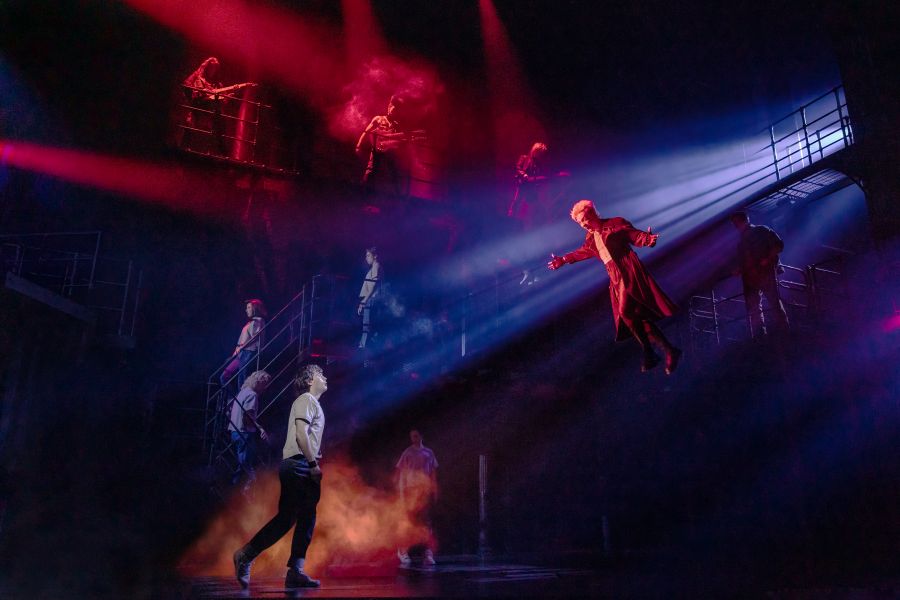
The 1980s promised us two divergent fantasies. One insisted that everybody wanted to rule the world; the other quietly suggested that sweet dreams were made of desire, ambition, consumption, and the frenetic search for something—or someone—to exploit. Beneath the synthesizers and shoulder pads, the decade throbbed with paranoia: Cold War dread, runaway capitalism, media saturation, urban decline, moral panic, and the creeping suspicion that institutions no longer knew how to support and make provisions for the people living and working inside them.
Perhaps that is why the zeitgeist suddenly finds itself bathed in neon once again. On Broadway, audiences have been invited back into the leather-clad, punk-rock-vampiric seductions of The Lost Boys, the tear-soaked “chick flick” melodrama of Beaches: A New Musical, the geopolitical romanticism of Chess, and the gleeful, transgressive camp of The Rocky Horror Show. Off-Broadway, the phenomenon is no less pronounced: The pitch-black high school survivalism of Heathers: The Musical continues its reign of candy-colored nihilism at New World Stages, while Little Shop of Horrors, still flourishing at the Westside Theatre, remains perhaps the definitive parable of Reagan-era aspiration gone carnivorous—a musical in which capitalism itself grows teeth.
Late 20th-century intellectual property has become one of the theatre’s preferred reservoirs of reinvention. Yet this resurgence suggests something deeper than nostalgia or an industry hedging its bets on recognizable brands. In revisiting stories from a decade that sold itself on glamour and abundance while its reality pulsed with cultural Balkanization, financial erosion, systemic disinvestment, and televised neurosis, the American theatre conjures a cultural imagination crowded with the outsiders, monsters, con artists, hungry things, and chosen kindred of the analog twilight—not to retreat into the past so much as to reflect the anxieties of the present.
No figure better embodies this strange afterlife of retro IP and radical reinvention than Andrew Lloyd Webber, currently experiencing a monumental third-act career renaissance by handing his most iconic scores over to directors intent on ripping them out of the museum. The transformation is on full view in Cats: The Jellicle Ball, the revelatory, runway-ready, ballroom-themed insurgency that premiered to ecstatic, twice-extended acclaim at the Perelman Performing Arts Center in 2024 before transferring to Broadway, where it’s turning the Broadhurst Theatre into a literal catwalk of queer sanctuary; transforming feline eccentricity into something spiritually resonant and startlingly urgent. Meanwhile, the crown jewel of Lloyd Webber’s oeuvre, The Phantom of the Opera—the maximalist mega-musical that shuttered after a record-breaking 35-year run in 2023—has returned as a multi-level, immersive interactive event (à la Sleep No More) with Masquerade, directed by Diane Paulus. The production sends audiences roaming through a four-story French Renaissance Revival-style landmarked building at 218 West 57th St. in Midtown, reconfiguring one of musical theatre’s defining spectacles for an era increasingly ravenous for intimacy, immersion, and experiential nostalgia.
This subversion of the Lloyd Webber catalog arguably began with Jamie Lloyd’s minimalist take on Sunset Blvd, which began in London in 2023 as a showcase for Nicole Scherzinger’s ferocious, ultimately Tony-winning turn as Norma Desmond. And the Lloyd/Lloyd Webber run continues with a highly anticipated 2027 Broadway transfer of Evita, starring superstar ingénue Rachel Zegler, who recently secured the Laurence Olivier Award for Best Actress in a Musical for her performance in London. Zegler’s impending arrival as Argentina’s ultimate political antihero, in a piece that debuted in 1978 but helped to dominate and define the 1980s, cements this theatrical moment: These artifacts of the Reagan era are not mere museum exhibit; they have become funhouse mirrors of a contemporary world defined by a profound cultural whiplash not unlike the collision of Reaganomics, the Cold War, and Wall Street greed that birthed the original material. And we live an era defined, after all, by a man whose tastes and values were formed in and by the 1980s; Trump has called Evita his favorite musical.
Wind Beneath My Wings
To fully understand the mechanics of this retro-fueled phenomenon, one must look beyond the stylistic overhauls of these mega-musicals and examine the specific, intimate refuges being built on our stages, in particular The Lost Boys, Beaches, and The Rocky Horror Show. In speaking with cast members and creative teams of these three pivotal productions of the 2025-26 Broadway season, they insisted that mining this archive is far from an act of escapism; rather, for them it has been a deliberate deployment of the coping strategies birthed in that pre-digital era, retooled to make sense of a world on the brink.
“I was pregnant in 1985, and that was right around the time that Rock Hudson died, and the AIDS crisis was something everyone feared and talked about and didn’t talk about,” said Iris Rainer Dart, author and playwright best known for the cult classic novel Beaches, which was adapted into an iconic film by director Garry Marshall and screenwriter Mary Agnes Donoghue, starring Bette Midler and Barbara Hershey, and then into the recent Broadway musical. “Several of my friends, we were in our early 40s at that point, and we had babies in unusual ways—through open adoption or surrogates—and one of my friends had a sperm donor who was her best gay male friend. We were fearing for the baby, fearing for the mother—so the idea of someone coming into your life and sacrificing everything to be there to take care of you was very important.”
By the time the film was released, in 1988, Dart noted, “The AIDS crisis was in full-blown consciousness,” which is why, she believes, Beaches’ theme of “chosen family…I can see why it would move the story into a lot of lives and make it important to a lot of people.”
An impulse toward self-preservation and the forging of chosen kinship against existential precarity may date to her roots: Dart’s mother emigrated from Ukraine and her father from Lithuania. Growing up as one of nine children, Dart says her earliest memories were underscored by the laughter of aunts gathered late into the night, coloring and setting one another’s hair—an intimate ritual of care and communion that shielded them from the brutalities of displacement and adaptation. That quiet but radical network of devotion has remained the beating heart of Beaches. Jennifer Maloney-Prezioso, producer of the musical, called it “a love story about friendship between women who define their lives on their own terms.” In “quietly and powerfully centering a relationship where the primary love story is not romantic” feels, to Maloney-Prezioso, “more necessary and in some ways, more radical.”
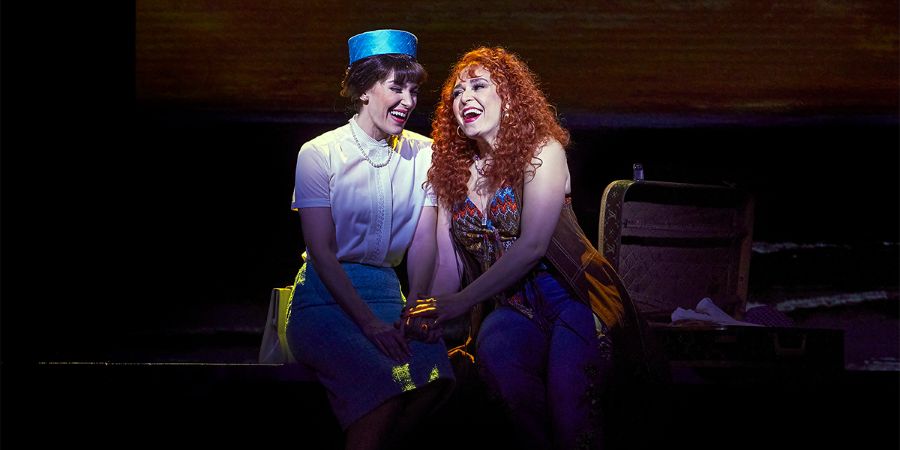
Beaches, ostensibly a story of female friendship, quietly exposes something American masculinity has long struggled to sanction: emotional dependence without humiliation. Its central relationship offers the kind of lifelong, sustaining intimacy many men are culturally discouraged from seeking outside romance, a reminder that friendship itself can be a life raft.
“My best girlfriends have been the people who have saved my life, really, truly,” said actress Kelli Barrett, who played the role of Bertie White in Beaches on Broadway. “They’ve been my chosen family since I was very young, and I don’t know where I would be without them emotionally, physically, literally. The story I’m telling is to honor them…and the bonds between women and how deep they go.”
Barrett also connected the musical’s themes to a broader contemporary anxiety: the deepening crisis of male loneliness. “I have so much empathy for men,” she said, reflecting on the ways intimate friendships between men are often socialized out of existence. Recalling an observation from Jane Fonda, Barrett pointed to the different ways society often teaches men and women to connect. “Men bond over what they’re looking at in front of them: a sports game, a hot car, a beautiful woman,” she said. “Women bond over what’s happening inside of them. So, for men, it’s what’s externalized, and for women, it’s what’s internalized… I wish for men that same relationship, and I think if they had it, we wouldn’t be on a fucked-up planet.”
But the emotional patience of Beaches clearly sat uneasily within a Broadway economy increasingly driven by spectacle. The show ended its run at the Majestic Theatre on Sunday, May 24, playing just 28 previews and 38 regular performances after weathering soft ticket sales and critical headwinds; still, a national tour is planned for 2027. The show’s premature closing feels particularly painful when measured against the literal lifetimes anchored to its score. Dart, now 82, spent more than a decade developing the musical (her second Broadway credit, after 2011’s The People in the Picture,starring Donna Murphy), after surviving the 2015 passing of her book co-writer, Thom Thomas. Meanwhile, the musical’s legendary composer, Mike Stoller, navigated this volatile Broadway venture at 93, standing as perhaps the oldest living composer to debut a score on the Great White Way.
The commercial death of Beaches exposes the brutal gravity of modern Broadway, proving that these reconstructed communities are ultimately only as safe as the capital backing them. It also serves as a sharp reality check for this wave of nostalgia: The stage can freely conjure these defiant, neon-drenched outcasts of the pre-digital era, but the landlord still must be paid.
Lose Yourself, or Belong to Someone
If Beaches treated the terrifying arrival of a literal blood crisis as a gentle catalyst for matriarchal devotion, the era’s vampire lore approached that same late-’80s existential dread through the visceral vocabulary of horror. Tom Holland’s 1985 film Fright Night—a text widely dissected for its sharp contemporary HIV/AIDS allegories of hidden afflictions infiltrating suburban neighborhoods—was succeeded by the 1987 film The Lost Boys, which crystallized a cultural moment in which a single, intimate transgression or fluid exchange could permanently alter one’s biology, transforming healthy-looking young people into “silent carriers” of a hidden, fatal affliction. The film’s famous hedonistic tagline—“Sleep all day. Party all night. Never grow old. Never die.”—offered a bittersweet fantasy flipside to a tragic reality in which an entire generation was stopping aging permanently, cut short in their youth by disease. While Fright Night got a “love letter” homage in Michael Shoberg’s 2024 stage adaptation for interACT Theatre Productions at New Jersey’s Burgdorff Center for the Performing Arts, The Lost Boys has been turned into a lavish Broadway musical (its budget is around $25 million), and it’s leaning into its ’80s frame, even beginning the show with a televised speech by President Reagan. But in translating the film for the contemporary stage, the adaptation unearths timeless anxieties about contamination and family surveillance, transforming the classic vampire pack into a portrait of modern isolation.
The new show’s score is by an L.A.-based pop-rock indie trio, The Rescues (Kyler England, Adrianne “AG” Gonzalez, and Gabriel Mann). In a joint statement, they mused about the “curse of the vampire musical,” referring to the terrible box-office track record of showtune-slinging bloodsuckers. “We seem to have broken it,” they said, “but that’s in part because, while being a vampire musical on the face of it, our show is really about family and belonging.”
Not that they didn’t try to make it about vampires too. While director Michael Arden, who brought them on board, let them write a first draft without interference from producers, when they did finally get notes from Arden and the producers, they were told “the word ‘blood’ is off limits.” Never mind that they had literally written a song called “Ode To Blood,” which is “basically David expounding on his love for blood!” The Rescues, though, “quickly understood the importance of the note as a way to avoid the curse of the vampire musical. But it was a hilarious moment for us because we had gone all in with blood on that particular song.”
The Rescues spent five years writing 50 original songs (the book is by David Hornsby and Chris Hoch), of which 21 made it to opening night on Broadway. The show’s arduous 30-performance preview process in front of New York audiences saw the show slash 25 minutes, cut two songs, and insert one new one. The result has a remarkably cohesive theatrical language. The score’s mélange of alternative/indie rock, post-punk, dark pop power ballads, and sun-kissed New Wave sounds aligns more closely with the post-Larson pop-rock-flavored musical theatre sound of Jason Robert Brown or Duncan Sheik than with the cavernous, reverb-drenched gothic grandeur of Echo & the Bunnymen or the dance-rock snarl of Billy Idol. Yet this pop-theatrical framework never dilutes the story’s bite; instead, it provides the emotional clarity required to make the characters’ desperation feel devastatingly immediate.
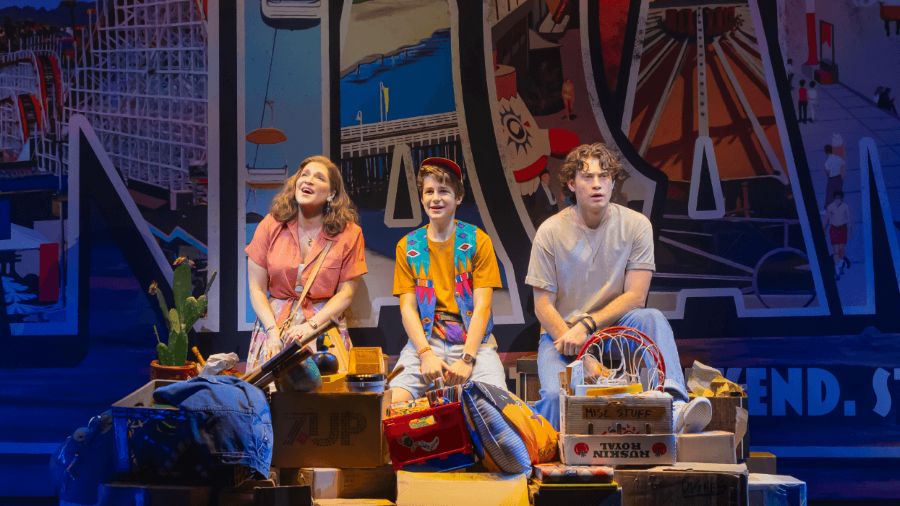
Benjamin Pajak, 15, plays Sam Emerson, the little brother who joins his fellow nerds in taking on the town’s vampires. Pajak said that executing the show’s delicate tonal tightrope requires treating the character’s comedic beats not as mere punchlines, but as a psychological defense mechanism.
“Sam uses humor almost like armor,” Pajak explained. “He’s constantly joking or reacting because if he slows down for even a second, he has to deal with the fact that his brother might actually be slipping away from him. What I love is that the comedy only really works if the fear underneath it is real. Sam isn’t performing comedy for the audience—he’s desperately trying to survive.”
The show’s balancing act isn’t just felt in the script’s tension between ’80s retro charm and modern edge; it is also anchored by the generational dynamics of the cast itself. Paul Alexander Nolan plays the role of Max, a businessman who owns a popular video store in the fictional beach town of Santa Carla, and who takes a romantic interest in Lucy, played by Shoshana Bean, in a Tony-nominated performance. Having adult anchors onstage provides a crucial thematic weight to an otherwise youth-driven horror narrative.
“I think marrying the youth with the mid-career and late-career artists is vital, and we don’t see it much in musical theatre,” observed Nolan, who continues his collaboration with Arden after starring in a Broadway revival of Parade and a production of My Fair Lady at Bay Street Theater. “Musical theatre is a bit ageist, and I really want to have roles as I age, so I hope that composers and writers keep writing mature stories as well as youthful ones for us to embody so I too can be mentored by those older artists whom I look up to.”
The structural dynamic between generations becomes particularly urgent given the cultural crisis the show’s younger characters find themselves navigating on the streets of Santa Carla.
“There is an increasing sense of individualism that has plagued our society a bit too much in the last five years,” said rising star Ali Louis Bourzgui, who plays David, the peroxide blonde leader of the town’s vampire pack. “While being unique and true to yourself is important, I believe humanity is nothing without community. I think people feel really lonely and isolated these days, and most people my age have very intense social anxiety because of social media and phone culture. I think our show is actively telling the story of finding a family and a community that you can share life with.”
Bourzgui’s performance is a collage of influences, taking inspiration from Billy Idol and Kiefer Sutherland, rock star icons David Bowie and Scott Weiland, and idiosyncratic sex symbols Tim Curry and Jeff Goldblum. Earning a Tony nomination in the Best Featured Actor in a Musical category for his performance as David—a seductively sinister bloodsucker with a baritone purr quietly draining the life out of Santa Carla—he plays the character with an acute, chilling clarity that vampires are hunger incarnate.
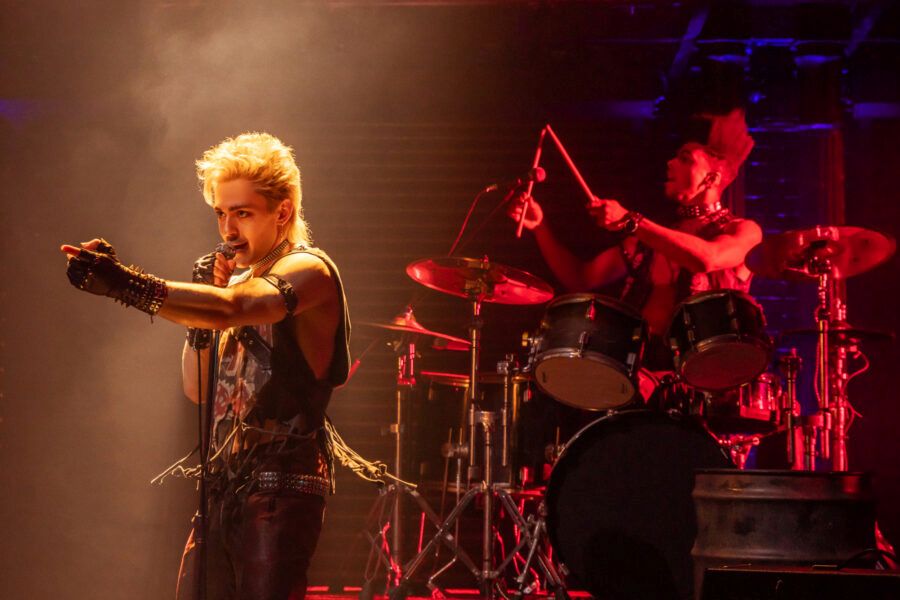
“At the core of it is a misinterpretation of what love is,” explained Maria Wirries, who plays Star, a tormented half-vampire rock goddess and the love interest of teen lead Michael. “I think on David’s side, he mistakes love for control. On Star’s side, she mistakes love for indebtedness. Over time, she begins to resent the cruel existence he has created for her, and what was inherently a selfish act on David’s part.”
The blurred line between magnetism and manipulation extends directly to the boys David ensnares.
“I’ve always imagined David as the older brother I never had,” said LJ Benet, who plays Michael Emerson, a role made famous by Jason Patric in the film version. “But also, David feels like a version of myself that I so desperately want to become. They say never meet your heroes, and I think that perfectly describes Michael and David’s relationship.”
This shared backstage preoccupation makes perfect cultural sense. The 1980s were a decade obsessed with hardness: hard bodies, hard ambition, hard emotional limits. It aggressively sold an archetype of manhood built on rigid self-reliance, corporate dominance, emotional stoicism, and physical invulnerability. That several of the season’s most prominent revivals originate in the 1980s—a decade that aggressively policed masculine performance—feels less incidental than revealing. At a moment when researchers warn of a deepening loneliness crisis among men, particularly younger men, several of this season’s most familiar titles carry unexpectedly contemporary questions about intimacy, belonging, and the delicate mechanics of connection.
By anchoring David in this primal, bottomless void, Bourzgui brilliantly threads some of the show’s darkest contemporary themes, mapping the charismatic cult leader’s predatory recruitment directly onto the toxic undercurrents of the modern manosphere and the compounding isolation of the male loneliness epidemic. Beneath the cult-horror surface of The Lost Boys is the story of displaced, emotionally vulnerable boys searching for fraternity, only to discover that companionship can arrive with a cost. Michael is not seduced by evil so much as by companionship; the leather-clad, predatory vampire pack offers what loneliness so often renders irresistible: identity, status, and the promise of never feeling abandoned again. Even the title lands differently now—not bad boys, but lost ones. Seen today, the vampire pack resembles an eerie precursor to the modern manosphere: a hyper-masculine fraternity promising belonging to the isolated at the cost of empathy, vulnerability, and, eventually, humanity.
It is a cultural deficiency recognized across the theatrical landscape this season, observed even by those playing the objects of that toxic, externalized desire. “I feel as though we rarely get to witness the innocence and playful nature of young men, who are repeatedly told by society that male closeness and sensitivity are wrong or taboo,” Wirries noted. “I hope this moment, which a live theatre audience gets to be a part of every night, creates more space for that exploration to exist and inspires young men to reach out to one another and build brotherhood that goes beyond societal expectations.”
This urgent reclamation of boyhood vulnerability finds its electric, high-adrenaline peak in Sam’s definitive second-act solo. For Pajak, the emotional climax of the production isn’t in the spectacular stage blood or the vertigo-inducing aerial wirework, but in the moment young boy learns to weaponize his own inner life to conquer his terror, offering a blueprint for empowerment that rejects the toxic invulnerability of the vampire pack.
“No question, it’s ‘Superpower,’” Pajak says of the sequence that leaves him completely spent onstage. “That’s where Sam finds his strength, his courage, his identity. I love that Sam uses something that means the world to him—his imagination and his comic book world—as a vehicle to find identity. What kid wouldn’t want to tell or be a part of that story?”
Don’t Dream It, Be It
If The Lost Boys transforms the subcultural spaces of the 1980s into a warning track for predatory radicalization, director Sam Pinkleton’s high-octane revival of The Rocky Horror Show unearths the decade’s ultimate counter-cultural sanctuary. Though Richard O’Brien’s glitter-rock musical debuted onstage in 1973 and on the screen in 1975, it was during the 1980s that the property underwent its most radical sociopolitical evolution. As the Reagan administration’s neoconservative wave and the escalating panic of the AIDS crisis aggressively policed bodily autonomy, Rocky Horror grew into an institutionalized suburban rite of passage. (The Rocky Horror Picture Show is the longest-running theatrical release in film history.) For Generation X, who were navigating a hyper-sanitized culture of corporate excess on the one hand and severe latchkey isolation on the other, the weekly midnight movie screenings, which started at New York City’s Waverly Theater in April 1976, and before long became a nationwide network of alternative community centers. In a decade when queer expression was heavily criminalized and stigmatized by the state, Rocky Horror served as a vital, self-governing bunker. It was a space where the isolated, the weird, the queer, and the repressed could step out of the stifling conformity of suburban malls and into a dark theatre to deploy shadow-casting and trash-glamour to survive a hostile cultural landscape. For an unsupervised generation craving visceral communion, shouting back at the screen wasn’t just a gimmick; it was a collective reclamation of agency—a transgressive laboratory for testing the boundaries of desire when the world outside treated intimacy as a death sentence.
Arriving more than two decades after its last Broadway revival, Pinkleton’s production honors that subcultural utility, converting the theatre into a living, breathing laboratory designed to disrupt modern isolation. By trading O’Brien’s classic synthesis of 1930s Universal horror tropes and 1950s Technicolor B-movie sci-fi for a chaotic, DIY aesthetic, this revival channels the LSD-infused theatrical genderfuckery that originally paved the way for the 1975 film. Pinkleton’s vision functions as a delirious callback to Charles Ludlam’s Theatre of the Ridiculous and the outrageous legacy of The Cockettes, the maximalist psychedelic theatre troupe of acid queens and thrift-store drag artists who defined San Francisco’s late-1960s Haight-Ashbury scene. Rather than leaning into the jukebox-adjacent pulse of sock-hop nostalgia, Pinkleton detonates the material into a carnival where the stifling, pristine innocence of Eisenhower-era Americana is shattered by a lawless, modern-day resurgence of pure queer-punk, gutter-glitz performance.
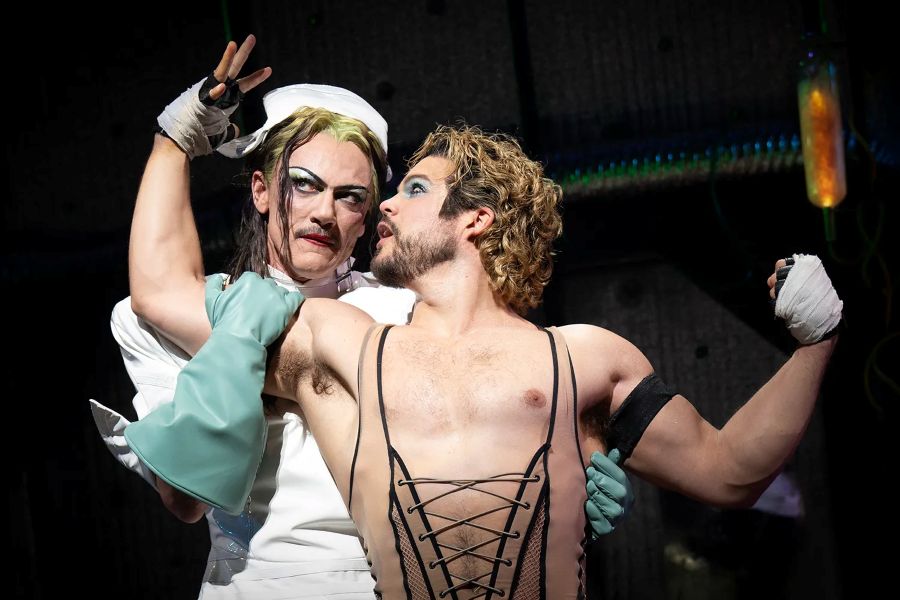
To achieve this, Pinkleton deliberately leans into the production’s inherent instability, calling Rocky Horror “one of our greatest myths of mess that we have.” This intentional embrace of chaos serves as a direct counterproposal to modern anxieties. Where contemporary manosphere culture prescribes hierarchy, emotional repression, and rigid gender performance, Rocky Horror imagines an entirely different blueprint: vulnerability through razzle-dazzle, belonging through difference, and liberation through the deterioration of the status quo.
Crucially, the show stages this transformation through Brad, the archetypal straight man whose stiffness is diagnostic of the pitfalls of conventional masculine performance. He arrives emotionally constipated: buttoned-up, self-conscious, and eager to preserve order even as desire and uncertainty press against him. Into that repression bursts Dr. Frank-N-Furter, a creature of pure, unadulterated id whose castle functions less as a physical place than as a destabilizing social experiment. In Frank’s orbit, vulnerability, erotic confusion, and emotional permeability cease to be humiliations. Instead, they become invitations into a collective, boundary-smashing world where isolation begins to dissolve only when the performance of traditional manhood does.
For Pinkleton, executing this experiment meant anchoring this collapse inside the visceral, historic reality of the performance venue itself.
“The serendipity of getting to do Rocky Horror at Studio 54 doesn’t really need explaining,” Pinkleton said of the one-time disco haven club that is now one of Roundabout Theatre Company’s two Broadway houses. “At every moment with my designers, we thought about how to make Studio 54 a pleasure center. Rocky Horror is a musical that knows the audience is there the whole time. That isn’t new—that’s Brecht—but I think the architecture of Studio 54, the legacy of Rocky Horror, and my own interest in just making things that remind us that we’re actually in the room together has made the thing porous in a really fun way.”
This porous, high-wire environment extends directly from the rehearsal room, where Pinkleton’s process privileges experimentation over precision, creating an atmosphere that mirrors the boundless freedom of a certain Oscar-winning multiverse sandbox.
“Something that feels really similar, in a weird way, to the process of making Everything Everywhere All at Once, and this is that Sam (and the Daniels) give their actors so much permission to play,” said Academy Award nominee Stephanie Hsu, who plays the show’s leading lady, Janet Weiss, a virginal, “All-American” good girl caught in a turbulent vortex of pansexuality, pleasure, and uninhibited desire. “That makes the Pandora’s box of possibility feel so limitless, because what you’re given is a lot of permission, and the core guidelines are shared, but that just makes mischief infinite.”
For Hsu, that mischief only succeeds because it is grounded in fierce emotional stakes. She recalls a piece of backstage wisdom passed down from show creator Richard O’Brien: “The actors need to play this as the most serious thing that’s ever been written.”
“I really love that, because there is, of course, the camp element and the satire,” Hsu shared. “But underneath it, all her desires are very real. If it was just fun and fluff, it would deplete itself and get boring. But because underneath it all her wants are so juicy—and every night she has to find a way to get it—it makes it sustainable to go on the journey eight times a week. We’re at the point in the run right now where it’s really starting to feel like ours—it’s starting to bloom open.”
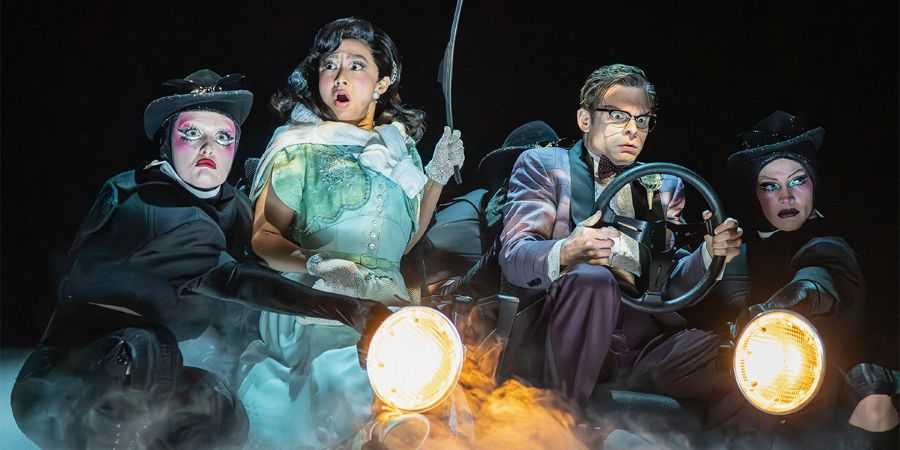
This sustainability hits at the core of the show’s enduring cultural rescue mission. “One of the wildest and most specific things to Rocky is the size of the umbrella that misfits have huddled under,” Pinkleton observed. “There are people who put on fishnets and go to Rocky and have had their lives saved by it, who would never go to a Pride parade. It actually treats everyone like a misfit. It assumes that no identity is a fixed point, which is radical. It is a piece of popular culture that has a countercultural agenda. It assumes the freak in everyone.”
For Hsu, a Los Angeles-born theatre kid raised by a Taiwanese single mother, stepping into an icon of Americana historically coded as white meant expanding who gets to exist within that countercultural legacy. In rehearsals, she dug through archival photos of Studio 54 and struggled to find faces that looked like hers, a realization that sent her searching for a deeper global lineage.
“The land of disco sort of led me to this world of Hong Kong disco that happened in the late ’70s,” she explained. “It was happening simultaneously as Studio 54, but in Asia, where Divine was actually one of the hosts for the grand opening. For me, every night, subliminally, just getting to be in that space and come out in a jockstrap at the end is a kind of reclamation of past, present, future, simply just by existing. Getting to exist inside that iconography feels like it’s taking up space and expanding my own lineage inside of queer culture.”
That reclamation directly fuels Janet’s evolving relationship to agency and desire, mutating a mid-century trope into a vehicle for modern bodily autonomy.
“The gift of getting to blow Janet up now into this 2026 version is like there is actually still so much more to go in her journey,” Hsu said. “Even from the version that existed in the ’70s—which is right around women’s lib as well—there’s still more that we’ve discovered in terms of agency and claiming our bodies, and that felt like a really exciting opportunity to bring forth this go-round.”
Working alongside Pinkleton, intimacy coordinator James, and the broader creative team, Hsu said the production ultimately pushed her to imagine sexuality itself as stranger, messier, and more expansive than contemporary language can often hold.
“What really broke open for me is starting to think of sexuality not as this thing that even exists in our contemporary minds, but that is—because they’re aliens—even beyond what we have the language for,” she continued. “So it’s not just like top/bottom, you know what I mean?” Hsu said with a laugh. “There’s way more that aliens do that we don’t have the language for. Thinking of her embodiment and her sexual embodiment is not as something that is conscious of the mind, but something that is actually quite animal and shameless.”
Dancing at the End of the World
What links these seemingly disparate revivals is not merely their shared status as recognizable intellectual property, but their common fixation on a distinctly modern ache: the search for connection in a culture increasingly organized around estrangement. Taken together, they suggest that today’s appetite for nostalgia may be less about revisiting the past than recovering forms of intimacy, community, and vulnerability that feel increasingly difficult to find in the present.
Viewed this way, the American theatre’s current obsession with late 20th-century intellectual property is not a white flag of creative bankruptcy, nor is it a simple corporate retreat into the financial safety of recognizable brands. Using the stage as a grand funhouse mirror where the anxieties of the past illuminate the cultural and political fragmentation of our present, artists are digging into the rubble of the 1980s because they recognize the topography of the ruins.
Whether Broadway’s current neon nostalgia boom can financially withstand the brutal, top-down gravity of commercial real estate remains an open question. But so long as the world outside the theatre doors remains hostile to the vulnerable, audiences will continue to seek out these collective spaces. We cross the threshold not to hide from the terrors of the present, but to learn how to lock hands, jump out of the plane, and dance at the end of the world.
Marcus Scott is an award-winning New York-based playwright, musical writer, and journalist. He’s written for Architectural Digest, Time Out New York, The Brooklyn Rail, Elle, Essence, Out, and Playbill, among other publications.
Source link
