


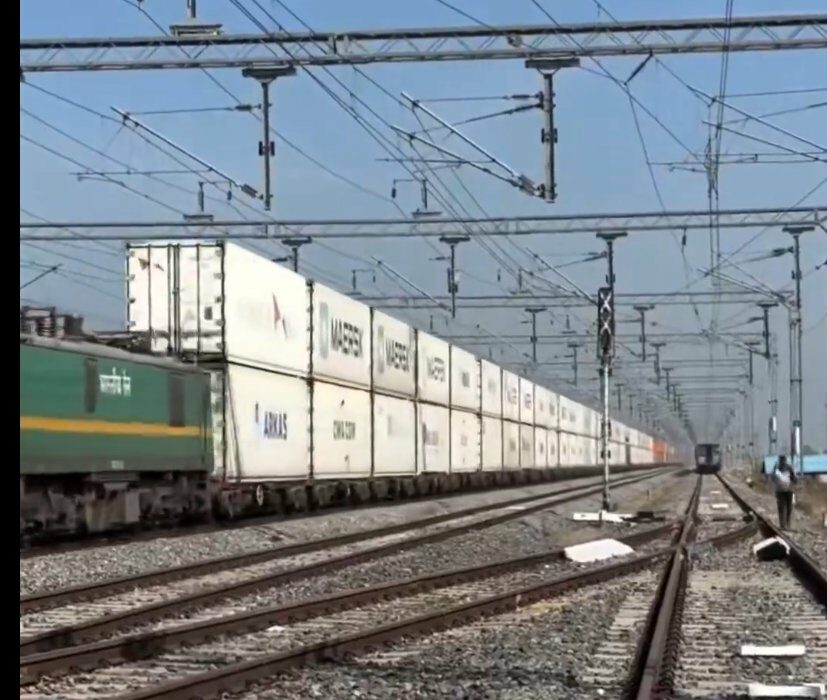
NEW DELHI : India continues to set new benchmarks in railway innovation and freight transportation, becoming the first and only country in the world to operate double-stack container trains hauled by electric locomotives under overhead electrification, a remarkable engineering achievement that has drawn global attention.
While countries such as the United States and China operate double-stack container trains, these services are largely powered by diesel locomotives or run on routes specifically designed without the constraints of overhead electric infrastructure. India has successfully overcome the complex challenge of combining double-stack container operations with fully electrified railway corridors, marking a significant milestone in the evolution of sustainable freight transportation.
The breakthrough has been achieved on the Western Dedicated Freight Corridor (WDFC), one of India’s most ambitious rail infrastructure projects, developed by Dedicated Freight Corridor Corporation of India Limited. To accommodate the exceptional height of double-stack container trains, engineers designed a unique High-Rise Overhead Equipment (OHE) system, with contact wires installed at approximately 7.45 metres, significantly higher than the conventional railway electrification standard.
Complementing this innovation are specially developed high-powered electric locomotives equipped with advanced high-reach pantographs, enabling uninterrupted power collection while hauling double-stack container trains at higher speeds and greater efficiency. These locomotives are capable of transporting substantially larger cargo volumes in a single trip, reducing logistics costs and improving operational productivity.
The Western Dedicated Freight Corridor, stretching from Dadri in Uttar Pradesh to Jawaharlal Nehru Port near Mumbai, has emerged as a game-changing logistics artery for the nation. The corridor enables seamless movement of containers between manufacturing hubs, industrial clusters, ports, and consumption centres, significantly reducing transit times while enhancing reliability.
The introduction of electric double-stack operations offers multiple advantages. By carrying nearly twice the container load of conventional freight trains, the system boosts network capacity, lowers fuel consumption, reduces carbon emissions, and supports India’s broader goals of sustainable and green transportation. The initiative also aligns with the Government of India’s vision of transforming the country into a global manufacturing and logistics hub under programmes such as PM Gati Shakti and Make in India.
Railway experts have hailed the achievement as one of the most significant freight transportation innovations in recent decades. The successful integration of heavy-haul freight, double-stack container technology, and electrified operations demonstrates India’s growing expertise in railway engineering and infrastructure development.
As freight volumes continue to rise and Dedicated Freight Corridors expand across the country, India’s pioneering model is expected to serve as a reference for railway systems worldwide, reinforcing the nation’s position at the forefront of modern rail logistics and sustainable transportation.
India’s electric double-stack container train operations stand today as a symbol of engineering excellence, technological innovation, and the country’s commitment to building a faster, greener, and more efficient logistics ecosystem.
