


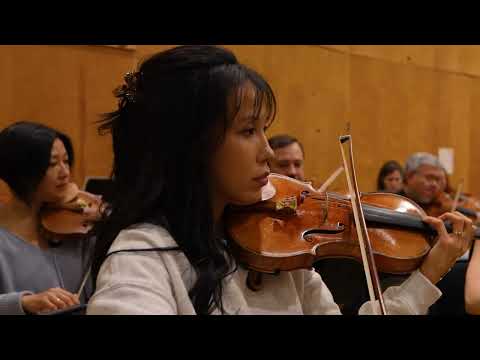
The Metropolitan Opera Orchestra going through the motions of Wagner’s “Liebestod” – “diminished motivation: as if the music fails to impel a commanding physical and emotional response.”
To access a pertinent podcast conversation between Joseph Horowitz and conductor Kenneth Woods, click here. To discover a final whiff of optimism, go to 1:00:53.
An accelerating hiatus between Europe and the United States, especially obvious to Americans (such as myself) recently abroad, touches on aspects of daily life, of governance, and – not least – of civilization.
For instance: though it’s not yet widely noticed (except privately), there’s a growing gap between the top European orchestras and the big-name American orchestras — and it’s symptomatic of bigger things. Perhaps this will prove a reckoning moment for classical music in the United States, documenting a cumulative failure to absorb the European parent culture and, moving on, to grow New World roots.
If so, it’s a failure that was long deferred and disguised by stellar immigrant conductors and instrumentalists — who today, however, are barely a memory. When I wrote Understanding Toscanini: How He Became an American Culture-God and Helped Created a New Audience for Old Music in 1987, it was pilloried for falsely forecasting a classical music crisis particular to the United States. My premise was that the high-pitched celebrity of an Italian symphonic conductor signified a “culture of performance” seduced by foreign glamour and sidelining the creative act. In today’s US, the Toscanini loyalists are by now long gone, music critics are gone, audiences are gone or newly clueless. Our composers increasingly confect makeshift music. I predicted it would happen – but never imagined it would transpire so quickly.
Back in 1927, Charles Edward Russell – a popular socialist writer – called America’s orchestras our “foremost cultural asset,” a “sign of honor among the nations.” It was a credible claim. The concert orchestra was largely a New World invention, versus pit orchestras abroad. And we had some great ones. Just listen to broadcasts of the symphony orchestras of Boston, New York, and Philadelphia, and of the Met orchestra, during the thirties and forties.
Curiously – revealingly – they’re a heterogeneous group. They don’t share a common “American” style. Serge Koussevitzky’s Boston Symphony boasted an exceptionally robust string choir. Many of those players, including the concertmaster, were Russian. The winds were French. Koussevitzky was himself a Russian string player (a double bass virtuoso) who arrived in the US by way of Paris. What did they sound like? Koussevitzky was a Tchaikovsky specialist. Try this torrid 1943 broadcast of Tchaikovsky’s Francesca da Rimini.
The New York Philharmonic was more Italianate, at least when Arturo Toscanini was on the podium. Its signature was a scorching combination of precision and song. Here is the overture to Rossini’s Semiramide.
Downtown at the Met, the orchestra was even more Italianate, with more Italian members (impossible to count because the Met’s archivists now store previously accessible records where they’re not “retrievable”). As I’ve often written, under Ettore Panizza’s baton this group was a powderkeg. Its whipsaw attacks, lean sonorities, and taut melodic filaments manifest a Verdi style. That in Wagner, under Artur Bodanzky, the same style proved unidiomatic but thrilling demonstrates how tradition deeply seated in performance can be liberating rather than confining. I once shared with my late friend Alexander Toradze Bodanzky’s January 30, 1937, Siegfried broadcast (the mightiest rendering of that opera that I know). We sampled the mountaintop passage leading to Brunnhilde’s awakening, then the beginning of the duet. Many treasure this performance because the singers are Kirsten Flagstad and Lauritz Melchior. Lexo’s incredulous response was: “What an orchestra!” And so it was.
(More than those of any American concert pianist I can think of, Lexo’s interpretations – of Ravel, of Prokofiev, of Shostakovich, of Stravinsky, of Rachmaninoff – were inflected by the rhythmic energies of American jazz, which he had zealously absorbed via the Voice of America “Jazz Hour.”)
Stokowski’s band in Philadelphia was sui generis. They emitted a sonic lava flow, sans subito dynamics. Even staccatos were viewed with suspicion. This is the orchestra Rachmaninoff called “the greatest the world has ever known.” My favorite Stokowski/Philadelphia performance is of Beethoven’s Fifth, as experimentally recorded (with remarkable dynamic range) by Bell Labs in 1931. The misterioso passages of the Andante, reconceived by Stokowski as an Adagio, attain an hypnotic poetic stasis. And listen to his cellos sigh the opening tune.
The only thing these four orchestras had in common was a caliber of engagement rarely encountered nowadays. The players were closer in time and disposition to the repertoire at hand. They “feel it.” Today, that link’s been severed.
Recently, I felt impelled to return to the most astonishing symphonic ensemble I ever encountered in live performance. This was Yevgeny Mravinsky’s Leningrad Philharmonic, on tour in the US (for the only time) in 1962. I was fourteen years old and listened in a state of shock. Thanks to the Iron Curtain, Mravinsky and his players inhabited a time warp. For half a century, beginning in 1938, his prerogatives were absolute. Rehearsals and performances observed a sacred calling. The lineage back to Tchaikovsky remained intact. For new music, they had Shostakovich’s symphonies. In Tchaikovsky’s Fifth (which I heard), the vibrating horns and piercing trumpets and (most of all) the bewitching string choir, with its vast range of nuance and dynamics, revealed to my ears the true sound of Tchaikovsky. And yet this specificity of style and sound was empowering, not constricting. You can now hear Mravinsky in a wide swath of repertoire, recorded in concert. His affinities are actually Germanic. His Beethoven and Bruckner seem to me incomparable. The trombone vibrato is an acquired taste.
American orchestras, in comparison, have never enjoyed a stylistic base linked to native repertoire because there is no adequate American canon. Might there have been? Two possible progenitors were our two supreme concert composers: Charles Ives and George Gershwin. But Ives exerted no influence during the decades he was composing, and Gershwin was sidelined as an interloper from the tainted precincts of Broadway and jazz – the very influences that might have fostered a distinctive New World swagger (at times detectable in various Leonard Bernstein interpretations).
I’ve often written that the biggest “what-iff” in the history of American classical music is: What if Gershwin had lived as long as Aaron Copland? Responding to my recent blogs, the composer David Chesky writes: “Gershwin reflected the syncopation, rhythm, optimism, and energy of American life. His orchestral work captured the sound of a nation coming into its own. Our cities pulse with jazz, hip-hop, Latin music, rock electronic music, and countless hybrid forms. If America is going to have a living classical tradition, it must absorb those rhythms and that vitality. . . . If American classical music had been allowed to develop naturally, it might have continue the lineage of Gershwin – with richer harmonies, greater complexity, and new orchestral colors.”
In retrospect, what’s “American” in common for Ives or Gershwin or Stokowski is a self-made insouciance, discarding or mangling Old World tradition. In my Classical Music in America: A History of Its Rise and Fall, I made the same claims for Jon Vickers and Glenn Gould – the signature North American opera singer and pianist, whose performances of Old World classics were never idiomatic. Of Vickers I wrote:
“The most original Met artist during the [Rudolf] Bing and [James] Levine years was the Canadian tenor Jon Vickers. In an era when other singers worked to recapture the fleeting essence of styles Italian, French, German, or Russian, Vickers eschewed every pretext of stylistic authenticity; like the great singers of the Met’s Golden Age and before, he was always the same. For Fernando De Lucia in the 1920s, performing “nun sei bedankt, mein lieber Schwan!” in Italian, Lohengrin was quite simply an Italian role, as enthrallingly and sinuously lyric as Puccini’s Rodolfo. As a Canadian, Vickers had no such recourse: like the comparable New World originals Stokowski, Gould, and the later Bernstein, he was sui generis, one of a kind. None of his signature roles – not Beethoven’s Florestan, sung in German; not Berlioz’s Enee, sing in French, not Leoncavallo’s Canio, sung in Italian, not Tchaikovsky’s Hermann, sung in Russian was idiomatic as he sang it. In fact, closer contact with a Giovanni Martinelli or Peter Pears could only have diluted his Otello or Peter Grimes – not because he was the greater artist, but because his artistry was whole, and wholly iconoclastic. One foundation for Vickers’ singular vocal personality is obvious: unlike most other North Americans of his generation, he had extensive experience singing . . . in his mother tongue. A specialist in outcasts – Tristan and Siegmund were also among his roles – he was himself an operatic pariah.” (I once attempted a pertinent phone conversation with Jon Vickers; it proved untenable.)
Back to orchestras – today’s best, many would say, is the Berlin Philharmonic. Two seasons ago, at Carnegie Hall, Kyrill Petrenko took them through Rachmaninoff’s The Isle of the Dead. The sustained fortissimo string tremolos crowning that performance were the most explosive I have ever heard. This past season, the Chicago Symphony came to Carnegie with Klaus Makela. The windswept landscape of “Lemminkainen in Tuonela,” the third of Sibelius’s four Lemminkainen Legends, is a cruel study in tremolo: you feel it or you don’t. What I think I observe among the young Chicago violinists – and those of the New York Philharmonic, of the Met orchestra, of the Boston Symphony — is diminished motivation: as if the music fails to impel a commanding physical and emotional response.
The Berlin players retain a dark sonic signature going back at least as far as their fabled decades under Wilhelm Furtwangler. To the south, the Vienna Philharmonic can still play a waltz, can still summon a special sweetness in Strauss (either one) and Mozart (I just heard them in their Staatsoper pit in The Magic Flute). And I recently encountered (at the Mahler festival in Steinbach) the Wiener Theatermusiker, whose mastery of the waltz idiom is enduringly divine.
Bettina Gradinger, who leads the Theatermusiker with deft virtuosity, is concertmistress of the Vienna Volksoper. How I wish I had heard her narrate the zany foibles of the composer’s wife when Chicago assayed Ein Heldenleben at Carnegie. The dour acrobatic violin solos of movement three (“The Hero’s Companion”) deserve to be as inimitable as Pauline Strauss herself. The Theatermusiker program I heard in Steinbach also organically incorporated some hilarious jazz riffs. (European classical musicians have long been more receptive to jazz – and, during the interwar decades, to George Gershwin — than the Americans. This is the “jazz threat” and “Gershwin threat” I discover in Classical Music in America.)
In correspondence with Tscho Theissing, the former Volksoper violinist who masterminds the Theatermusiker, I discovered kindred concerns about an emergent “international style” penalizing string players in particular. He writes: “Many young string players who enter Viennese orchestras have no or very little idea about our style, as it seems not to be taught at the universities (where of course there are many professors from all over the world), and there is a lack of conductors who are capable and/or willing to work on these topics – or they are willing but do not get the opportunity.”
I asked in a recent New York Times piece: “At 250, Has America Delivered on its Classical Music Promise?” When it was picked up by Norman Lebrecht’s slippedisc, the headline read: “Will America Have Orchestras in 2076?” Norman continued: “Classical music [in the US] is now in retreat on most fronts. Apart from raging Dudophilia in Los Angeles and New York, there are few manifestations of classical music as a limelight of American civilisation. Classical music has been eradicated from public education. Historic orchestras in Boston and Pittsburgh are playing half-empty. African-American musicians in orchestras are few and far between. Ensembles are sustained by an influx of US-trained Chinese and Koreans. Europe’s leading maestros (Finns apart) show little interest in becoming music directors in America. The public seems resistant to energetic efforts to diversify the performing repertoire. There are few causes for optimism.”
I wrote to Norman for the names of “leading maestros” with “little interest” in the US. He replied: “Kirill Petrenko, Rattle, Chailly, Gatti, Simone Young, Thielemann, Guggeis, Pappano, Lahav Shani, Bychkov, Popelka, Jakub Hrusa, Marie Jacquot, Lorenzo Viotti, Tomáš Netopil, Philippe Jordan, Mirga Gražinytė-Tyla, Kazuki Yamada, Ivan Fischer, Adam Fischer, Robin Ticciati.” While I’m not sure what to make of this list, I can report that when Daniele Gatti conducted Parsifal in New York in 2013, the Met orchestra for once sounded like a great orchestra. I’ve written about that, also about Ivan Fischer and his Budapest Festival Orchestra.
If we are in fact broaching a reckoning moment, if the chickens are in fact flocking home to roost within America’s top symphonic ensembles, what to do? Performance history is actually susceptible to study. There is a Verdi style, documented on recordings by Toscanini and Panizza, among many others. American conservatories could systematically expose budding violinists and trumpeters to jazz. Then there are the Central European dance genres that permeate the symphonies of Dvorak, Bruckner, and Mahler — they, too, can be shared. As for the Viennese waltz style documented on recordings by the likes of Franz Lehar — it can’t be that hard to learn to kick the second beat. Writing about the eminent New York chamber orchestra accompanying Jonas Kaufmann at Carnegie Hall in 2018, I reported:
“Never have I heard so clueless a performance of a Central European waltz as the [Orchestra of St. Luke’s] treatment of Lehar’s divine Ballsirenen from The Merry Widow; a lilt was not even attempted. But the evening’s nadir was the waltz from Giuditta. Whatever time was allotted to rehearsing this number (surely very little) would have been better spent inviting the instrumentalists to audition Hilde Gueden in ‘Meine Lippen sie Kussen so heiss’ via youtube (I am perfectly serious). They showed no more familiarity with the pertinent style than they might have performing an Indian raga or a Javanese gamelan number. My wife, who is Hungarian, said she would have preferred ‘the Budapest postal workers’ orchestra.’”
I happen to know a former Metropolitan Opera violinist. He was in the pit for many performances ineffectively led by Valery Gergiev. I once asked him: “Have you ever heard Gergiev conduct his own Mariinski Orchestra? They play in New York all the time.” He had not. So he did — and it proved instructive. So would be Ettore Panizza’s 1938 Otello.
A pipedream.
