


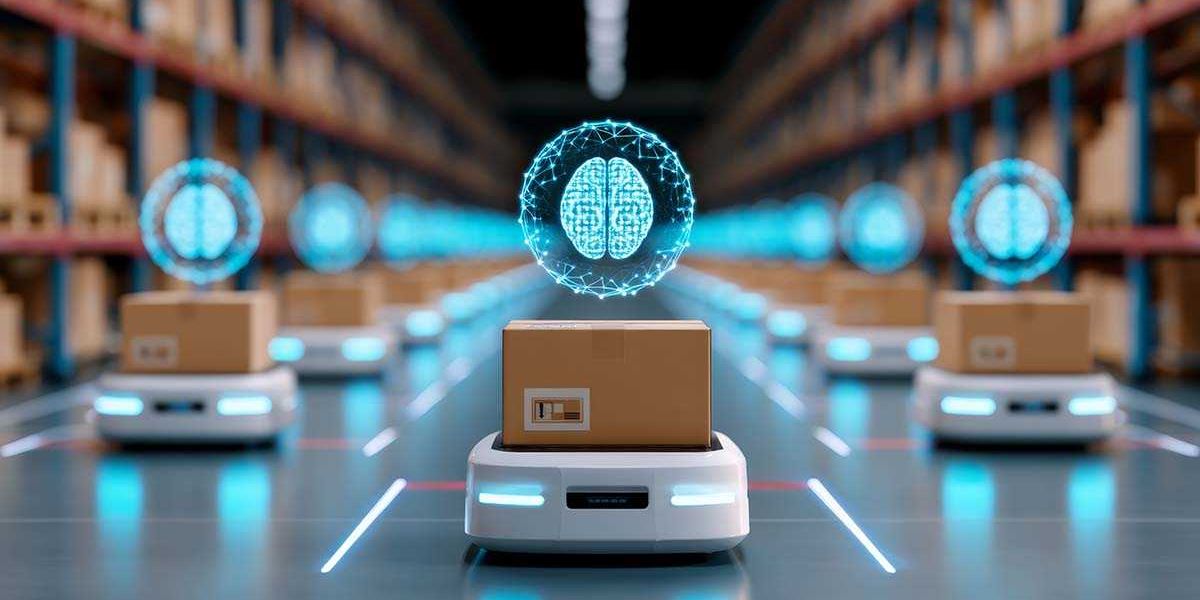
Artificial intelligence (AI) has been maturing at breathtaking speed in recent months. And as often happens with new technologies, the single, umbrella acronym “AI” has splintered into an array of subcategories along the way. Today it’s common to hear people talk about conversational AI, generative AI, industrial AI, and agentic AI.
And now an additional variant—physical AI—has emerged, and the term is often mentioned in connection with logistics and supply chain operations. So exactly what is physical AI, and do you need it in your distribution center?
To answer that question, it helps to know a little about the older types of AI—or more specifically, their capabilities. Conversational AI, such as basic chatbots, can automatically reply to questions by choosing from a predetermined set of answers. Generative AI can analyze vast amounts of generic information to identify trends and provide unique answers. Industrial AI can combine those two capabilities but restricts its replies to appropriate, sector-specific business knowledge such as blueprints and manuals. And agentic AI can build on all three of those models by not just generating an answer but also instructing another program to digitally follow that advice.
Physical AI is different because it adds a connection to the three-dimensional, physical world.
“We’ve been talking about AI for decades; not so long ago, people might have said an ATM machine was artificially intelligent,” says Teddy Ort, senior vice president, robotics software and AI at the Massachusetts-based robotics and automation technology company Symbotic. “But all those [precursors to physical AI] live only in the informational space; they can’t actually do anything [physical] with their answers. They’re all talk and no action.”
That’s still the case in many parts of the logistics world. Most warehouse operators in recent years have abandoned their pencils and clipboards and adopted warehouse management system (WMS) software, Ort says. “A WMS can figure out which inventory should go to which truck and which store. And it can show that to you in a beautiful dashboard view. But as soon as it wants to do anything, it’s powerless; it has to call someone who can drive a forklift to come and move a pallet.”
According to Ort, the missing link is physical AI, which endows robots and automation with the “intelligence” to accomplish real-world tasks around the warehouse. That’s not to say that the typical autonomous mobile robot (AMR) needs access to the vast cloud-based computational power of commercial AI products like ChatGPT, Claude, Copilot, or Gemini, he says. It just means they need basic problem-solving capabilities. For example, each Symbotic AMR comes equipped with a graphics processing unit (GPU) computer chip with enough smarts to handle relatively simple tasks like confirming the identify of a package or plan a route to move it across the building.
BUILDING A DIGITAL WORLD
Once they’ve decided on a strategy, physical AI platforms can then perform the necessary operations in different ways, navigating the world around them by using various types of sensors, such as radar, scanning, or machine vision.
Although the underlying technology may vary, all of those approaches share a common theme, according to Wiliot, a California-based provider of supply chain visibility technology. “You’re giving physical assets a digital identity and using AI to analyze that data,” says Amir Khoshniyati, vice president at Wiliot. “That means any digital trigger that comes from an asset, so it could be location, temperature, humidity, or light.”
As for what constitutes a “physical asset,” Khoshniyati says the definition varies by industry but notes that in the logistics world, common examples include pallets, crates, cases, and individual items.
Wherever they pull their data from, physical AI applications have gained traction in 2026 not only because of the wider availability of AI computing power but also because of foundational enabling technologies such as GPU chips and IoT (internet of things) tags.
Consulting group BCG says physical AI combines three things that have been around for years but have only recently started to be combined into a single platform: the physical technology of intelligent robots, advanced AI that provides instructions to those robots, and digital-twin environments that allow planners to simulate the intersection of those two things.
As exciting as the prospect of those combined capabilities may be, supply chain managers will have to be careful as they look to apply physical AI to existing workflows, like creating store-ready mixed pallets in a warehouse, cautions Alex Yurek, managing director and partner at BCG. “The idea of a completely dark factory or dark DC is still in the future, but people are now working alongside robotics more than in the past,” he says. “The days of the split between IT doing only digital operations and the operations department getting value out of it are over. They need to cooperate.”
As warehouses set out on their physical AI journey, it’s critical that all parts of the business work together as part of an integrated group—one that includes representatives from the physical hardware layer, the cloud infrastructure, and the operations team.
“It’s not so different from the ways in which people have applied other digital and AI solutions, but now the stakes are higher because of the physical robotic impact,” Yurek says. “So you need a system that’s ‘empathetic’ to all stakeholders in that environment.”
