


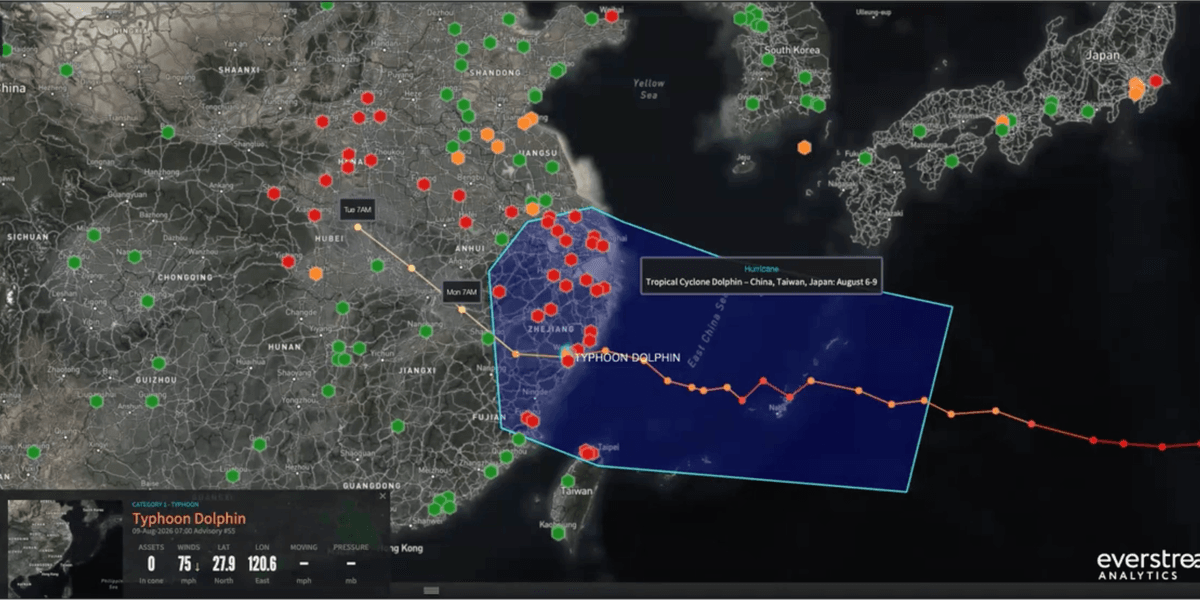
Logistics flows in Europe and East Asia have been slowed by extreme weather conditions this week, including record low water levels in major freight rivers in Germany and a typhoon storm that closed maritime ports in China.
Severe disruptions began on Friday, August 7, when China’s Port of Ningbo suspended operations due to the arrival of Typhoon Dolphin. The storm then made landfall on Sunday in China as a Category 1 typhoon after battering Okinawa, Japan, with Category 2 winds topping 100 mph, threatening inland flooding and impacting 3 cargo airports, 6 major ports, and 22 major cities across China, Japan, and Taiwan, according to a report from Everstream Analytics.
In the short term, the port’s closure meant that no empty container pickups or returns were possible, loaded containers were no longer accepted, feeder/barge traffic was stopped, and vessels were evacuated out of the port. But since Ningbo is one of the busiest container ports in the world, the move has created ripple effects that will spread broadly through global trade patterns, according to a statement from freight broker C.H. Robinson.
“The port closures due to Typhoon Dolphin come on top of pre-existing backlogs. Wait times were already 2-3 days at Ningbo and 5-8 days at Shanghai. Immediate recovery from the storm may add several days to these delays. Additionally, working through the broader disruptions caused by increased vessel queues, container backlogs, disrupted carrier schedules, and equipment rebalancing is expected to take several weeks,” C.H. Robinson’s president of Global Forwarding, Mike Short, said in an email.
“Shippers with ocean cargo moving through East China should expect schedule disruptions, delayed container pickups and deliveries, and the possibility of cargo rollovers as carriers work to restore vessel schedules. Customers should stay in close contact with their logistics providers, confirm terminal operating status before dispatching cargo, and build additional lead time into transportation plans. While the direct storm impacts may be measured in days, congestion and vessel bunching could affect shipping reliability across the region for several weeks after operations resume,” Short said.
Even as China strives to recover from that blow, freight flows in much of Europe have slowed to a crawl, as the continent is now in its fourth heat wave of the summer, with temperatures 4–7°C above normal affecting nearly half the population and setting records in Western and Central Europe. Combined with historically low rainfall, the weather pattern has drained the Rhine and Danube rivers to record low water depths, which means cargo ships can no longer carry heavy loads that force their hulls to ride low in the water.
To continue sailing their scheduled routes, some vessels are carrying just 20% of their usual capacity, Everstream said in its weekly “Forecast in Focus” report. And forecasted rains for southern France, Spain, Portugal, and Italy next week will come too late to help ailing crops or river levels, the report said.
