


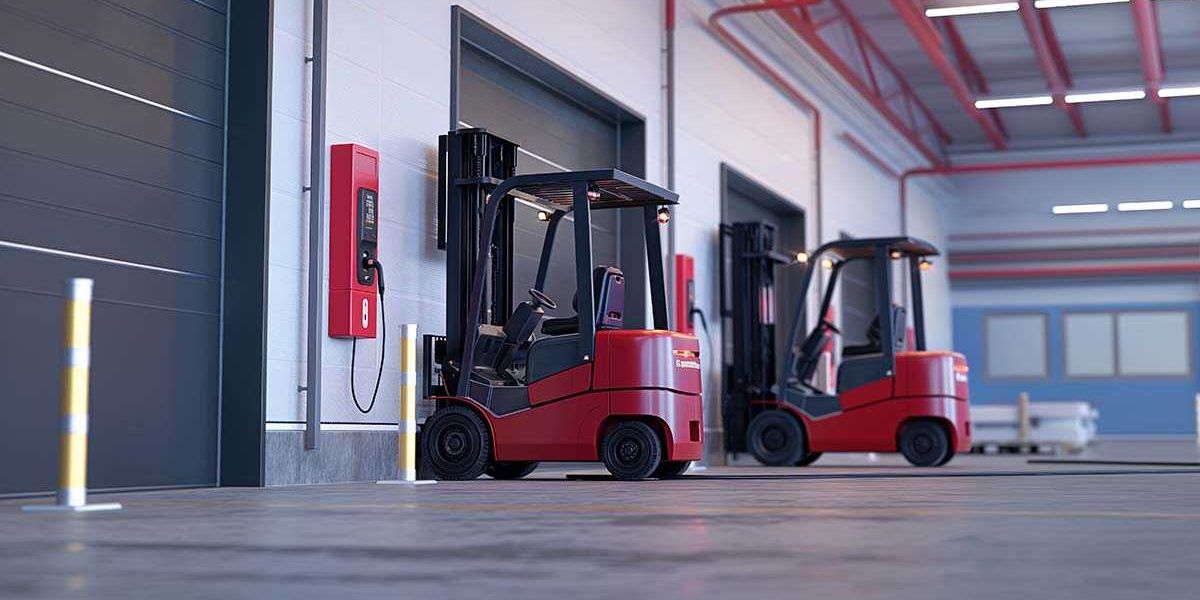
There’s a trend emerging across the forklift market as more and more equipment users electrify their fleets: The rapid adoption of, and strong preference for, lithium-ion (Li-ion)–powered, battery-electric trucks is spurring forklift manufacturers to bring the production of those advanced power solutions in-house—as a way to both build revenue and provide customers with a one-stop shop on their electrification journey.
One of the latest manufacturers to do so is Hyster-Yale Material Handling, which launched lines of lithium-ion power solutions that are purpose-built for its Hyster and Yale lift trucks this past spring. With that move, Hyster-Yale joins the ranks of original equipment manufacturers (OEMs), including Big Joe Forklifts and The Raymond Corp., who already provide a single-source for trucks and Li-ion batteries.
Although their approaches vary, the companies’ efforts confirm the industry’s solid shift toward electric power: Recent industry research from Interact Analysis predicts that Li-ion–powered forklifts will make up more than 70% of the global, full-electric forklift market (which includes both Li-ion and lead-acid models) by 2034, for example—up from roughly 32% in 2024. As that market grows, a restructuring of business models is occurring as companies work to provide “full value-chain solutions,” according to the research.
Maya Xiao, research manager at Interact Analysis, explains that the combined design and delivery of forklifts, batteries, charging solutions, and infrastructure support—as Hyster-Yale, Big Joe, Raymond, and others are doing—helps lower barriers to adoption and reduce costs for customers.
And that’s a compelling reason for equipment makers to bring all of those services under one roof.
“For manufacturers, the ability to successfully build integrated service capabilities will be central to establishing a competitive advantage in the post-lithium battery era,” she wrote in the February report.
Ken Schreiber, energy solutions leader for the Yale brand and senior product director for electrical energy solutions for the Hyster brand, agrees.
“Our goal is to give warehouses as frictionless an experience as possible,” Schreiber said in a statement announcing the Yale launch in June. “The unified solution of advanced battery technology, chargers, and lift trucks delivers on that promise, with easy day-to-day usability and performance, backed by the one-stop shop convenience of support from our local dealers.”
As Li-ion power takes the forklift market by storm, those unified solutions are heating up as well.
THE RISE OF LITHIUM
Company leaders at Big Joe Forklifts anticipated the industry’s move to Li-ion power more than a decade ago, says Martin Boyd, the company’s chief marketing officer. He explains that Big Joe “skated to where the puck would be,” betting on lithium’s attributes as a cleaner, lower maintenance, and faster charging solution compared to forklifts powered by internal combustion engines (ICE) and lead-acid batteries. It also bet on the technology becoming more affordable: Ten years ago, Li-ion batteries were about three times as expensive as lead-acid batteries, putting them out of reach for most customers, Boyd explains. But prices have come down considerably, making them a more attractive solution to a broader range of users.
For those reasons and more, Big Joe decided to build on the experience of its parent company, China-based EP Equipment, which had already been developing Li-ion batteries for smaller trucks—pallet jacks and similar Class III “walk behind” forklifts. The result was EP’s launch of a purpose-built, integrated lithium-powered sit-down counterbalanced, or Class I, forklift, introduced in Asia and Europe in 2017. Big Joe launched the line in North America in 2020 and today primarily targets customers transitioning from Class IV and Class V ICE-powered forklifts to Li-ion versions. The integrated solution means that the battery is integrated into the design of the truck; Boyd explains the truck is comparable to an ICE-powered version in form and function.
“We have a distinct leadership position in developing integrated lithium battery solutions that were purposely built with a form factor that makes it easy for an operator to move from Class IV and Class V to Class I [electric counterbalanced trucks],” Boyd explains. “It will only be a matter of time before other OEMs start to develop the solutions Big Joe has, so with this being a window of opportunity, Big Joe is squarely focused on that opportunity while it’s front and center.”
Indeed, others are following suit—developing integrated solutions as well as building individual Li-ion batteries that can be dropped into existing trucks to replace lead-acid batteries. In both cases, the goal is to put the expertise for the truck and its power source in one place.
“I think there’s a clear trend toward forklift manufacturers developing their own [Li-ion] solutions or integrating with third parties,” explains Schreiber, emphasizing the advantages that come from having a single source of expertise about the machine, the power source, and the charging technology being used—not the least of which is having one point of contact when problems arise.
“It’s going to become increasingly important that we do this for our product and to take care of our customers,” Schreiber says, adding that Hyster-Yale offers both integrated and drop-in Li-ion power solutions.
And about those problems: Forklift users can choose from multiple third-party battery vendors when transitioning to Li-ion forklifts, a complexity in itself. The situation gets more complicated when there’s a problem or the truck breaks down: Is the forklift or the battery the issue? Or is it the charging infrastructure? It can take multiple phone calls and tech visits to get to the bottom of the problem.
Schreiber explains that the truck, battery, and charger represent independent systems, each with its own software and controls. When updates are made separately across any one of these components, it can create misalignment that prevents the overall system from functioning properly.
“One thing gets updated and then the whole system doesn’t work,” he says, citing Hyster Tracker telematics as a response to those concerns: The system monitors both truck and battery operation, streamlining troubleshooting by delivering information that may aid in identifying and understanding system issues while improving overall visibility across the system.
A COMPLEX PROBLEM
Jennifer Lupo, vice president of technology solutions for The Raymond Corp. (a brand of Toyota Material Handling North America), agrees that bringing power expertise in-house is a must as the industry transitions to advanced power solutions. She points to the complex nature of Li-ion compared to more traditional power sources as a case in point.
“It’s much less forgiving,” she says of Li-ion technology, noting the tighter requirements for matching the power source to the vehicle’s capacity demands. “You have to be more exact about the amount of power the vehicle needs and the amount of power the energy source can provide the vehicle. And no one knows better than a vehicle manufacturer, like ourselves, what the requirement of the vehicle is and what the requirement of the power source is.”
The Raymond Corp. released its first lithium-powered forklift in 2017—a pallet jack with an integrated lithium-ion battery. Since then, the company has taken an incremental approach to adding advanced power solutions and now offers its own Li-ion drop-in solutions as well as other advanced power sources, such as thin-plate pure-lead (TPPL) batteries, along with charging systems and more. Solutions are developed with partner companies and in-house. Raymond opened an energy solutions facility in Rochester, New York, in 2025 that develops, tests, and produces advanced power solutions, including Li-ion batteries and hydrogen fuel cells, for use in the Raymond and Toyota brands. Lupo says those efforts are part of a broader, more holistic approach to customers’ material handling needs—one that includes the truck, the power source, and even the data integration that helps the equipment maintain optimal uptime and efficiency. It’s all part of building the “future truck” that can power the most sophisticated warehouse operations.
“This is really an expansion beyond who we were in our core,” she explains. “To get to that end game—that future truck end game for those customers that are very sophisticated, that want to be running automated vehicles 24/7/365—and do that without interruption, you must use telemetry and you must use an advanced power source.
“We knew we needed to build this capability.”
And like Boyd and Schreiber, Lupo says she expects the trend to accelerate: “It’s not surprising that there are more [equipment manufacturers] in the material handling industry headed in this direction—because of the benefits.”
She says she also hopes the industry’s successes in developing battery-powered lift trucks will help boost confidence in the technology on a larger scale.
“There is so much in the media about challenges with EVs [electric vehicles] and lithium batteries,” she says, pointing to the consumer vehicle market. “I like to shed light on our industry and the success we have had. We’ve been electric vehicle manufacturers for decades, and we know that batteries can work in the most stringent applications. Commensurate with our brands in the marketplace being well known for quality and reliability, we would not bring any type of technology solution or power source to the market unless we were sure they were going to perform and deliver value.
“I hope that, somehow, we can raise that idea up to consumers, who generally doubt the [performance capabilities] of an EV.”
