


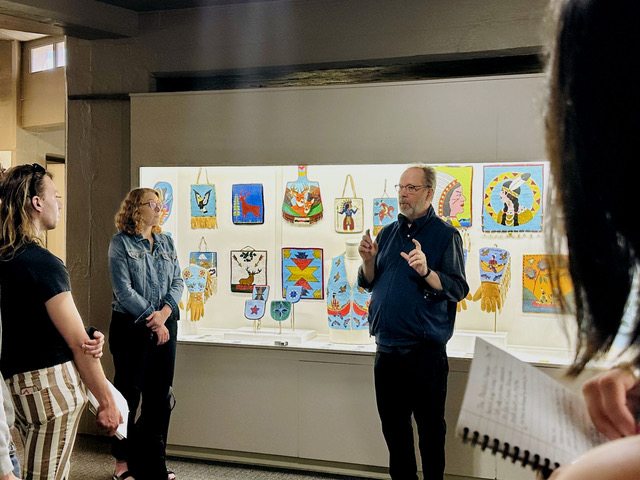
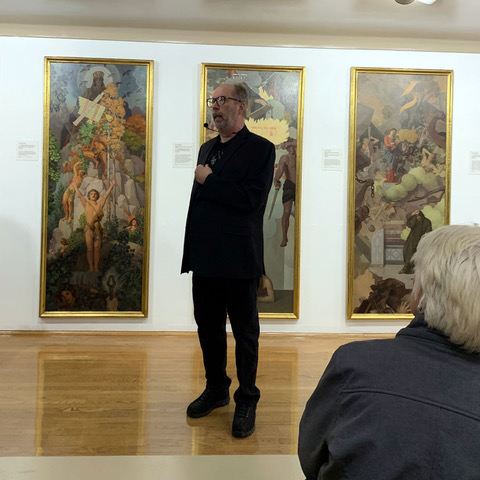
It’s official. Steven L. Grafe, Ph.D., has retired from his post at Maryhill Museum of Art.
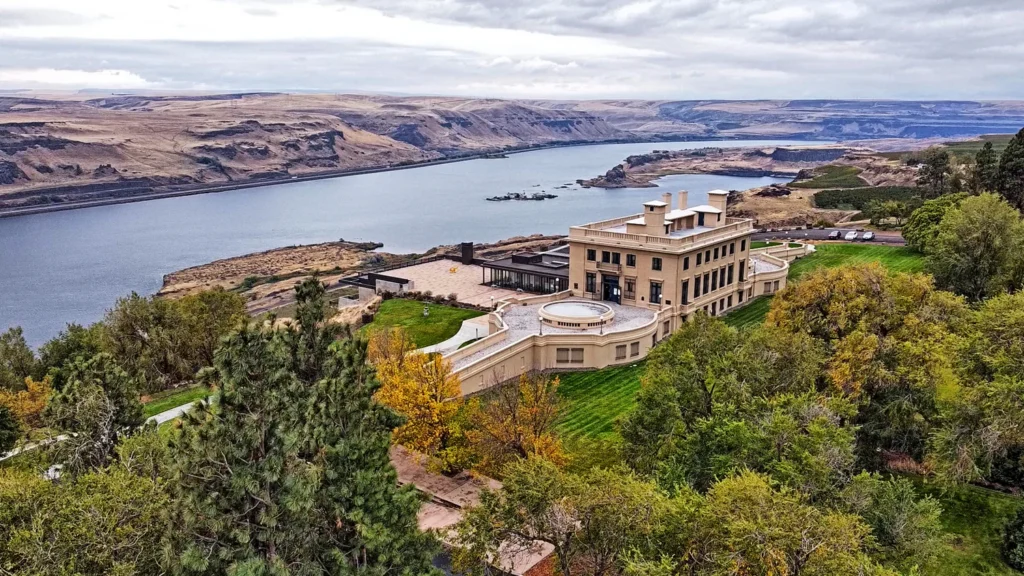
Grafe has served as the Curator of Art for the small-but-mighty museum overlooking the eastern end of the Columbia River Gorge since 2009. During his tenure, Grafe revitalized the Museum’s Indigenous Peoples galleries, championed historically underappreciated academic realists (e.g., R.H. Ives Gammell and Richard Lack), and grounded the institution’s programming in the ecology and history of the Pacific Northwest.
In short, Grafe’s ambitious programming initiatives and curatorial vision helped modernize the Museum once described by The Oregonian as “the Pacific Northwest’s overstuffed family room,” expanding the scope of its permanent collections and helping to transform it into the eclectic institution it is today.
“Eclectic isn’t a pejorative,” Grafe told The Columbian in 2018. “It’s a compliment.”
Born and raised in Salem, Oregon, Grafe’s roots in the Pacific Northwest run deep. While his father’s family hails from the Santiam area, his mother’s family is from Zigzag near Mt. Hood, according to Oregon ArtsWatch Executive Editor Bob Hicks’s blog, Art Scatter. After completing his doctorate in art history at the University of New Mexico—where he studied pre-1880 beadwork from the southern Columbia River Plateau—Grafe served as chief curator of the Southwest Museum of the American Indian in Los Angeles, in addition to brief stints at Mesa Verde National Park in Colorado and Cape Hatteras National Seashore in North Carolina.
This week, Grafe and I discussed standout moments in his career, his optimism for the future of Indigenous art preservation and repatriation, as well as a few of his retirement plans. Below is our conversation.
I understand you’ve just installed your final exhibition at Maryhill. After 17 years as Curator of Art—not to mention an illustrious career writing, cataloging, and curating across the country, beforehand—I imagine you’re experiencing a combination of grief and relief.
What led you to this decision? And, most importantly, how are you feeling?
With the slate of 2026 exhibitions installed, and after the conclusion of 2026 Pacific Northwest Plein Air in the Columbia River Gorge, the time seemed right. I was interested in the planned 2027 exhibitions, but by leaving now, the Museum has ample time to find a replacement and prepare for next year. I feel fine about the decision, but as someone who has historically had difficulty creating a healthy work/life balance, the transition into a new schedule has contained some surprises.
Nearly two decades is more than enough time to witness a museum’s highs and lows. Let’s start with the highs. In your tenure as Curator, what projects or accomplishments are you most proud of?
I remember the 2010 Comics at the Crossroads: Art of the Graphic Novel exhibition with great fondness. It provided the opportunity to work with a number of Oregon and Washington comic artists, all of whom were enthusiastic about the project. I would argue that comic artists are, to a certain extent, the descendants of the Classical tradition because of the need to constantly render the human form. That is a skill that is often overlooked.
E. Irving Couse on the Columbia River (2013) allowed me to explore work done in Washington state by an artist who is generally associated with northern New Mexico. Couse met his wife in Paris but was anxious to visit his in-law’s sheep ranch near Roosevelt, Washington. His great desire was to create a uniquely American work, and he imagined Indigenous models could provide that opportunity. A large 1891 tableau related to the aftermath of the Whitman Massacre was subsequently shown at the 1892 Paris Salon and the 1893 World’s Columbian Exposition in Chicago. The artist ultimately settled in Taos, New Mexico, and the works he painted during multiple stays in the interior Pacific Northwest are poorly known.
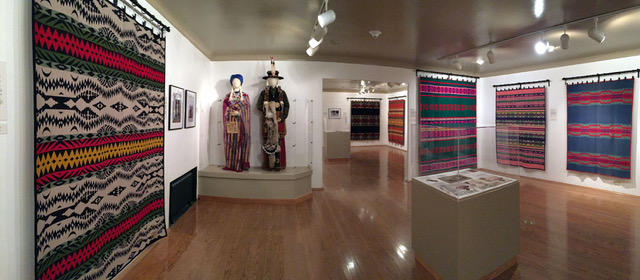
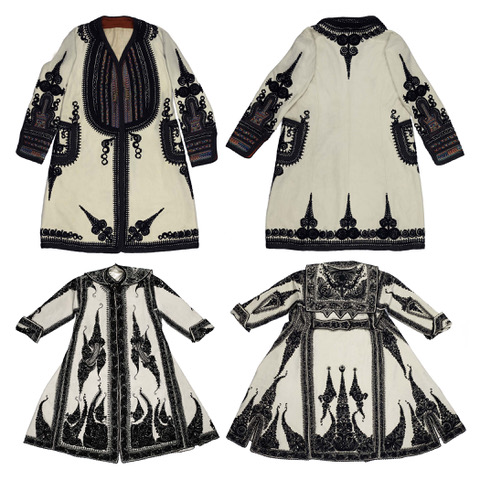
A Kaleidoscope of Color: American Indian Trade Blankets (2016), West Coast Woodcut: Contemporary Relief Prints by Regional Artists (2019), A Particular Beauty: Romanian Folk Clothing (2020-21), and Northwest/Southwest: Indigenous Art After 1980 (2022) were all favorites. The Columbia River: Wallula to the Sea, featuring the work of Thomas Jefferson Kitts and Erik Sandgren and the concurrent King Salmon: Contemporary Relief Prints (2024) will always have a special place in my heart. Exhibitions related to the work of sculptor James Lee Hansen (2014), multimedia artist Angela Swedberg (2015), glass artist Raven Skyriver (2015) also provide warm memories.
In 2012, I began upgrading individual cases in the Museum’s Indigenous Peoples of North America Gallery. This sometimes meant refreshing case paint and providing new labels; but as donations were received, new items were also put on view. In 2025, we unveiled a large display of Columbia River Plateau beadwork, as well as a video monitor and a case featuring contemporary art.
What were the biggest challenges you faced when you started at Maryhill? What’s the biggest challenge your successor will face?
As would be expected, one of ongoing challenges I faced was an absence of funding. Maryhill is a small non-profit that receives no public support, apart from the occasional grant. I never had much money to spend on acquisitions, although individual patrons were conscious of ongoing needs and were very generous in supporting purchases of specific objects. Nonetheless, a lot of affordable auction lots passed by and left me pondering what could have been.
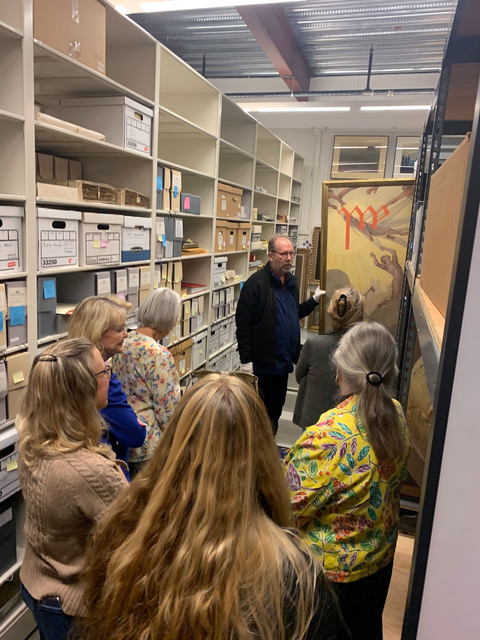
My successor will be faced with several challenges, including diminishing collection storage space, the general absence of funds for travel and research, the need for a curatorial assistant or two, and the requirement of embracing duties that include exhibition curation, design, and fabrication/installation. Given the Museum’s location, a lot of exhibition-related needs require travel to vendors in Portland.
Tell me more about the Maryhill community. What was your audience like? How did you witness art education and engagement change during your time as Curator?
My knowledge of Maryhill’s visitors is primarily anecdotal, because only a limited amount of data has been secured through visitor surveys. The Museum is visited by a fair number of Gorge residents, people who stop in during extended road trips, and those who visit as part of a river cruise. It may be safe to say that some visitors arrive while travelling to local wineries. My impression has been that many visitors are not regular museumgoers and that some are apprehensive about visiting an art museum. Maryhill is arguably the only art museum between Portland and Spokane. The Dalles, Hood River, and Yakima are the only population centers within an 80-mile radius.
During my tenure, the amount of art education and programs varied by the personalities of those who served as Curator of Education, as well as the two Executive Directors with whom I worked. Colleen Schafroth, who retired in 2023, was Maryhill’s Curator of Education before becoming its Executive Director. The Museum had a vigorous education program during her tenure.
Your curatorial interests at Maryhill have been diverse, including expansions to several of Maryhill’s collections, including their fashion and religious art collections, as well as spearheading the Pacific Northwest Plein Air in the Columbia River Gorge event for more than a decade. However, the connective tissue of your career seems to be the preservation of indigenous art. In fact, all the contemporary Indigenous art in Maryhill’s collection was acquired during your tenure.
What lit this particular fire in you?
My interest in Indigenous art was kindled when I was young, starting with a nighttime visit to a performance by the Lelooska family that was organized by OMSI. As a 14-year-old, I had an “aha” moment when visiting what is now the Buffalo Bill Center of the West in Cody, Wyoming. I realized that museums can be educational institutions, because visitors are relaxed and don’t always realize that they are learning.
I took my first class in Native American art history from Barbara Loeb, while an undergraduate at Oregon State University and learned that this was a career possibility. Two years later I was enrolled in the Art History program at the University of New Mexico with a specialty in Native American art. My dissertation focused on historic beadwork from the southern Columbia River Plateau, because the region was close to home. Those who understand much about the current Indigenous art market will also appreciate what three years in New Mexico afforded outside of the classroom.
The landscape of Indigenous art preservation and advocacy has evolved over the last few decades. What has it been like to witness—and be a part of—that change?
Let me go back 30+ years instead. The 1990 passage of the Native American Graves Protection and Repatriation Act (NAGPRA) prompted American museums to really look at their collections and begin dialogues with Indigenous communities. This allowed institutions to gather unprecedented amounts of data about their holdings and prompted the return of an array of sensitive items, including human remains. The 2023 updated version of NAGPRA prompted the revelation that many museums were not in compliance with the 1990 statute. For the record, Maryhill took NAGPRA seriously from an early date and applicable items in its collection were returned to representatives of the five major Columbia River reservations in 2010.
In 2024, prehistoric pottery from Mesa Verde, Colorado, was taken off view because its origins could not be established and there was a possibility that it may have been secured from pot hunters. That same year, the museum’s display of carved Columbia River stone was removed from view because of tribal concerns that it showed sacred imagery.
During the last 20 years, many Indigenous professionals have entered the museum field as both employees and consultants for tribal museums and mainstream museums. One example of this vocational growth is the value and popularity of the Association of Tribal Archives, Libraries, and Museums. Coincidentally, ATALM’s 2026 conference will take place in Spokane in September with hundreds of people in attendance. This bodes well for the growth and vitality of tribal museums. Changes to the demographics of those who work at museums and the nearness of new, informed voices can only serve to improve the interpretation of Indigenous subjects related to collections care, exhibitions, and public programs.

A watershed moment related to this topic in the Pacific Northwest occurred at the end of March 2026, when the Confederated Tribes of the Umatilla Indian Reservation signed an agreement with Walla Walla collector Fred L. Mitchell. His massive, multi-generational collection of Columbia River Plateau beadwork, baskets, photographs, and lithics is now being transferred to Tamástslikt Cultural Institute on the Umatilla Reservation. This is significant because the material is returning to an Indigenous community with which it is associated, rather than being scattered to the winds via private sales and auction houses.
It is a truism to say that Baby Boomers are finding themselves in possession of collections that do not interest their children and grandchildren, and one hopes that this recent property transfer can become a model for the ongoing growth, vitality, and relevance of tribal museums. Tamástslikt is a state-of-the-art institution with a professional staff, and it is a worthy home for this collection. Historically, few collectors of historical material have had interactions with living people from the communities from which they have collected, and this transfer proves that change can occur.
The philosophies shaping museum practices are sometimes inscrutable to the public. It is my perception that many museums are on the vanguard of societal change, and if equity remains a core institutional value, the future bodes well for the museum management of Indigenous concerns.
If you could impart one thing to the next generation of curators, what would that be?
My response to this includes three things. Curators must be willing to do the hard work of being well-educated, constantly informed, and unflinchingly accurate. They must strive to avoid the fallacy that AI can somehow contribute value to their work. They must also have at least an informal 50-year plan and continually think about how the decisions they make will impact their institutions a generation or two from now.
I understand you have a few more projects on the horizon. What are you most excited to dive into, in your retirement?
Several people have encouraged me not to commit to anything for a while, until after life has settled down. I am thinking about a couple of book possibilities but in the short term, I need to edit a memoir that my wife wrote about growing up in Ethiopia in the 1960s. She wrote it during the pandemic, so it’s time for me to get busy on it.
