


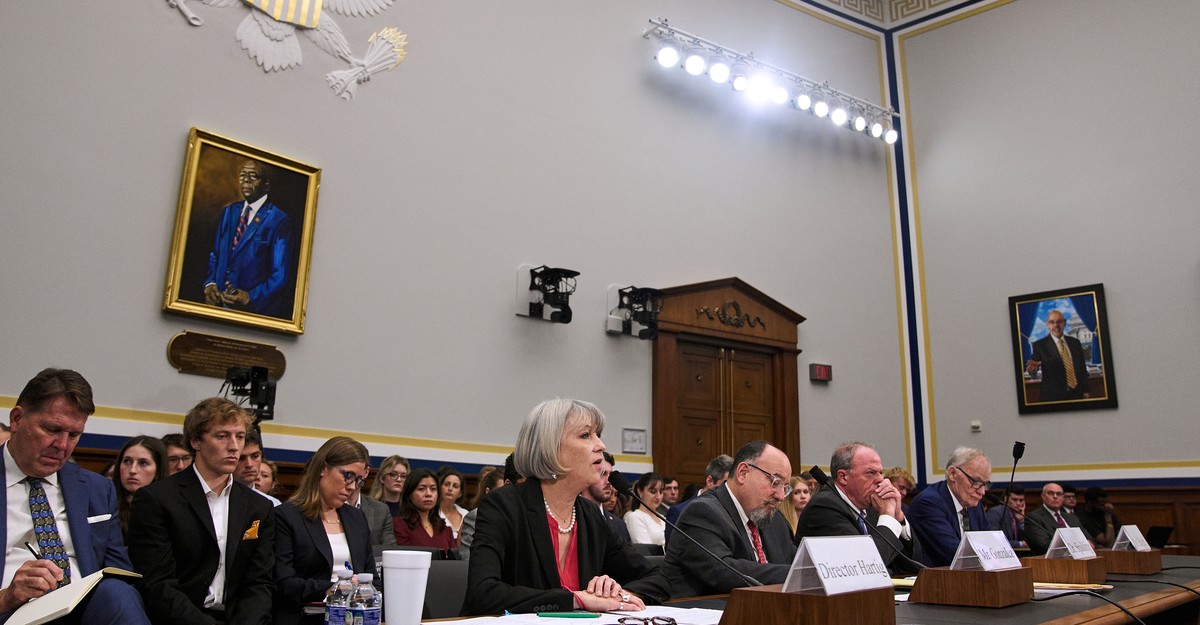
The nation’s most scrutinized museum director showed up to Congress this week acutely aware of her audience. Anthea Hartig, the head of the Smithsonian’s National Museum of American History, referred to the institution as “your” museum. She emphatically affirmed her love of this country. She even cited her family’s Revolutionary War roots. Hartig had been called to testify at two hearings that House Republicans had organized in response to a 162-page White House report accusing the American-history museum of “extreme political activism.” But her opening remarks, in which she also asserted that the report “does not fairly characterize the full body of work of this museum,” didn’t ward off a patriotism sniff test.
“Do you love America?” Representative Eric Burlison of Missouri, a Republican, asked Hartig yesterday during a hearing held by the House Delivering on Government Efficiency Subcommittee. “I love this country unconditionally,” Hartig replied, a sentiment that she would repeat at least half a dozen times during this de facto trial on Capitol Hill.
Whether she confirmed or denied her allegiances didn’t actually matter. Hartig mounted a defense that the museum is “committed to rigorous, fact-based, museum-quality experiences” and acknowledges “enduring debates so that visitors can understand how we’ve wrestled with democracy and citizenship and liberty and national identity.” She called telling the full story of American history “a form of respect for the American people.” But the GOP’s judgment had clearly already been cast. The hearings, rather than serving as opportunities for information gathering, were meant only to widen Donald Trump’s attack on the Smithsonian by enlisting Congress in his efforts to reshape public memory.
Hartig’s appearance followed more than a year of pressure on the Smithsonian from the White House as it has sought to cleanse “improper ideology” from the institution and combat what it sees as a pessimistic approach to history that is too focused on—in Trump’s words—“how bad slavery was.” They marked the most public and outwardly combative test of the institution yet, as some members outright scolded Hartig. Trump’s interest in the Smithsonian has already resulted in changes to wall text discussing his impeachments, and in National Portrait Gallery Director Kim Sajet’s resignation after Trump tried to fire her on social media last year. But the White House has not attempted to overhaul the Smithsonian like it has the Kennedy Center, and it can’t—the institution’s unique legal status and leadership structure insulate it from the president’s whims. By contrast, Congress appropriates much of the public-private institution’s funding and exercises oversight over the institution, which is governed by a board of regents.
Over the course of two days of congressional testimony, Democrats challenged the framing of the museum as politically biased and defended the Smithsonian’s independence, including with their own report, noting errors in the White House document. Republicans, meanwhile, echoed the administration’s claims and dissected Hartig’s public statements, particularly an offhand comment made during a 2021 webinar for the Slave Dwelling Project Conference in which she said, “As we all know in this conference, loving America is very complicated.” The White House had plucked the quote for its report as an example of what it sees as Hartig’s lack of patriotism, and Trump allies in Congress regurgitated it this week like it was her personal slogan, during hearings that quickly took the tenor of a loyalty test.
Perhaps, in a way, it was: The Yale historian David Blight, who also testified both days, noted that in its July 4 report claiming that the museum had strayed from its mission, the Trump administration cited statements dating from the institution’s opening without considering the political context that might have sparked such “triumphalism”: the Cold War. The Heritage Foundation fellow Mike Gonzalez, whom Republicans called as a witness both days, was playing his role in Tuesday’s time warp of a hearing when he leveled accusations of Marxism at the museum before his call to “clean out house” at the Smithsonian. (Witnesses also included the Hillsdale College professor Matthew Spalding yesterday and the president of the conservative think tank American Main Street Initiative, Jeffrey H. Anderson, today.)
Whether “love” is really the metric by which one should assess a historian’s credibility seemed outside the scope of the discussion. Nuance was treated like a threat. It seemed to be no coincidence that the two points that GOP members took issue with most were Hartig’s statement about the complexities of patriotic love and an exhibit that had closed more than three years ago, called “Girlhood (It’s Complicated),” which touched on the struggles of transgender youth.
This allergy to complexity in the representatives’ approach to questions was unmissable. There was a recurring pattern: A GOP member would ask an extremely loaded question—whether the museum should display materials with sexual themes, for instance—and Hartig would try, seemingly in earnest, to respond, and almost instantly she’d be met with: Yes or no! It’s a yes-or-no question! In one particularly illustrative moment today, Representative Mike Carey asked Hartig what she meant when she said she wanted to change the museum’s “America First” approach. She had barely uttered the words “I would argue that the American-history museum” before he cut her off, asserting that she wasn’t answering the question.
Serving in Congress and running a history museum seemed like they might be professions that are too alien to each other to interact. GOP lawmakers repeatedly employed the kind of narrow logic and treacly sentiments that historians cringe at, such as when Representative Pat Fallon asked Hartig to agree that America “is the greatest nation history has ever known.” Burlison suggested to Hartig that, with the World Cup bringing legions of foreign tourists to the country, “you would think” that the Smithsonian would be “the one institution that would be trumpeting the great and wonderful things that this country has done.” Again and again, Hartig’s GOP interlocutors seemed to be operating from a definition of a museum that sees its role as dispensing propaganda.
Anyone who had come to the Hill hoping to gain insights into the American-history museum’s actual philosophy or operations would have been hard-pressed to find them. The first hearing began with a YouTube-style mashup of Hartig giving land acknowledgements. The second, held by the House Administration Committee, ended with a staffer trotting out, for at least the third time during the two days, a poster board emblazoned with photos of drag queens and other exhibition materials.
Critiques of the museums fell into a few categories. One line of criticism involved selecting artifacts that lawmakers disliked and seeking to cast them as representative of the 1.7 million–object history museum. Another offered a kind of museum-edition whataboutism, in which representatives played curator and gave exhibit suggestions: “Did you have a new one for George Washington for the 250th?” one member asked. “How ’bout Thomas Jefferson?” This seemed to misunderstand the limitations of space and time in a museum that has no shortage of Founding Fathers material. Another lawmaker on Wednesday opined about the historic importance of banjos (the museum has 45) and how the creatures that Lewis and Clark discovered should be discussed in exhibits (which would seem to be the purview of the natural-history museum next door).
A related line of attack took issue with the tone of the museum but again felt strained. The National Museum of American History is unpatriotic and doesn’t honor the country’s founding enough, members suggested, never mind the huge room dedicated to the star-spangled banner or the buff George Washington statue. Hartig seemed to have shown up prepared for this argument on Day 2: “We have a dozen exhibitions that include the founding era right now: 368 objects, 340 labels. George Washington is mentioned 54 times. You have to walk by a whole section on George Washington in the Kenneth Behring Hall of Military History to get to a 15-foot-tall reproduction of the Declaration of Independence,” she said.
GOP representatives also repeatedly stressed the idea that America had led the world in ending slavery and that the museum should highlight that. Blight, the Yale professor, corrected the record: What is unique about the United States is not that it abolished slavery, because many nations did before it, but that it took killing hundreds of thousands of citizens in a civil war to do so.
Over the years, the Smithsonian has operated outside the influence of the White House, and much of its work has been celebrated on both sides of the aisle—look no further than President George W. Bush’s efforts to establish the National Museum of African American History and Culture and praise for its nuanced telling of difficult history, which Representative Jonathan Jackson of Illinois, a Democrat, applauded yesterday. Still, the Smithsonian has never been impervious to political headwinds either.
This week’s grillings recalled a controversy from the 1990s, when a planned Air and Space Museum exhibit about the Enola Gay had Congress threatening to eradicate its funding from the institution wholesale. The debate about whether the airplane that had dropped an atomic bomb over Hiroshima should be displayed alongside evidence of the devastation that it had caused had the American Legion and the Air Force Association coming after museum leadership with similar allegations of subpar patriotism. The Smithsonian secretary at the time, Michael Heyman, defended his colleagues on ABC’s Nightline, using words that could be coming out of current Smithsonian Secretary Lonnie Bunch’s mouth: “When one is dealing with momentous events, showing a full picture of their occurrence so long as it’s unbiased and it’s balanced is a role for the Smithsonian,” Heyman said. That defense did not hold, however. The Air and Space Museum Director Martin Harwit, who had pushed for the full story of the Enola Gay, resigned. The exhibit that eventually opened had minimal text and none of the historical context that he had intended.
During that 1994 Nightline segment, the interviewer Aaron Brown offered a question to Heyman and American Legion National Commander William Detweiler that feels eerily applicable today. Maybe, Brown said, “what the Legion wants here is a memorial, a commemoration—and what the Smithsonian wanted was something else, was a history.”
