


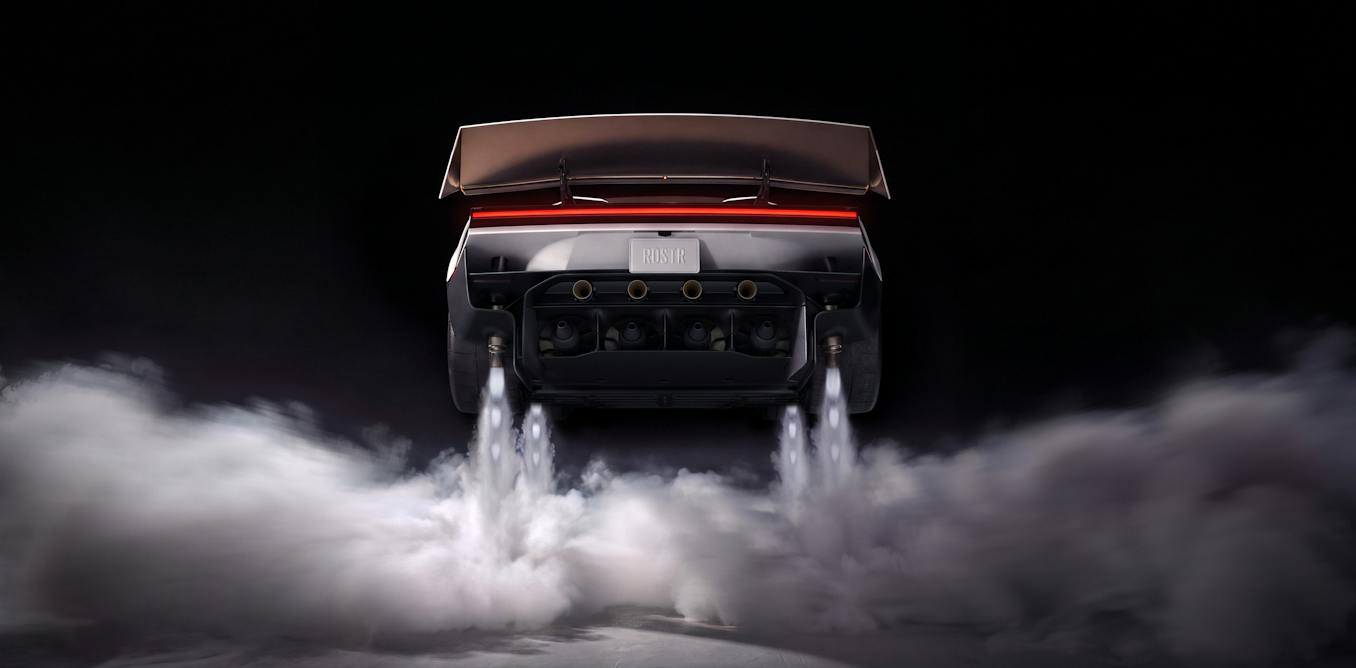
When Elon Musk unveiled Tesla’s latest Roadster, much of the attention focused on the obvious spectacle. Here, apparently, was one of the oldest promises of science fiction finally made real: a flying car.
The demonstration had everything you might expect from contemporary technological theatre. Watching the futuristic vehicle on a looping track climb, flip and descend, it was difficult not to think of Hot Wheels tracks, science-fiction films and the illustrations of the future that filled children’s books during the latter half of the 20th century.
Yet what struck me most, as a researcher in performance and public communication, was not the car itself but the audience. The event was livestreamed, captured from multiple camera angles and quickly circulated online. People were also assembled to witness it physically. Most revealingly, Musk reportedly remarked that the live audience was there so nobody would think the footage had been made with AI. In a single sentence, he captured one of the defining cultural anxieties of the present moment: seeing is increasingly not enough when it comes to believing.
For more than a century, technologies of reproduction progressively reduced the importance of physical presence. In The Work of Art in the Age of Mechanical Reproduction, the cultural critic Walter Benjamin connected authenticity to an original’s particular “presence in time and space”. Photography allowed us to see somewhere we had not been, film extended that principle, television took it further and the internet collapsed geography altogether. For a time, the photograph or moving image acquired its own evidential authority: seeing something recorded was, with reasonable caveats, grounds for accepting that an event had occurred.
Tesla
Artificial intelligence unsettles that relationship. Convincing images can now depict events that never happened. Deepfakes can simulate people saying things they never said. The significant change is that increasingly persuasive representations of reality need not have an originating event in the physical world.
This creates a curious reversal. The more sophisticated our technologies of representation become, the less the image alone can tell us about where it came from. In that context, the crowd at the Tesla demonstration acquires an unexpected function: they didn’t merely witness the evidence, they became a part of it. Audience members produced their own recordings and images, so credibility no longer rested entirely with Tesla’s official footage. The event acquired a form of distributed corroboration.
But there is an important problem here. Human witnesses are not reliable simply because they are human. When magician David Copperfield made the Statue of Liberty appear to disappear on television in April 1983, a live audience formed an essential part of the illusion. Around 50 million television viewers reportedly watched, but those physically present could truthfully say they had seen the statue apparently vanish – although it had, of course, gone nowhere. Copperfield’s audience didn’t authenticate an explanation of reality, it authenticated an experience.
So an event can be real, but witnesses do not always convert spectacle into truth. Audiences can be manipulated or incorporated into the performance they appear to authenticate. A hundred recordings of an illusion remain recordings of an illusion.
Perhaps the question then becomes not simply whether an image is real, but one about provenance. Where did that image come from and who is prepared to account for it?
Synthetic media (text, image, audio, video, or 3D assets that are artificially created, modified, or generated) doesn’t need a camera with an object in front of it, or even for a depicted scene to exist. This changes the nature of authenticity.
I have explored a related problem through the idea of the “unapproved orator”. Public communication increasingly reaches us through layers of speechwriting, editing, platforms, algorithms and summaries. The difficulty is not simply determining whether statements are true or false, but establishing whose voice we are really encountering and who ultimately stands behind it. Synthetic media pushes this further by allowing representations to circulate while their human origin, and therefore accountability, becomes increasingly difficult to establish.
A witness cannot resolve that problem. People can be wrong, lie or misunderstand what they have experienced. But a witness is present and can potentially be questioned. A witness can locate themselves within the event and say: “I was there”. In a sense, we borrow their presence. Perhaps that is what becomes valuable when images cease to function as reliable evidence alone. The question shifts from “does this look real?” to “where did this come from?” and “who stands behind it?”
For all its rockets, robots and flying cars, the technological future may therefore depend upon something extraordinarily old-fashioned: people gathering together, looking at something and afterwards being prepared to say, “I was there. I saw it happen.”
This article features references to books that have been included for editorial reasons, and may contain links to bookshop.org. If you click on one of the links and go on to buy something, The Conversation UK may earn a commission.
