


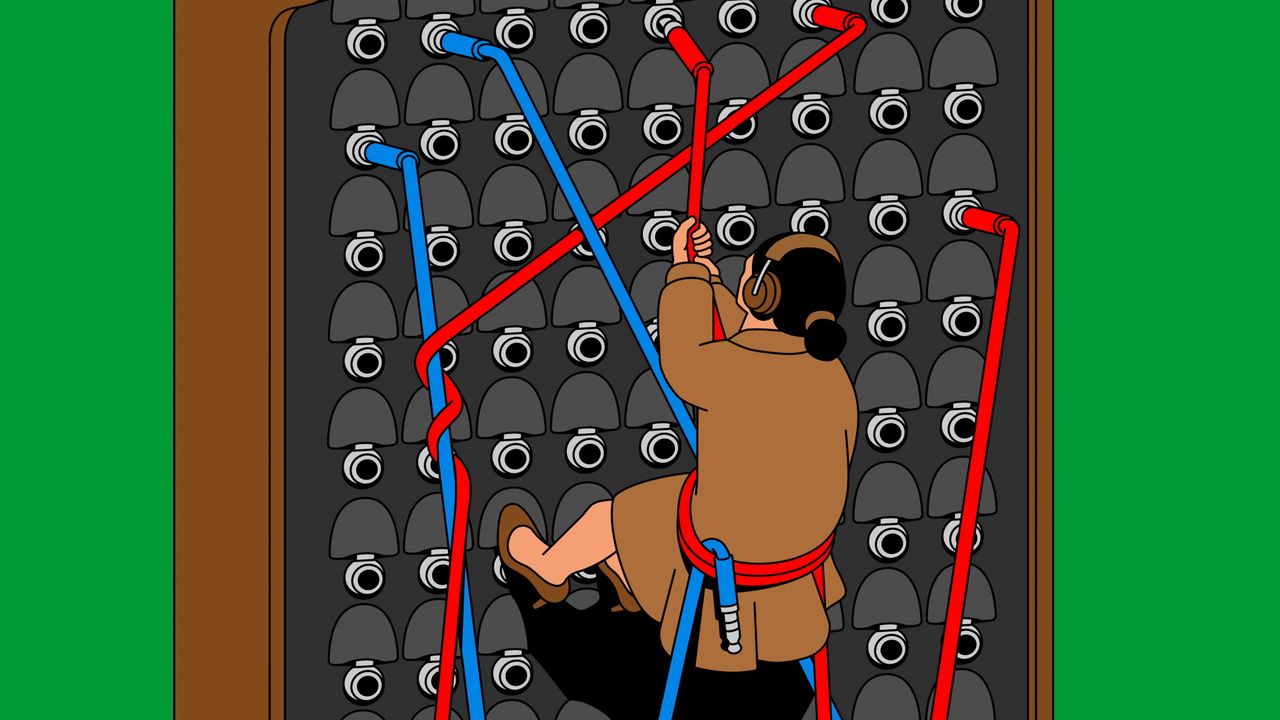
Gleick has a rich supply of oddities and delights from the telephone’s early history. Just a year after the patent was granted, we learn, America gained its first switchboard, a rickety thing run from a Hartford drugstore. Mark Twain, living nearby, installed a telephone line that he said was “the first one that was ever used in a private house.” (Like many of his claims, this was almost true.) The following year, a commercial exchange opened in New Haven, forty miles south. Six years later, the figures had leaped: Scientific American reported nine hundred and six exchanges and 123,625 American telephone subscribers. (Gleick’s interest, and mine, lies in the telephone’s essential form—sightless conversation at a distance—but carrying the story to the present reveals a world where even Ma Bell and her core technology look modest. Witness the ubiquity of the smartphones on which we so expensively spend our lives.)
As the telephone proliferated, it began to remake the social rules. It wasn’t clear, initially, how you ought to behave on it. Even beginning a call was fraught. Then as now, when you met someone in the street, you might greet them with a handshake, a bow, or a kiss, along with some less demonstrative signalling, such as a distance kept or closed, and a few introductory words, such as a formulaic greeting, or an offhand quip, or the thing you’d been longing to say for weeks. The telephone scrambled these habits. It wasn’t just that you and your interlocutor couldn’t see each other; because the earliest phones were always “on,” your opening words had to grab attention. Bell preferred the nautical word “Ahoy,” which was sometimes “Ahoy-hoy,” presumably for the less alert, and, in our own time, for the ancient Mr. Burns of “The Simpsons.” Edison liked “Hello,” also known as “Hallo” or “Hullo” or “Hulloa.” That was an early-nineteenth-century coinage, used for hailing a fellow from afar. Through a mixture of corporate encouragement and popular acceptance, it quickly became the norm. Other injunctions were ignored. The New Haven telephone company, in its early years, encouraged its users to end a conversation by declaring, “That is all.”
The telephone could also upend the norms of civility. In 1905, the magazine Telephony cautioned readers against the “hasty communication of tempestuous thoughts to the telephone girl.” Abusing the operator was apparently part of an epidemic of telephone behavior that Telephony deemed “the great ethical problem” of the day. During the same period, a Michigan telephone company offered subscribers bland advice—don’t hog the lines, don’t eavesdrop—but also warned that something deeper was at stake: “Some people take advantage of the telephone to say things to others they would not think of saying were they face to face with them. This shows a cowardly spirit.” More than a century later, such behavior remains familiar. In this light, the telephone seems less like A.T. & T.’s beacon of civilization than like a strong intoxicant.
Controlling access to the telephone proved easier than controlling the speech it conveyed. Ma Bell aggressively enforced her patents and granted her subsidiary, Western Electric, exclusive license to make telephone equipment. By the mid-eighteen-nineties, Bell’s original patents began expiring, allowing independent telephone companies to spring up, but A.T. & T.’s infrastructure was already so widespread that denying competitors access to its network could freeze them out of the market. The farther the telephone spread across America, the clearer the problem became. As with the U.S. Post Office, a formal monopoly since the late eighteenth century, Americans rarely had a meaningful way to take their business elsewhere and so push to improve their telephone service. And, though Congress at least set postal rates, A.T. & T. initially charged whatever it liked. Bell’s first telephone sets, which he rented out to users in 1877, were priced according to purpose: twenty dollars a year (six hundred and thirty dollars today) for “social” use and twice that for “business.” By 1894, the average subscription in Manhattan cost two hundred and forty dollars (more than nine thousand dollars today). Not signing up cost both nothing and everything: an advertisement in the early nineteen-hundreds warned reluctant readers that “every new telephone makes you the more isolated.”
Such slogans hinted at extortion, and onlookers were unimpressed. As early as 1886, the Times had had enough of the Bell System: “From the beginning it has plundered the people. A fraudulent patent at the foundation, and upon it a business built up by means of stock watering, collusive suits at law, secret alliances with other similar corporations, unjust discrimination and extortionate rates.” That year, some seven hundred subscribers in Rochester, New York, furious at plans to raise their charges, withheld their payments for eighteen months, until the phone company backed down. Then again, perhaps they were lucky to be extorted. Compare Bell, once more, with the Post Office, which was ordered by Congress in 1916 to serve “as nearly as practicable, the entire rural population of the United States.” A.T. & T. was under no such obligation. Theodore Vail, the company’s formidable founding president, spoke airily of “one system, one policy, universal service,” but all he meant by “universal” was the pursuit of monopoly—one nation under Bell. In parts of that nation where service provision would be too costly, A.T. & T. left people literally out of the loop.
Some citizens came up with clever work-arounds. Gleick tells us about the “barbed-wire telephone cooperatives” created by farmers on the prairies, who used steel fence wires as cables, one connecting to the next, insulated by corncobs and leather straps. Multiple households shared a circuit, resulting in “party lines,” on which anyone could pick up and join the call. This was a time when the Industrial Workers of the World had a serious foothold in U.S. labor and when sabotage, in the pursuit of workers’ aims, was practiced in rural industries; the farmers’ telephonic moonshine had a similar air of rebellion. Why go begging to Ma Bell when you could rig a contraption of your own? And these measures kept farmers from having their pockets picked in more ways than one: Gleick mentions a cheerful Iowan who, in 1905, declared that, thanks to the barbed-wire lines, “chicken stealing has become a lost art.”
