


U.S. consumers are changing their food buying habits due to high grocery prices triggered by rising fuel costs, according to a survey from supply chain software firm Blue Yonder.
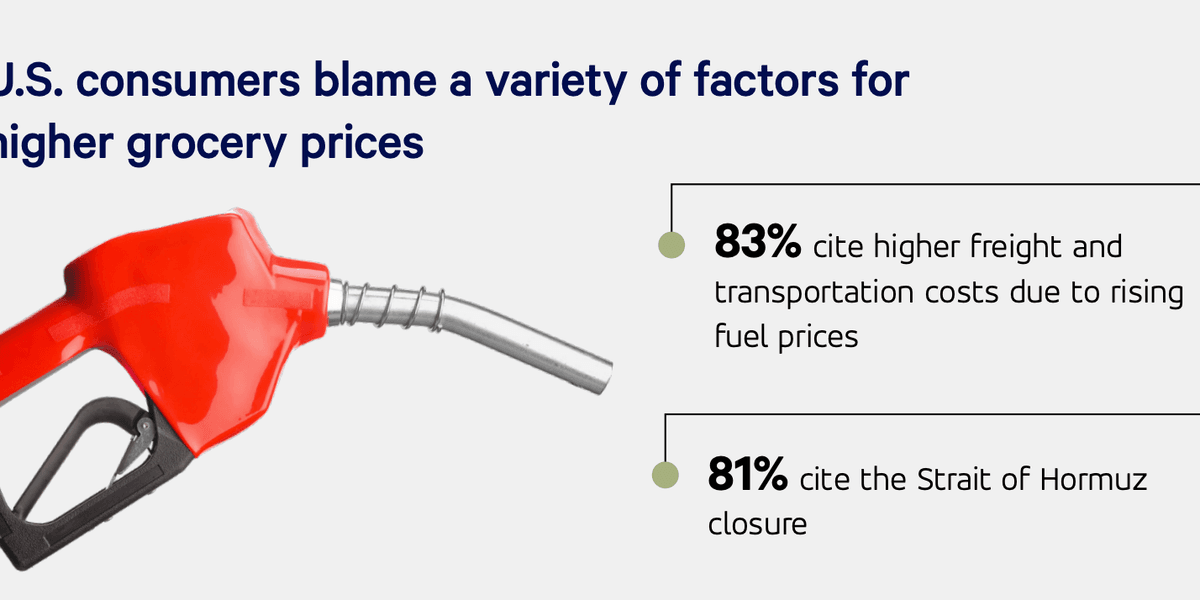
The results showed that 85% of respondents say they are concerned about the impact of grocery prices due to inflation. Consumers place the blame primarily on higher freight and transportation costs due to rising fuel prices (83%). This aligns with the 81% of respondents who believe the Strait of Hormuz closure is responsible for elevated prices, given that roughly one-fifth of global oil moves through the region.
Survey respondents also believe that global tariffs (64%) are responsible for inflated grocery prices, closely followed by the increased cost of raw ingredients (57%), increased profit margins for brands and manufacturers (50%), and increased labor costs in manufacturing and food processing (47%).
The “2026 Consumer Grocery and Protein Trends” report was fielded by a third-party provider which surveyed over 1,000 consumers across the United States in June-July 2026.
One of the biggest impacts of changing buying patterns has affected the protein sector specifically, where 55% of U.S. consumers are buying less beef or have stopped entirely, citing rising prices, the New World screwworm outbreak, and mounting global trade disruptions. At the same time, one-third of consumers have increased their overall protein purchases in the past six months, as health-conscious shoppers shift their spending toward chicken, eggs, canned proteins, and other alternatives.
The New World screwworm, a livestock parasite not seen in U.S. cattle for decades, has recently been detected in Texas and has begun spreading beyond its initial containment zone. Seventy-eight percent of respondents say they are concerned it could further affect beef prices or availability.
As shoppers increasingly avoid beef, they have shifted to other protein sources. Forty-four percent are buying more chicken, pork and seafood, 28% are buying more canned or shelf-stable proteins, 22% are turning to egg-based proteins, 18% are opting for plant-based proteins, and 10% are increasing purchases of protein powder substitutes.
“The data is striking. More than half of consumers are pulling back from beef, and the screwworm outbreak is adding another layer of uncertainty to an already strained supply chain,” said Wayne Usie, Chief Strategy Officer, Blue Yonder. “At the same time, demand for protein overall is not going away. Consumers are actively rethinking where they get their protein and how much they’re willing to pay for it.”
