


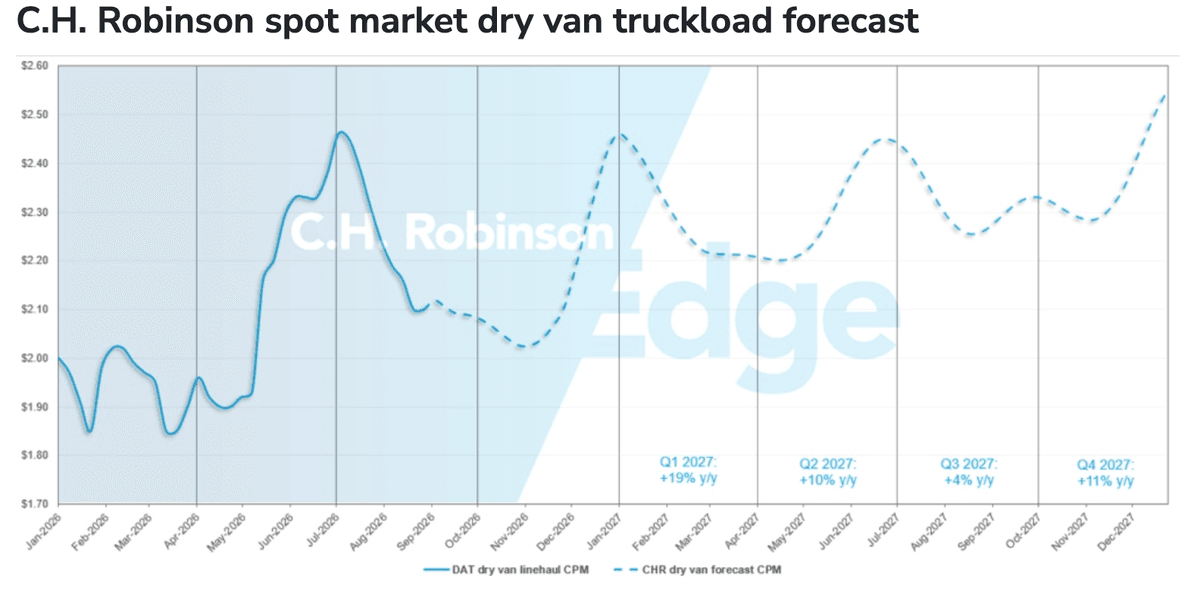
As the freight market continues to normalize after a nearly four-year rate recession, brokerage firm C.H. Robinson is forecasting that spot rates in 2027 are expected to rise another 10% year over year for dry van, 11% for reefer, and 10% for flatbed as trucking capacity continues to contract.
That model comes from C.H. Robinson’s September Edge report, which reflects a market where freight demand remains relatively muted in the near term, but transportation supply continues to contract. As capacity exits the market, costs are expected to increase steadily through 2027, even without a significant change in underlying freight demand.
A significant portion of excess freight capacity—the industry term for the number of trucks and trailers on the road—has shrunk in the past year, due in part to White House labor policies. For example, the U.S. Department of Transportation has pressured multiple states to revoke non-domiciled commercial driver’s licenses (CDLs) which it says were unlawfully issued to drivers no longer residing in those states. And the Federal Motor Carrier Safety Administration (FMCSA) has moved to increase the penalty for failing English language proficiency tests to include revoking of a driver’s license.
Such moves have apparently helped to prop up freight rates, but some transportation analysts caution that the strategy has created a “capacity-driven recovery” that may not be sustainable unless demand for freight services also begins to rise.
Likewise, C.H. Robinson’s report finds that truckload rates in September are coming down from their peak in July as uneven consumer spending has kept demand from rising.
“This has prompted a modest reduction in C.H. Robinson’s full-year 2026 spot-market forecasts for both dry van and refrigerated truckload,” the report said. “However, the fundamental story of the freight market remains largely unchanged. Elevated insurance costs, stricter driver requirements, federal enforcement actions, and other business challenges continue removing capacity from the market.”
“This creates a market that remains increasingly sensitive to disruptions. Seasonal events, weather, enforcement campaigns, and year-end shipping patterns are expected to create greater volatility than in recent years because there is less excess capacity available to absorb sudden changes in freight demand,” C.H. Robinson said.
