


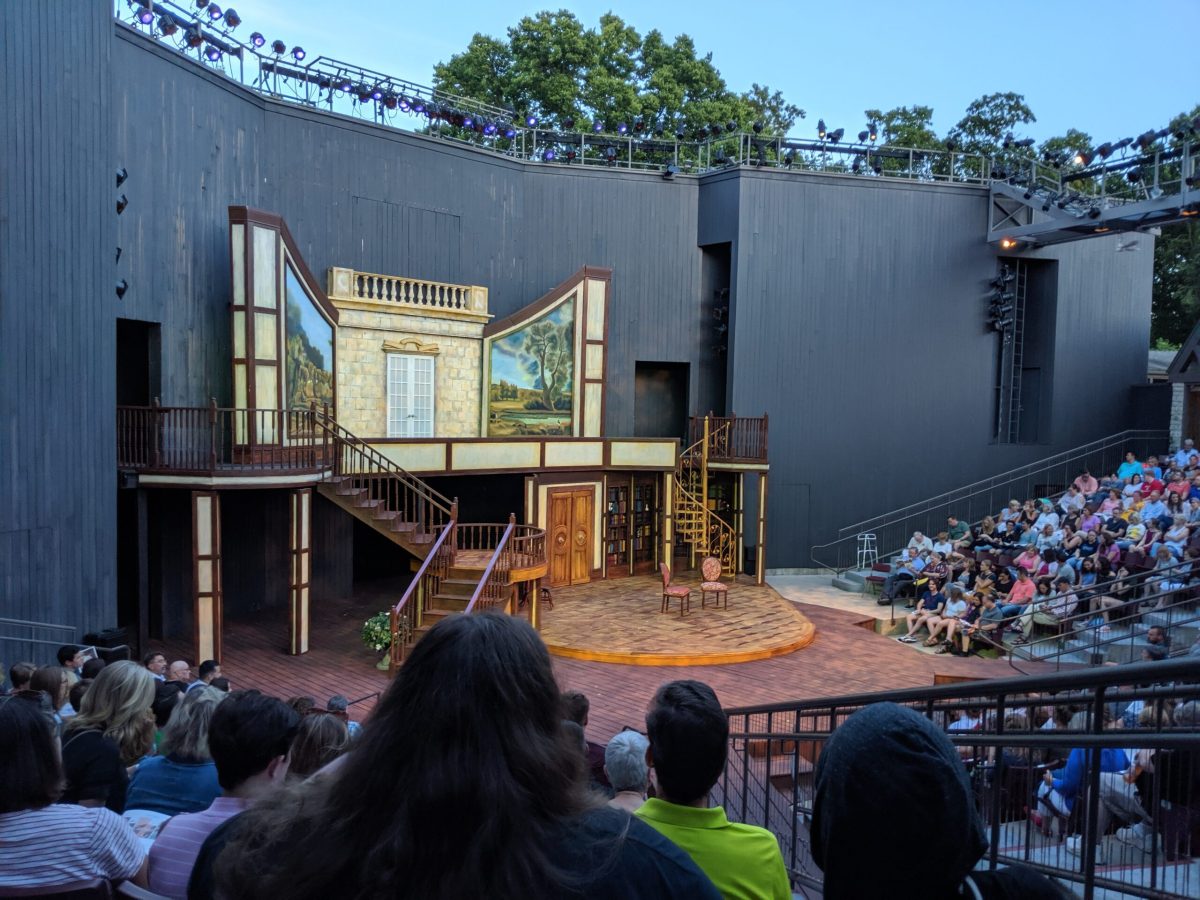
A Broadway producer told The Hollywood Reporter that big Broadway musicals are “not quite find[ing] the audience that can sustain them at the level that they need to be sustained because the costs have gone up so much.” This in the same week that the Public Theater’s Oskar Eustis announced he’ll leave the Public in 2028 and contended that the American nonprofit theatre movement is over, with “absolutely zero consensus on whether theater should exist as a nonprofit performing arts field or whether we should exist at all.”
That sounds scary, coming from one of theatre’s most prominent executives. But it fits with a wave of closures and collapses across the arts — particularly in theaters — in the past year. It’s difficult to deny that something structural in the arts seems to be failing. I’ve written a lot about the withering of America’s cultural middleware, the connective layer of civic tissue that once built context for a community and connected audiences with the arts but has largely disappeared over the past decade or so.
Today, I’d like to tackle the idea from the other end. And it starts with, of all things, Paramount’s attempt to buy Warner Bros. Discovery. The story at first might seem unrelated, but I’d like to make the case that it’s connected to something troubling.
Last week Paramount agreed to pause trying to close its $111 billion merger after attorneys general from 12 states sued to stop it. Most of the rank and file in the entertainment industry are opposed to the deal, since it will almost certainly lead to significant job losses and reduced production at a time when Hollywood is ailing. The Writers Guild filed its own motion to block it this week.
The Paramount/Warner deal is the largest media transaction in a generation. The Broadway story, on the other hand, fits inside forty-one theaters on eleven blocks in Times Square. And regional non-profit theatre is tinier still and more disconnected. But they all make different versions of an argument about a mentality currently afflicting our culture — the notion that all art, all culture, has merged into one giant vat of attention where everything competes with everything else. Paramount states the case most plainly, in a legal filing, because it is one of the last creative industries that can still credibly scale. Broadway lives it, because a merger case isn’t available. And non-profit theatre is trapped in a system in which it has virtually no ability to meaningfully scale.
Derek Thompson, one of my favorite writers on culture and technology, recently wrote about philosopher Agnes Callard’s one-word theory of why everything in the culture around us feels so strange right now. She calls it the uni-context.
A context, Callard says, is a set of circumstances that tells you how to behave. There used to be many — church, bar, parlor, club, work — each with its own rules. To operate successfully in any of them, you had to learn the rules, the relationships and the culture. And we learned to switch from one to another, expectations translated and adjusted.
Now, she says, there is only one room, and we are all in it, and the rules are the same everywhere. Since everything is competing for attention, and attention has become the global currency, that common currency is imposed across everything. In an age of endlessly scrolling screens and so-called context-collapse, in which fragments of “content” are endlessly mixed and stripped of locality by algorithms, the distinctions that only local rules could make disappear. In this (ahem) context, quiet and local and “better” are no longer a fixed, or for that matter, viable, thing.
And so the Paramount merger and Broadway and non-profit theatre are strangely arguments circling the same idea. Paramount essentially argues that there’s no such thing as the movie business anymore, only the attention business, and so its merger should not be considered in the context of other movie makers, but also to YouTube and TikTok and Netflix and Amazon.
Theatre has ceased to be measured against other theatre (and even when it is, who really seems to care?) and competes inside an attention economy that lives at a scale it can’t hope to be viable in.
Paramount’s case is not that a combined company will result in better or more films. It’s that the combined company will be bigger. That’s it. Its chief legal officer — Makan Delrahim, who ran antitrust at DOJ in Trump’s first term — told California’s attorney general in May that “absent something transformative, neither party is positioned to grow to a scale where they would catch up to the leading streamers.”
As arguments go, it’s a reasonable one: neither can compete with the big streamers alone, so let these big ‘ol legacy studios combine forces and give it a try. But look at what the yardstick is. Not audiences, not the work, not whether either company can run a profitable business at the size it already is. The stated benefit of the merger is getting bigger, and the mechanism by which it delivers that benefit is not more resources to make better work but simply being allowed to grow bigger. We need scale in order to compete with scale for scale’s sake.
A Wall Street Journal editorial this week made the uni-context case about as plainly as it can be made, calling the state attorneys general suing to block the deal “Norma Desmond clinging to a bygone era” for insisting theatrical distribution is a market at all. Movie-making, in other words, isn’t a distinct market anymore.
Except that the agency that approved the deal doesn’t seem to agree. DOJ cleared it in June while explicitly holding that YouTube and TikTok “do not appear to be competitive substitutes here under well-established antitrust legal precedents, although they compete broadly for consumer attention.” So the government approved a merger justified by the need to compete with these platforms after finding these companies don’t legally compete with the platforms? Hmnnn.
But that is the whole fight, and it isn’t about movies. It’s about whether separate contexts still exist at all — whether a film in a theater and a vertical microdrama on a phone are two things or one thing.
Expand that idea to anything that competes for your attention. Online competes against live theater competes against streaming music competes against TikTok videos competes against books. The uni-context. In the uni-context, you don’t succeed if you don’t scale. Even if you still make a profit. This is the Big Tech business model straight out of Silicon Valley and the basis for the digital revolution a generation ago that helped erode audiences for culture.
But here’s the trouble with the uni-context as a business strategy: in a single-comparison field, size is the only durable competitive advantage, and nobody can get enough. So everyone chases getting to scale, and the chase is what ultimately does damage.
The states’ complaint against the merger contains a telling statistic about scale: two giants — Disney and Fox — released 112 wide films between 2015 and 2018. The same entities released 54 between 2022 and 2025, a 52 percent decline against an industry-wide drop of 13 percent. Scale, once achieved, produced less, not more. And Netflix, which seemingly won the streaming wars and is currently the giant, is in a bit of a tailspin of its own right now. The stock price has dropped roughly by half from a year ago, and the streamer seems perplexed that viewers aren’t coming back for second seasons of its own hits.
So Broadway is maybe a control experiment, because Broadway can’t really scale. There is no “merger” available and there is a fixed number of seats. Subjected to the same scaling logic with nowhere to scale, it has arrived at the same ethos by a different road: an all-time record $1.9 billion gross in 2025-26, achieved with 35 new productions and six original new musicals, down from sixteen two seasons earlier. Attendance is still below 2019. And about ten of the thirty-one running shows take half the money. The math, it really ain’t mathing anymore.
When you can’t add product, a growth imperative has to turn inward. You have to extract more from the seats you have and you ultimately stop making risky things. Australia is watching its homegrown musical sector come apart for this reason. These are attempts to wring more money out of markets that aren’t scaling bigger. But it’s ultimately a self-defeating game as an over-extracted market starts to fail. Thus Eustis’s warning of failure for the theatre industry.
And when you can’t extract any more, you get absorbed. In Dallas this week, the AT&T Performing Arts Center and Dallas Theater Center — one of its five resident companies — announced they’ll merge, with DTC becoming ATTPAC’s producing arm. A theater company that has been making work since 1959 becomes a department of the building it rents. That’s the Paramount logic arriving three tiers down, where nobody has to file an antitrust brief to justify it.
Meanwhile the category itself is quietly dissolving. When the UK government announced a 20 percent cut in business rates for pubs, social clubs and live music venues in England, it left theatres out — even though theatres and arts centers run on much the same operational model. That isn’t hostility. It’s a government that no longer has a separate context for theatre either.
Callard’s argument has an interesting kicker. Rather than rejecting it, people seem to choose the uni-context. They understand it because it’s where they live. They go where their attention is drawn, no longer sticking to genres or even specific art forms. Which means the standing complaint — that audiences ought to value the local, the particular, the in-person — may not really be a messaging failure to be fixed with better marketing. It’s a bet against something people have been choosing for what she says is now a hundred years.
So that’s depressing.
But maybe the more interesting strategy is counterintuitive: reject the uni-context and reimpose your own context. Manufacture it and charge for it.
The most useful evidence for this isn’t a clever consumer brand. It’s already happening inside our own sector. A year ago Congress killed the Corporation for Public Broadcasting — which is the funding shock Eustis is describing, arriving suddenly. The results are not what most people predicted. Stations posted record giving, some covering the entire federal loss. South Dakota Public Broadcasting rebuilt after losing every federal dollar. Wyoming’s public TV network is dropping the PBS brand — “We are Wyoming’s storyteller first and a member station second.” Huntsville’s WLRH dropped NPR programming and climbed from around tenth to fourth in its market.
Read that as a scaling story and it makes no sense at all. Read it as context and it’s obvious. Those stations didn’t win by competing harder inside the national room. They walked out of it and rebuilt a smaller one with its own rules, and their audiences followed them in.
The same instinct shows up in commercial form. Costco is thriving as the anti-Amazon because it decides for you — the lower-choice pre-selection is the product, packaged in an in-person experience. British zines are back because you’ll spend longer with one than with anything you scroll by. Los Angeles movie theaters reactivated a nearly extinct craft to run 70mm projectors, scrambling to meet demand for Christopher Nolan’s Odyssey.
None of these really scales.
One caution, though. The same reporting on public media shows rural stations were hardest hit. And SMU DataArts found that as federal COVID relief wound down, the gap between the strongest and weakest city arts sectors widened sharply. And the city that led that cohort in revenue growth was Cleveland, on the strength of a dedicated public operating subsidy — which is to say, on the last surviving piece of exactly the consensus Eustis says is gone.
So “prove you matter to your community” sounds like a market test but behaves like a redistribution mechanism. Context can be manufactured. It can’t be manufactured out of nothing. Somebody in the room has to be able to pay for the room.
Which brings me back to middleware.
You can see the collapse of cultural middleware as a funding story, the civic connective tissue starved and cut. The uni-context suggests something bigger. Middleware was context. That was its job: an institution existed because “local” meant something, because a community had its own rules and needed a broker between those rules and the art. Dissolve the contexts and you haven’t just defunded middleware, you’ve removed local context that defined communities and their culture.
Which changes what rebuilding means. You don’t get middleware back by funding the old institutions to their 2010 budgets, because the thing they were built to connect doesn’t exist in that form anymore. What can be built is context itself — deliberately, as a product, with a price on it.
Broadway’s problem isn’t that it wants to get bigger. It’s that it can no longer survive selling out. Cats: The Jellicle Ball won three Tony Awards, played to better than 93 percent of capacity, and closed four months after opening because a million dollars a week couldn’t service its capitalization. Death Becomes Her grossed $102.5 million over twenty months at 92 percent capacity and has never announced break even. Roughly seven percent of the musicals that have opened since the pandemic have paid back their investors. A full house is no longer a business model. With numbers like these, the whole business isn’t even really a business model anymore.
That’s the uni-context as a balance sheet rather than as strategy. Broadway couldn’t scale in seats, so it scaled in cost — capitalizations have roughly doubled in a decade — and in a single comparison field a musical isn’t measured against other musicals, it’s measured against the Vegas Sphere, against a Marvel blockbuster opening, against a streaming series with a $200 million budget. Any cost structure that requires more than that ceiling can generate is a business engineered to fail at capacity. Baumol told us costs would rise faster than productivity. He didn’t anticipate a second escalator, in which you also have to look like you belong in the same frame as things that cost a hundred times what you can gross.
So the uncomfortable question isn’t how the arts grow — or even just maintain. It’s what the room can actually generate, and whether there’s a version of the work that fits inside it. That question points downward — smaller, cheaper, more often.
But in a uni-context world, smaller reads as losing.
Also Worth Your Attention
A court has now set the price of a book at $3,000. A judge approved Anthropic’s $1.5 billion settlement with authors and publishers last week — roughly $3,000 per work for an estimated 500,000 works. Many authors are happy with the windfall. It’s the largest copyright settlement in American history. But it’s a very bad deal. That number buys permanent ingestion of books into an AI model with a one-time payment; it values the input and says nothing about the output, or about the market for the next book. And worse — it establishes the market which everyone downstream will now have to negotiate against as a ceiling. Sony’s second suit against Udio, asserting copyright violation of 30,117 recordings, is the first test of whether $3,000 a work becomes a benchmark or an outlier.
Nebraska took back a third of its cultural endowment. The Nebraska Cultural Endowment matched philanthropic gifts dollar-for-dollar with state money, a structure built so that culture wouldn’t have to re-argue its relevance every budget cycle. The state clawed back a third of it to help close a budget shortfall. The premise of every endowment is that permanence buys you out of politics. Alas, we find out that it doesn’t and a legislature can un-promise. Meanwhile SMU DataArts finds the gap between the strongest and weakest arts cities in America widened sharply as federal relief has drained away, with Cleveland’s dedicated public funding at the top of the ranking. Why? It’s a dedicated local revenue stream with a constituency attached to it.
Editor’s Note: These weekly essays are meant to connect stories from the week to larger trends and ideas across the arts world. Want to support our work? Subscribe to ArtsJournal’s free newsletters. Or better yet, support us with a premium ArtsJournal subscription at $5/week or $52/year. Much appreciated.
Related
Discover more from diacritical
Subscribe to get the latest posts sent to your email.

