


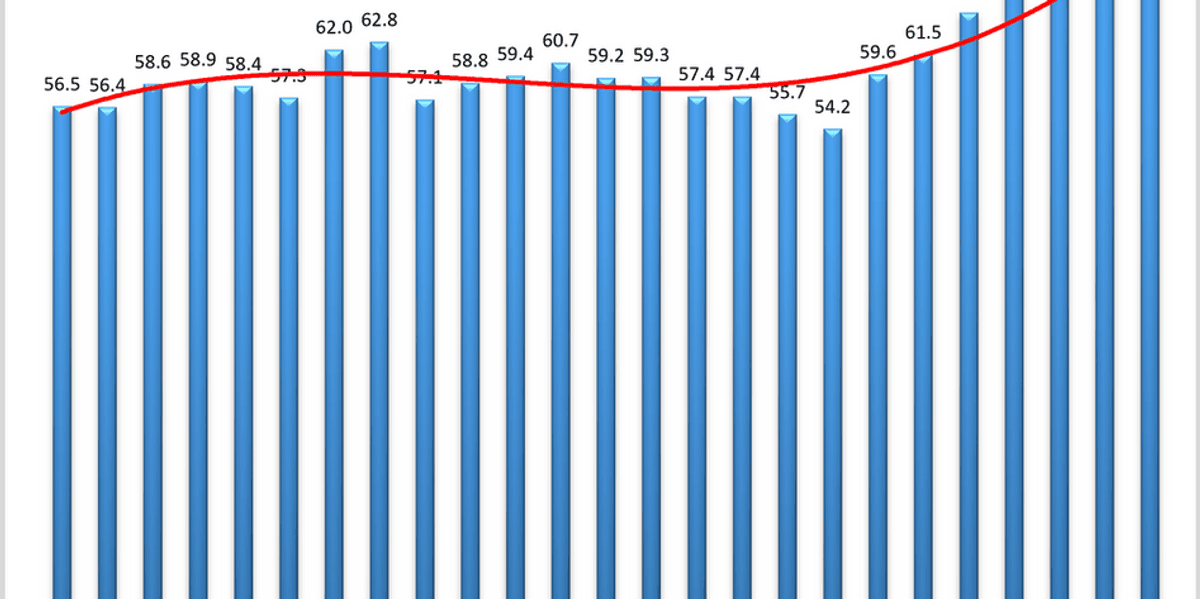
Economic activity in logistics slowed in July but remained above recent highs, indicating continued strong demand for logistics services nationwide, according to the latest Logistics Managers Index (LMI) report, released this week.
The July LMI reading was 68.9, down from June’s reading of 71.1, which was the index’s fastest rate of expansion since March 2022, according to LMI researchers.
The LMI is a monthly measure of economic activity across warehousing and transportation markets based on a survey of U.S. logistics managers. An LMI reading above 50 indicates expansion across the industry; a reading below 50 indicates contraction.
The cooling in July reflects an inventory pullback among retailers who had stocked up in May and June due to tariff uncertainty and the impending expiration of temporary tariffs at the end of the month. The move to build inventory earlier in the cycle to prepare for the upcoming holiday peak shipping season is a broader response to continued trade uncertainties, LMI researchers said, noting that companies are bringing in third- and fourth-quarter inventory earlier after years of having a more just-in-time model.
Inventory levels fell five points compared to July, to a reading of 55. The slowdown was most pronounced among downstream retailers, whose inventory levels went from “robust expansion” at 66 down to 46.3, indicating contraction.
Tightening capacity across warehousing and transportation markets also contributed to July’s slower growth. The LMI’s Warehousing Capacity and Transportation Capacity indices both contracted further in July compared to June, falling slightly to 46.3 and 28.4, respectively. Those conditions drove up pricing: The LMI’s Warehousing Prices index was 75.5 in July—the fastest rate of expansion in that metric since January 2025—and Transportation Prices remained high at 86.9 but down compared to June’s reading of 92.4.
Looking ahead, respondents said they expect inventory levels to increase over the next 12 months, accompanied by continued cost and capacity pressures.
“Essentially, respondents are anticipating having to fit increasing inventories into tighter capacities at higher costs over the next 12 months,” the researchers wrote in the July report.
The LMI is based on a monthly survey of logistics managers from across the country. It tracks industry growth overall and across eight areas: inventory levels and costs; warehousing capacity, utilization, and prices; and transportation capacity, utilization, and prices. The report is released monthly by researchers from Arizona State University, Colorado State University, Rochester Institute of Technology, Rutgers University, and the University of Nevada, Reno, in conjunction with the Council of Supply Chain Management Professionals (CSCMP).
