


The great freight recession that’s sapped the trucking industry of any meaningful profit growth over the past four years finally seems to be petering out.
But it’s not for the reasons you might think.
“The word ‘recession’ gets thrown around a lot,” Jason Seidl, managing director at securities investment firm TD Cowen, has observed. “But freight was not always terrible. There was too much capacity, and that was the persistent, overwhelming issue that led to poor pricing and performance. It’s a supply side issue. And capacity is still coming out.”
A correction is well underway, and that’s slowly but surely deflating what has been a pretty durable supply bubble, primarily in the truckload markets. Regulatory initiatives also have played a part. Those have included states, at the federal government’s urging, rescinding or not renewing commercial licenses (CDLs) for non-domiciled drivers.
Also culling the driver pool has been the impact of the English language requirement and the government’s crackdown on fraudulent CDL schools.
Yet simple economics may have been the biggest factor in the now-deflating supply bubble.
When supply was abundant, the market was awash in one- to five-truck operators taking loads at rock-bottom rates, simply to generate enough revenue to pay their operating expenses, like fuel, maintenance, and insurance—and hopefully break even. To stay afloat, they were also drawing down the last of the Covid recovery funds in their bank accounts.
As that owner-operator capacity has continued to exit the market, it’s put a floor under pricing that seems to be holding. One has only to look at the firming truckload rates in the spot market and increased tender rejection rates for evidence of that, industry analysts say.
SEEING SOME GREEN SHOOTS
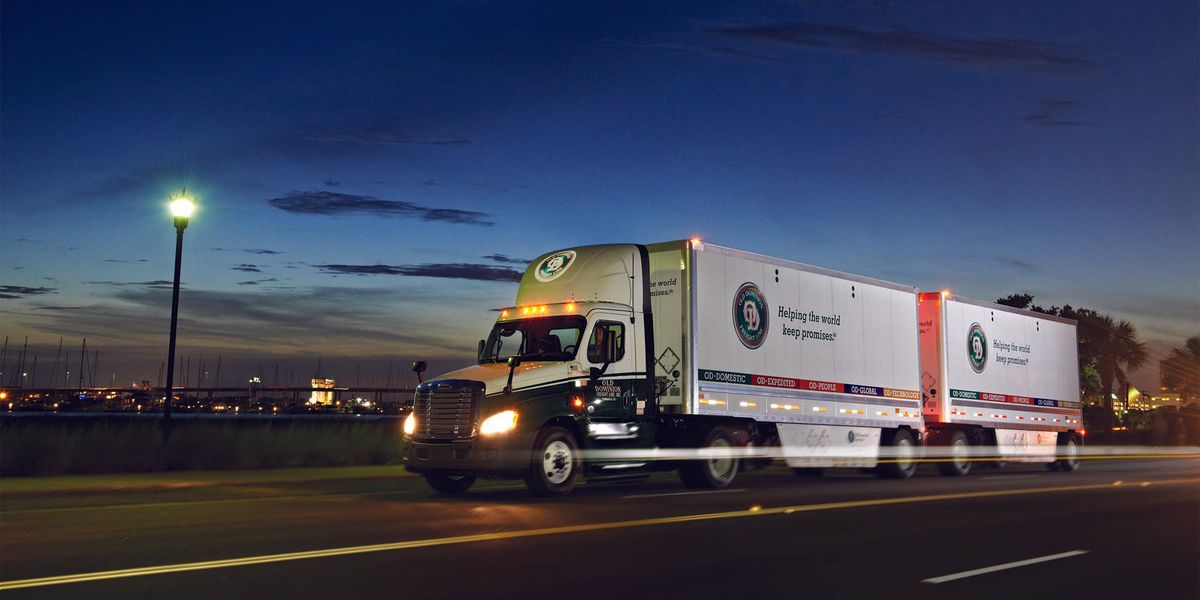
The recovery is playing out across trucking modes, including dry van. “We are seeing some green shoots, for sure,” says Greg Plemmons, executive vice president and chief operating officer at less-than-truckload (LTL) carrier Old Dominion Freight Line. “It’s primarily been a supply-driven rebound to this point,” he’s observed.
One industry trend during the supply bubble was heavier LTL shipments migrating over to the truckload (TL) space as partial truckload shipments. “Typically, that’s not what [TL] carriers want to haul,” Plemmons notes. “They were doing it when they needed it, to use up some of that excess capacity and to cover their costs.”
Now that trend is reversing itself. “So much capacity has left the truckload sector, those heavier or volume shipments [ones consisting of several big pallet loads] truckload carriers were handling are shifting back into our space,” he reports. “We expected these to come back, we prepared for it, and now we’re seeing it,” Plemmons says, adding that volume and heavier shipments are one of its faster-growing segments, a trend that’s illustrated in ODFL’s rising weight-per-shipment metric. “We felt confident these would come back when the cycle shifted.”
With a recovering market and rising demand on the horizon, ODFL also has increased its capital expenditure (CapEx) plan for the year. It’s raised its 2026 CapEx from $265 million to $380 million. “We wanted to take advantage of properties [that came available] and fit into our long-term strategic plan,” Plemmons says. “Plus, we pulled forward into Q4 some of our 2027 planned spending on equipment to take advantage of available build slots and favorable pricing.”
It’s a similar story at privately held LTL carrier Estes Express Lines. Despite the tepid freight market of the past several years, Estes has been bulking up its fleet and expanding terminal capacity in preparation for a strengthening market.
“I’m super glad that we invested in the added capacity, as that’s helped our teammates be more efficient and take care of the customer’s freight,” notes Webb Estes, the carrier’s president and chief operating officer. After investing heavily in expansion during the pandemic, Estes is “doubling down” to further grow its capabilities. Earlier this year, the company bought 600 more tractors—all with advanced driver-assist safety technology—and added nearly 1,000 trailers as well as more forklifts. “We bought faster than we thought we would need this year, kind of a double dip,” Webb Estes says. He also reports that the company plans to add another 700+ tractors by the end of the year.
Driver hiring has not been an issue, either, Estes notes. “We continue to have success recruiting and retaining quality drivers,” he says. “Our driver turnover has been less than 10%.”
MANUFACTURING REBOUND UNDERPINS GRADUAL RECOVERY
ODFL’s Plemmons and others cited positive news from the July Purchasing Manager’s Index report, published by the Institute for Supply Management (ISM). The July index came in at 55.6 (a reading of above 50% indicates growth), staying on the plus side of growth for the seventh consecutive month. That topped June’s index by 2.3%, “marking the highest monthly tally going back to May 2022,” the report said.
ISM noted that the growth was being driven by solid gains in production, new orders, and employment, with the employment index returning to expansion territory for the first time in 33 months. Export orders also improved, while customer inventories remained lean, supporting continued manufacturing demand.
Frank Granieri, chief commercial officer at LTL carrier A. Duie Pyle, while encouraged by the ISM report, characterizes the market as undergoing “a gradual recovery rather than a sharp rebound. Shipper demand is improving, but it’s still uneven by customer and industry,” he notes.
What’s different, he’s observed, is that the gradual recovery in demand is happening in parallel with a tightening supply environment. He agrees with other executives that capacity continues to leave the truckload market, adding that “driver availability is becoming more constrained, and LTL tonnage trends have strengthened as we’ve moved through the year.”
He believes the industry is entering a more balanced market environment “where demand gradually improves while available capacity tightens. If those two trends continue to converge, I think the freight environment could look meaningfully healthier over the next 12 months,” he says.
Though he acknowledges that “customers are still very focused on cost and productivity,” Granieri also reports that “we are seeing more conversations around growth, capacity planning, and longer-term supply chain solutions.”
Ali Faghri, chief strategy officer for LTL carrier XPO, agrees that the recovery is not uniform across every sector. “The retail sector has modestly outperformed throughout the year, but we’re beginning to see the industrial markets pick up steam, particularly manufacturing,” he says. “We’re also hearing more optimism from our customers, as they see their own demand increasing.”
With industrial customers accounting for roughly two-thirds of the LTL market, the upbeat ISM report also supports an optimistic outlook, Faghri notes. “This metric is historically a leading indicator of industrial activity … that’s a meaningful signal for where freight demand is headed,” he says.
It’s also reflected in XPO’s recent performance, as reported in its second-quarter earnings announcement. “Our tonnage was up 4% year over year in June. That acceleration in volume exceeded our expectations and is well ahead of seasonal norms,” he notes. Faghri adds that XPO has been diligently planning for the recovery by investing in its network and fleet during the downcycle. “Since 2021, we have added 30% more trailers, 20% more tractors, and 15% more dock doors.” XPO ended the quarter with 30% excess door capacity, “giving us the flexibility to grow alongside our customers without compromising service,” he says.
RIDING THE CAPACITY STORY
For retailers, volumes and usage of trucking providers is not significantly different than in past years. Similar to other trucking users, in retail, it’s been more of a capacity story, says Jess Dankert, vice president of supply chain at the trade group the Retail Industry Leaders Association (RILA). “Seeing the market right-size from a capacity standpoint is not necessarily a bad thing,” she notes. “The industry will equalize as market forces come into play.”
The more immediate concern for retailers, she says, is the consistent drumbeat of higher operational costs and how those are passed along to cargo owners. “Retailers are very concerned about how to keep [trucking] costs manageable, while meeting needs for timely and flexible trucking resources to support their supply chains.”
“How are we best using drivers, how are we using technology for better transportation planning and execution?” she asks. “Are we looking for opportunities to reduce empty miles and utilize more backhauls so we [and our carriers] can be more efficient? At the end of the day, that type of collaboration helps manage and control costs,” she notes.
Retailers also are placing increased focus on carrier engagement and being a shipper of choice. “It’s more of a focus on strategic, committed partnerships versus transactional relationships,” Dankert says.
It’s also a proactive approach that smart shippers are increasingly embracing to ensure dependable capacity, reliable service, and more predicable costs, she notes. “They are not only focused on the rate, the transaction. It is more of a strategic, collaborative, joint planning approach,” she says.
She emphasizes that in this day and age, it can’t be just about the rate, but more about quality of service, supporting a flexible supply chain, and engaging trucking partners that provide stability and consistency. “It’s about total cost to serve, looking at the whole ecosystem.”
RATES FIRMING
Avery Vise, vice president of trucking for economic forecasting and analytics firm FTR Transportation Intelligence, has watched capacity continue leaving the market steadily over the past three years. It’s only in the last six months or so that it’s dropped to a level where supply is falling below equilibrium with demand.
That’s driven a significant rise in rates, particularly in the truckload sector, where, according to FTR data, spot rates are up 35% to 36% this year, “most of which already is baked in” with spot rates now moving seasonally, Vise notes. He projects contract rates to be up about 10% this year “and another 10% or so next year.” Contract rate increases tend to lag the spot market by six to eight months.
“The spot market has likely fully reset,” he says. “Spot is no longer a refuge for shippers who want a better deal. The market is not loose anymore, so carriers are demanding more for a load and rejecting more of those that don’t meet their needs.”
One difference in today’s market, Vise believes, is that demand is not driven by heavy or accelerating volume pressure. ‘It’s really a slight volume increase on top of extraordinarily tight capacity.”
He doesn’t completely discount the notion that regulatory initiatives have been a factor in pushing more small operators and single truck drivers out of the market. But he cautions against reading too much into that. What is driving the market shift, in his view, is more of a traditional, economics-driven supply side correction.
“Headlines don’t translate into capacity,” Vise says. Regulatory actions “have been more a disruptor than something that caused the significant drop in capacity in the first place.”
Several brokers have shared with him a growing undercurrent of worry about small operators and their availability. What’s emerging is a “fear factor” among some immigrant drivers about being put out of service or being deported. “Some drivers are refusing loads to certain areas,” one broker told Vise. “He said that he used to have no trouble getting smaller carriers to go into Florida. Now they won’t go east of Colorado because [of the perception that immigration] enforcement is so much tougher.”
As truck spot and contract rates have accelerated, that supply and demand dynamic also is benefiting intermodal service providers, he adds. Intermodal volumes in July “were the highest since November 2021,” reflecting a shift of volumes from over-the-road to rail. “That’s almost certainly been a response to dry van rates,” he says. He believes that trend may have peaked, “as any shipper switching modes will already have done so.”
As well, assuming spot truckload rates have peaked or nearly peaked, “we don’t believe truckload rates overall have peaked,” he says. “We forecast continued contract rate growth in absolute terms [as opposed to year over year] for about another year.”
