


Logistics activity grew September, driven by tight warehousing and transportation capacity and marked by high costs that continue to pressure supply chains.
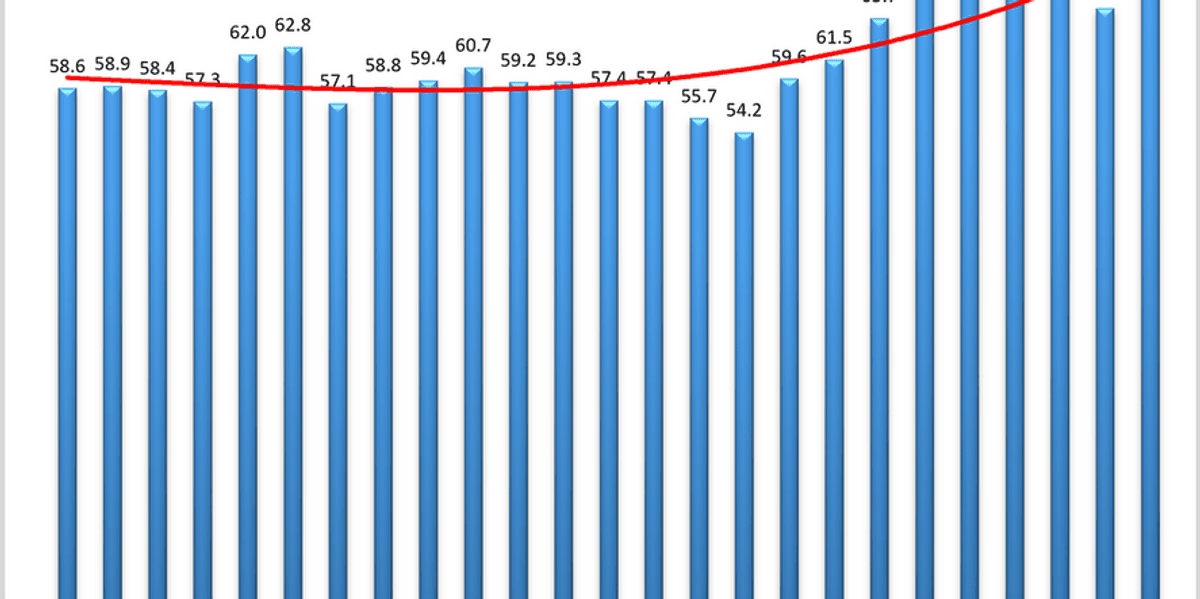
That’s according to the latest Logistics Managers’ Index (LMI) report, released this week. The LMI score for September was 70.2, up 3.6 points from August to reach its highest level in four years.
An LMI reading above 50 signals expansion across the industry, and a reading below 50 signals contraction. A reading above 70 indicates a “significant rate of expansion,” according to the LMI researchers; expansion equates to strong demand for logistics services nationwide.
Inventory levels grew at a faster rate in September compared to July and August, which drove up costs and contributed to tightening warehouse capacity. The LMI’s warehousing capacity index saw its fastest rate of contraction in four years, sinking to 39.3. Most of that inventory is sitting upstream, with wholesalers, and waiting to make its way to retailers for holiday peak season, a process that typically occurs in mid-October. Inventory costs rose to a reading of 79.9, the third-highest reading in two years.
Transportation capacity remained tight as well. The transportation capacity index dropped to 34.4, continuing a 10-month trend of contracting activity. Transportation prices continued to move toward historic highs, with the index rising nearly three points to a reading of 92.7.
The researchers pointed to the high “disruption-driven costs” as a key pressure affecting supply chains heading into peak season. They noted that Aggregate Logistics Costs—a combination of Inventory Costs, Warehousing Prices, and Transportation Costs—reached their highest level in September since April of 2022 “when supply-driven inflation was rampant in the wake of both the cessation of Covid-era demand and the invasion of Ukraine.”
Logistics managers expect costs to remain high over the next 12 months, according to the report. September’s Future Conditions Index scores for inventory costs, warehousing prices, and transportation prices were 81.3, 72.4, and 86.1, respectively.
The LMI is based on a monthly survey of logistics managers from across the country. It tracks industry growth overall and across eight areas: inventory levels and costs; warehousing capacity, utilization, and prices; and transportation capacity, utilization, and prices. The report is released monthly by researchers from Arizona State University, Colorado State University, Rochester Institute of Technology, Rutgers University, and the University of Nevada, Reno, in conjunction with the Council of Supply Chain Management Professionals (CSCMP).
