


Automated storage and retrieval systems (AS/RS) are often touted for their ability to help companies optimize warehouse space, ease labor constraints, speed fulfillment, and improve productivity—all of which is true. But these increasingly high-tech systems are strategic as well as tactical, often supporting broader corporate goals to expand market reach as well as a company’s product offering.
Shifting consumer demands underlie the trend across the manufacturing, distribution, and retail industries. The prepared-foods market is a case in point: Demand for ready-to-eat and frozen meals, snack packs, meal kits, and the like is expected to grow an average 10% annually between 2025 and 2035, according to recent research—factors that are pushing food producers to innovate.
“This growth is largely driven by the increasing demand for convenience food among busy working professionals, the rising trend of on-the-go eating, and the growing penetration of e-commerce platforms that make these products more accessible,” analysts from Core Market Research wrote in a July report. “As competition becomes more intense, manufacturers must continuously innovate and adapt to maintain their position in the prepared-food market.”
One way food and beverage companies are doing that is by investing in AS/RS technology that can tighten up operations and give them the speed and flexibility needed to respond to market changes and new opportunities. A recent pallet-handling project in Europe illustrates that point—and underscores the growing demand for AS/RS projects around the world.
AUTOMATING FOR EXPANSION
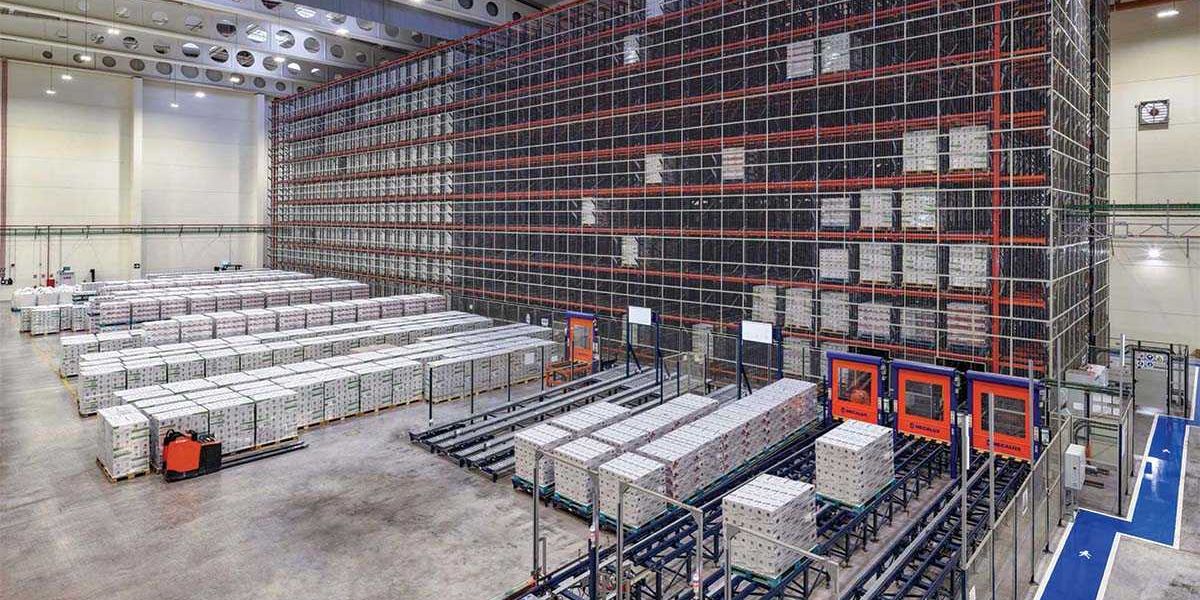
Spanish rice producer Herba Ricemills, a division of Ebro Foods, recently automated one of its warehouses to support market expansion to Africa and the Middle East—a direct response to rising demand for ready-to-eat meals, according to company leaders. The firm commissioned an AS/RS designed by warehouse storage solutions company Mecalux at its San José de la Rinconada plant, in the province of Seville. The site makes ready-to-serve cooked rice products and ships brands such as Minute to North America, Lassie to the Netherlands, Cigala to Portugal, and Brillante and Sabroz domestically.
The partners installed Mecalux’s automated pallet shuttle with a stacker crane to expand capacity, allowing the facility to support the planned market growth while also managing existing demand. The AS/RS consists of a racking system that measures more than 60 feet high and can store up to 5,400 pallets. A single stacker crane navigates a center aisle within the racking and transports pallets to their assigned lane; the electric shuttle takes it from there, moving the pallets to their storage positions.
Prior to the upgrade, the company managed inventory with its ERP (enterprise resource planning) system, with operators manually placing goods on shelves or directly on the floor. But as volumes grew, this system was proving inadequate to the task.
“That setup required greater flow coordination, used space less efficiently, and increased the likelihood of picking mistakes,” said Juan Pedro Álvarez, director of Ebro Foods’ ready-to-serve division in Andalusia, Spain, who described the project in a recent case study. “We needed a system that would maximize capacity, shorten handling times, and ensure complete traceability.”
Under the new setup, the entire system, which also incorporates a separate semi-automated pallet shuttle and traditional pallet-flow racking, is controlled by Mecalux’s warehouse management system (WMS) and works as follows: Ingredients and auxiliary materials used for rice production arrive at the facility’s loading docks and enter the automated warehouse through three inbound inspection stations along the side of the building. The bulk ingredients are stored in racking near an intake area. When it’s time for production, a fleet of autonomous guided vehicles (AGVs) retrieve the loads from the racks and move them to the intake area, where they are conveyed to production lines and prepared for cooking. After the rice is cooked and packaged, pallets of finished goods are picked up by the AGVs and ferried to the AS/RS’s infeed stations at the end of the production lines. The stacker crane then transports each pallet to its designated lane, and the electric pallet shuttle moves it into the correct storage position.
The coordination between these technologies creates a completely automated flow without manual intervention.
A transfer car sorts outbound SKUs (stock-keeping units) into a series of flow channels as directed by the WMS and the company’s ERP system. Pallet flow racking is used to hold goods in quarantine for inspection and quality control. All told, the setup minimizes travel distances, shortens forklift maneuvering times, and speeds up pallet retrieval.
The technology behind the system pulls everything together.
“[The WMS] provides us with end-to-end, real-time control over our facility,” Manuel Matías Martínez, head of warehousing and logistics management at the facility, explained in the case study. “We now track locations, inventory status, and product flows accurately. Training was straightforward, and the team gained full autonomy quickly.”
The results speak for themselves: In addition to improved storage capacity, managers say they’ve seen a 25% increase in productivity and a 95% reduction in picking errors since installing the system.
And they’re ready to capitalize on that market expansion.
“To remain competitive, implementing the latest technologies is essential,” Álvarez said in the case study. “It’s no longer a luxury—it’s an imperative. The time for innovation is now.”
