

Dance Place Is Searching for a New Executive Artistic Director After a Chaotic Summer

Editor’s note: This story was originally published on Sept. 1. It was updated on Sept. 3 with former executive director André Mazelin responses that were supplied to the writer before press time and were regrettably languishing in a spam folder when we initially published this story.
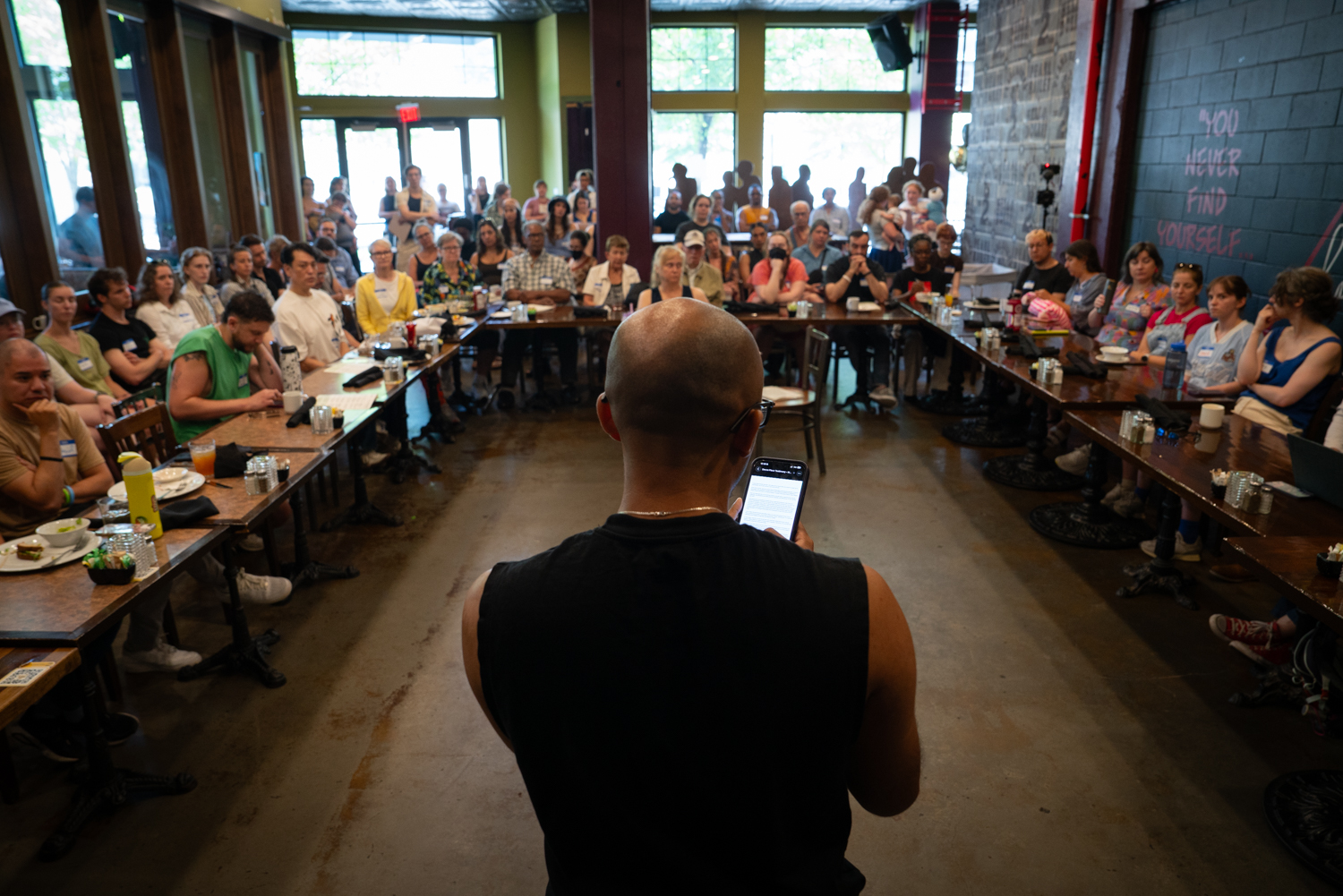
You could write a history of modern dance in the nation’s capital through the biographies of those gathered in the back room of Brookland’s Busboys and Poets for the Dance Place Town Hall on July 19. Nearly 100 people attended the hybrid event put together by the community organization Friends of Dance Place, including choreographers, dancers, former staff, and Dance Place co-founders Deborah Riley and Carla Perlo.
The town hall was organized after the company’s executive director André Mazelin fired artistic director Tariq O’Meally and eliminated the position entirely as part of a restructuring plan on May 28. Attendees accused Mazelin, who was not in attendance, of creating an unsafe work environment during his tenure at Dance Place. The following day, Friends of Dance Place issued a press release with four demands for the organization’s board of directors:
1. Reinstate the artistic director position;
2. Remove Mazelin and refill the executive director role;
3. Ensure Dance Place artistic director and executive director have financial parity moving forward;
4. Establish a regular stream of communication between Dance Place and the community.
On Aug. 18, one of those demands was met when Dance Place announced that Mazelin was departing the organization that same day.
Board member and Governance Committee Chair Erin A. Skinner, who previously served as interim executive director for the organization in 2022, will temporarily step into the role again while a search is conducted for a new executive artistic director.
For more than 45 years, Dance Place has been a nerve center of the dance community in D.C., offering classes, incubating early career artists, and producing performances by local, national, and international artists. In 2023, Mazelin was hired as executive director, marking the first time in the organization’s history that the role of executive director and artist director were separated.
At the town hall, as the press release notes, “former staff shared experiences with Executive Director André Mazelin, highlighting what they believe are his significant administrative, financial, and human resource management failings, contributing to the reasons they decided to leave Dance Place. Several former staff, patrons, and artists also highlighted Mazelin’s absence from many Dance Place events and performances, his perceived lack of investment in providing technical and marketing support, and an alarming absence of basic safety protocols for artists presenting in the space, ultimately calling for his removal.” City Paper’s interviews with six former employees and commissioned artists paints a similar picture.
“I am proud of the work I accomplished at Dance Place and deeply appreciative of the staff, artists, students, partners, board members, and community members with whom I had the opportunity to work,” Mazelin wrote in an emailed statement to City Paper. “My tenure included substantial challenges, including significant financial pressures and organizational change. Those circumstances required difficult decisions, but they also required an executive willing to take responsibility for the organization’s long-term sustainability and continued ability to serve its mission.”
A Dance Hub for D.C.
The origins of Dance Place stretch back to 1972 with the Dance Project, a studio and performance space in Adams Morgan created by dancer-choreographer Jan Van Dyke. In 1980, Van Dyke sold the space to a dancer in her company, Carla Perlo. Dance Place was born. In 1986, following a quadrupling of its rent, Dance Place relocated to its present location on 8th Street NE in Brookland. Choreographer Deborah Riley joined Perlo as a co-director shortly after.
“When I moved here in ’78, I needed a place to take professional-level class, and Dance Project was the only place that suited the things I was interested in,” Alvin Mayes, a dance professor at the University of Maryland, and a longtime figure in D.C.’s modern dance scene tells City Paper. “Carla was actually from the D.C. area, and she had an invested interest in making D.C. a dance hub.”
Since 1980, Dance Place has played a pivotal role in the development of dance in D.C. Mayes notes that when Dance Place began, the ballet and modern dance communities siloed themselves, isolating different styles of dance and dancers. “There were racial elements that went with that, too,” says Mayes.
“Dance Place threw out a net and invited all types of people in, it broke down a lot of those walls that separated different types of dance,” says Mayes. “One of the early things that happened was DanceAfrica came in, and there became an invested interest in the African dance community having a home. Different people started asking, ‘what can we do for this community?’—not just for the dancers, but for the whole community.”
Dana Tai Soon Burgess, the artistic director of Dana Tai Soon Burgess Dance Company, presented his first work at Dance Place 37 years ago and credits Perlo and Riley as guides for his nascent company. “Historically, Dance Place was a very important part of the dance ecosystem of Washington, D.C., specifically for modern dance, as well as culturally specific dance forms,” he tells City Paper.
Although he didn’t speak at the Town Hall, Burgess did attend. “I think it’s really important for all of us who direct dance organizations in D.C. to be supportive of the health of the ecosystem of dance,” he says.
In 2018, following the departure of Perlo and Riley, Christopher K. Morgan joined Dance Place as artistic executive director. “Morgan was the first director who came in after Perlo and Riley retired, and he was an extraordinary performer,” Mayes says. But, Mayes adds, under Morgan’s leadership, “The emphasis became much more on the sense of the performance and less on the development of the community. It was not that he didn’t care about the community, but there was less emphasis on it.”
After leading Dance Place through the COVID-19 pandemic, Morgan left the organization in late 2021. Before the end of that year, choreographer and dancer dani tirrell was hired as artistic director. Tirrell, who left Dance Place in 2024, did not respond to City Paper’s requests for comment.
Mazelin, an experienced arts administrator, replaced Morgan as executive director halfway through 2023 after a national search. Prior to joining Dance Place, Mazelin was the senior manager at Prince George’s Community College Center for the Performing Arts.
Mazelin Arrives
Following Mazelin’s onboarding, former Dance Place employees say there was an almost immediate change in the culture of the organization. “When André came on board, I immediately noticed the kind of closed demeanor that he had,” says Ashayla Byrd, who worked as both a communication and curation intern for Dance Place between 2021 and 2023. She has continued to work with the organization as a contractor. “He always kept the shades to his office window closed. He kept his door closed,” she says. “There was one time we were supposed to have a staff appreciation event. The staff gets to the lobby. There’s no food. André is not there. He came maybe 30 minutes late and we had to set up … everything.”
In response to claims about his closed door and drawn shades, Mazelin says he believes their positioning has “been raised as indicators of my reachability and engagement with my staff. I disagree with this measure.” He continues, “My office environment was a matter of personal workspace preference and operational necessity for privacy at different times.” He notes that he spent most of his time “participating in individual as well as team meetings, organization-wide activities, staff outings and celebrations while remaining engaged in the work of the organization.”
Mazelin says he doesn’t recall the specific event Byrd spoke of but says, “It is possible that one of my colleagues organized one of the events and I ran late because I was wrapping up another meeting. If I was not present at the scheduled start time, I regret any inconvenience that may have caused, but I would not characterize that isolated event as representative of my commitment to or relationship with the staff.”
At the town hall, Malik Burnett read a statement from the company’s former production manager Malik Gomes Cruz (who couldn’t attend the meeting) that said during the latter’s tenure at Dance Place, which began in June 2023, “many things were lacking, but most of all, care.”
In a follow-up interview, Gomes Cruz tells City Paper, “I think the true song of any nonprofit organization is that staff often take on more than what they initially signed up to do. I was supporting far more than what my original role was meant to be. … There was many a weekend in which I was working overtime by, like, 20 to 30 hours.” Gomes Cruz left their role at the end of 2025.
“Decisions regarding individual employees’ schedules or hours were operational matters handled through the appropriate management structure,” Mazelin says.
Byrd tells City Paper she was working 60-hour weeks during performance runs, because the production team had a staff of three people. When she asked to meet with Mazelin to discuss a raise, she says, “André kind of just laughed and was like, ‘nobody’s getting raises this year, probably not next year,’ and was just very nonchalant about it.” She adds, “That’s why I left Dance Place.”
No Artistic Director Necessary
Tariq O’Meally’s firing in May caught the public’s attention and started raising questions about what was taking place behind the scenes at Dance Place. “I kind of built my career and cut my teeth as an artist, as a choreographer, as a programmer through Dance Place,” O’Meally tells City Paper. O’Meally’s goal as artistic director was to make Dance Place a nexus for the art form and open the door to local artists. But they say, “My last 10 months of being with the organization was one of the most difficult professional experiences that I’ve had.”
The founder and lead curator of the annual performance and conference BlackLight Summit, O’Meally is a choreographer, curator, and producer whose work has appeared at the Kennedy Center and Richmond Dance Festival. From 2020 to ’22, they were an artist in residence at Dance Place and worked as the artistic planning coordinator at the University of Maryland’s Clarice Smith Performing Arts Center prior to joining Dance Place in June 2024.
O’Meally says their tension with Mazelin began almost as soon as they became artistic director.
Early in his tenure, O’Meally asked Mazelin to consider giving an employee a raise. Mazelin, they say, refused and “from there this thing spiraled.”
As members of Dance Place’s leadership team, Mazelin says he and O’Meally shared a commitment to the organization and its mission, “while at times having different perspectives about organizational priorities and programming.” He adds, “I respect Tariq’s contributions to Dance Place, and would consider our relationship professional in nature.”
O’Meally characterized the organization’s struggles as “a staffing issue, a morale issue, and definitely a financial issue.” During O’Meally’s first year as artistic director, they say more than half a dozen staff members left—including Gomes Cruz. Dance Place “kept getting leaner and leaner, which made it easier on the budget, but it was constant crisis management,” they say.
Mazelin recalls only one employee leaving his first year at the organization, but says, “Dance Place did experience a number of staffing changes during my tenure, particularly during a period of significant organizational transition.” That includes, according to Mazelin, voluntary resignations, changes in roles and responsibilities, and positions that were restructured.
O’Meally says their email was deactivated during the video call with Mazelin and a human resources representative before they learned their role was being dissolved. The action disconnected the call; O’Meally had to dial back in to learn they were being fired. “[Mazelin] said I had two hours to decide whether or not I was going to resign or take an involuntary termination,” says O’Meally. “Within those two hours, they had already notified the staff that I was no longer with the organization.”
O’Meally continues: “That was kind of shocking to have André deliver that, sitting with HR right there and using restructuring as the justification. How does that support your mission if you’re deleting a core component?”
Though Mazelin says he cannot discuss confidential information regarding an employee’s separation, he says, “O’Meally was not given any timeframe in which he had to decide whether to resign or be terminated and staff was not notified that day.
As for eliminating the role of artistic director, Mazelin tells City Paper, “Dance Place is undergoing a leadership and organizational restructuring … and exploring a different approach to curatorial decision-making. That organizational direction was part of a broader effort to reconsider how Dance Place distributes artistic and curatorial authority and how the organization should evolve for its next chapter.”
Following O’Meally’s termination, Dance Place announced in a statement captured by City Paper that has since been removed from its website that “day to day curatorial functions are being managed by the existing presentation team with support from the executive director, and curatorial advisory committee.”
Across Dance Place’s website there is no mention of or link to a “curatorial advisory committee.” There is, however, the Thresholds: Artist Advisory Council, which, according to the organization’s website, “stands as the cornerstone initiative of Dance Place’s new Thresholds program, embodying our belief that meaningful evolution emerges through collaborative community engagement.” As listed on the site, that council includes several Friends of Dance Place organizers and artists who spoke at the July 19 Town Hall, including Sarah Beth Oppenheim, Marcus Isaiah, and arts administrator Jane Raleigh.
“We have received no messages from André, and no messages from the Dance Place Board,” Raleigh, founder of D.C. Dance Network and the former director of dance programming at the Kennedy Center, said during the town hall. “It remains unclear to us if we are the curatorial advisory committee that was named in that statement or if that refers to a new body that has yet to be assembled.”
When asked if he had reached out to Friends of Dance Place, Mazelin wrote, “Yes, I engaged with members of the Dance Place community, including individuals connected to Friends of Dance Place.”
Money Woes
Rebecca Gushe worked as Dance Place’s individual giving manager from 2021 to 2024. In that role, she tells City Paper, “I was the direct recipient of feedback from the community of their perception of Dance Place and why they chose to give or not give. … And tension started early in the community with Andre’s onboarding and transition.”
According to Gushe, donors and community members “were feeling that André was unavailable to meet with them, to talk to them, to hear from them.” She continues, “It felt like I was on an apology tour for much of my time at Dance Place.”
O’Meally too notes that, “One of André’s first instincts is to save money, which is reasonable for an executive director, but there is only so much you can do when you’re not also raising it.”
A review of Dance Place’s publicly available tax filings shows that while it operated at a consistent, and not insignificant, loss of around $220,000 in 2022 and 2023, following Gushe’s departure, the operating deficit ballooned to more than $788,000 in 2024. During the same time, revenue dropped from $2.2 million to just under $1.6 million in 2024; those losses returned to a more modest $260,000 in 2025 with revenue rising to $1.7 million.
“The entire organization really experienced a perpetual stress and paranoia around the budget,” says O’Meally, who tells City Paper they were repeatedly asked to cut tens of thousands of dollars from production budgets only a few months in advance and were never given a set budget with hard numbers for the year. “Our departments, particularly I speak for presentation, never officially got our budget,” they say.
“Dance Place faced significant financial pressures and, at various points, had to make difficult budgetary decisions” which included production expenses, Mazelin tells City Paper. “I would not characterize those decisions as arbitrary reductions imposed without regard for the organization’s artistic or operational needs. Budget planning in a nonprofit performing arts organization involves balancing artist fees, production costs, staffing, facility expenses, earned revenue, contributed revenue, grants, and available cash.”
Mazelin continues, “During my tenure, I worked extensively to strengthen Dance Place’s financial position and secure resources that would allow the organization to continue operating and serving its community. Those efforts included pursuing institutional funding, managing organizational assets, and identifying other sources of financial support.”
Dance Place’s tax returns show roughly $4 to $5 million in total assets, but real estate and equipment account for the vast majority—more than $4 million. Documents show that Mazelin was paid more than $120,000 in Fiscal Year 2025 and $115,385 in FY 24. (O’Meally is not named in the tax forms, but tells City Paper they were making $70,000 a year.)
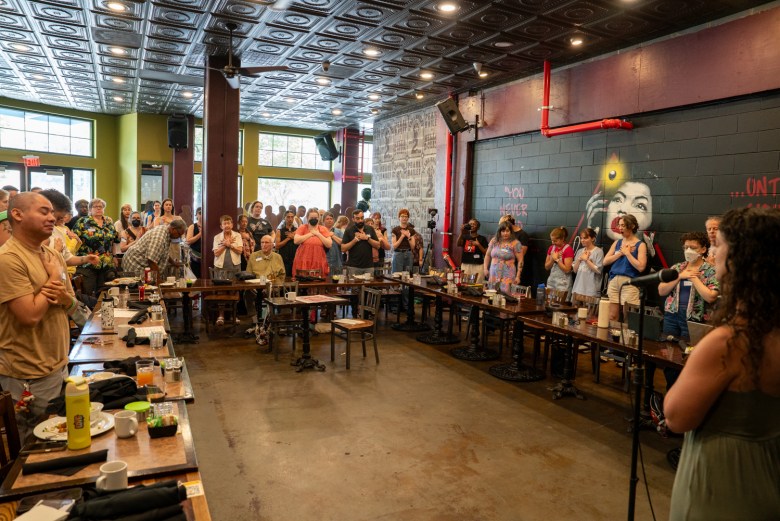
Chris Hornig, the only member of the board of directors who was present in person for July’s town hall, was careful to say that he was not there to speak for the board. But he did make a plea for donations saying, “I absolutely hope that those of you who have something extra to give Dance Place can give it in this period because the board needs energy, the organization needs money, and there are great things possible coming out of this I hope.” Hornig’s ask was met with silence.
A Problem Typically Solved With a Bucket
Ronya-Lee Anderson, a dance professor at American University and a commissioned choreographer at Dance Place, attended the town hall. “When I met with André over coffee when he first arrived here he said that, I quote ‘Dancers are needy,’” she said.
Choreographer Emily Ames was commissioned by Dance Place to present a 50-minute work in 2025. During the town hall, she said she’d been left in the lurch after the technical director departed the organization weeks before her show. “No interim technical director was implemented,” Ames said. “Myself and my choreographer were in the booth googling ‘how to use a lightboard.’”
Choreographer Brendan Drake was even more blunt. “André is a monster,” he said at the town hall. Drake’s work Ceremonials was performed at Dance Place in July. “You can tell him I said that.”
Speaking with City Paper, Drake says he had to ask multiple times for students from Dance Place’s summer camps to be kept out of the theater during Ceremonials rehearsals.
“There’s a lot of reasons for that,” Drake explains. “My dancers were naked. Eight-year-olds don’t need to see a bunch of naked people on stage. I can only imagine what their parents would think. Maybe more importantly, they shouldn’t have access to an empty theater where there’s expensive equipment and also electrical tools … Do you want the kid to get sawed in half? They don’t have enough people on staff to even manage the children there.” Drake was careful to say he did not blame camp staff or the educational programming team at Dance Place, but rather a lack of communication between departments in conjunction with understaffing.
Drake also describes dealing with technical and facility issues during his week in the theater, including speakers and lights that were not connected, and a main curtain that was inoperable. Halfway through a rehearsal, a dancer came backstage to tell Drake water was leaking from the ceiling and creating a hazardous slick on the stage. Dance Place staff reached out to Mazelin, who had left the building.
With Ceremonials, Drake notes, “We made a very vulnerable show with nudity, with sexual scenarios. The psychology of the work went really deep, and it’s extremely traumatizing for a performer to be doing that and then suddenly have this fear that they’re going to be electrocuted.”
In an email response to Drake regarding the leak, which City Paper reviewed, Mazelin wrote: “This is a facilities and operations matter rather than one related to artistic programming or anyone on the Presentation team … Based on our experience with this leak, it is typically contained with a bucket, so my hope is that you will be able to work around it as best possible during rehearsal. If the leak becomes more significant or materially impacts the performance, we can treat it as a force majeure circumstance and discuss appropriate adjustments to the presentation of the work.”
According to Byrd and information provided by Friends of Dance Place at the town hall, Mazelin had fired the facilities director, Darien Tucker, roughly one month earlier.
Mazelin declined to discuss “the confidential circumstances surrounding the conclusion of an individual’s engagement with Dance Place,” but says Tucker was an independent contractor and not a Dance Place employee or staff member.
Regarding accusations of unsafe working conditions, Mazelin writes, “Workplace safety was a responsibility that I took very seriously. … Day-to-day production staffing and technical procedures, including safety operations, were managed within the production department, under the direct supervision of the Artistic Director.”
“Where safety concerns were brought to my attention, I expected them to be addressed appropriately and in accordance with established safety procedures,” he says.
What Happens Next?
Both founders of Dance Place, Perlo and Riley, attended the town hall. “We were able to create what I call an oasis for artists,” Perlo said via video from a hospital room in Baltimore where she’s battling cancer. “For young people, for audiences, for students, and for people that really wanted to be in the arts and to feel a part of a community; to be a jewel in the crown of the arts community throughout the United States.”

O’Meally tells City Paper he thinks “the Dance Place we have known is probably gone and that’s OK because the world is different, and presentation is different.” But not everyone shares that view according to the town hall, and the nearly 500 signatories of the Friends of Dance Place petition that was delivered to the organization’s board of directors in July.
One month later, it seems as though at least some of what was said at the town hall has been heard. On Aug. 18, Dance Place announced that Mazelin would be departing his position as executive director that same day. No explanation for his departure was given. According to a statement posted on the organization’s website thanking Mazelin for his service, his leadership contributed to “financial sustainability and long term growth.” As well as the organization’s “continued commitment to artistic excellence, and community engagement.”
That statement also clarified that the board intends to return to a model with one executive artistic director at the helm, rather than separating the roles (contrary to the demands made by Friends of Dance Place). Board member Skinner will helm the organization as a search is conducted for a new director.
“The Dance Place Board of Directors believes that the Executive Artistic Director model best supports Dance Place’s financial health and the needs of the Dance Place community,” the board wrote in an emailed statement to City Paper. “We will conduct a national search to identify a leader with the executive leadership, artistic vision, and community engagement experience needed to guide Dance Place into its next chapter.”
The statement also notes that the board has held “conversations with community members, including current and former staff, artists, and supporters” and have “been alerted to a variety of concerns and have been working actively to address them in partnership with Interim Executive Director Erin Skinner and Dance Place staff. In late September, we will host a Town Hall meeting, which we view as part of our continuing dialog with our community and our commitment to ensuring that Dance Place is a safe and welcoming place for our community to come together through movement and dance.” (The board made the same promise to Riley via an email that was shared at the July town hall.) No event currently appears in the season calendar.
The board did not respond to further questions regarding the original statement about O’Meally’s firing, the Curatorial Advisory Committee and its role, or expand on its previous statement about Mazelin’s leadership.
Mazelin, however, tells City Paper, “I am proud to have led Dance Place during a period in which the organization continued to create opportunities for artists, serve its community, and contribute meaningfully to the field despite significant challenges.”
At the town hall, Riley, choking back tears, remembered what she and Perlo built over the past four decades, and what she believes is the organization’s power to move forward. “It has taken decades to build the trust and the faith in the organization, to feel like everyone at Dance Place has woven together a creative and vibrant place for people to feel welcome. You have it, if the board will listen.”
