


A survey of European logistics providers shows that road freight operators are continuing their efforts to cut emissions, but that their customers won’t pay the extra cost of greener transport.
The data showed that cost is now their biggest obstacle to going further, compared to last year’s survey, in which cost ranked second to infrastructure. Those numbers came from the “2026 Green Compact” survey conducted by world road transport organization group IRU and supply chain software provider Trimble.
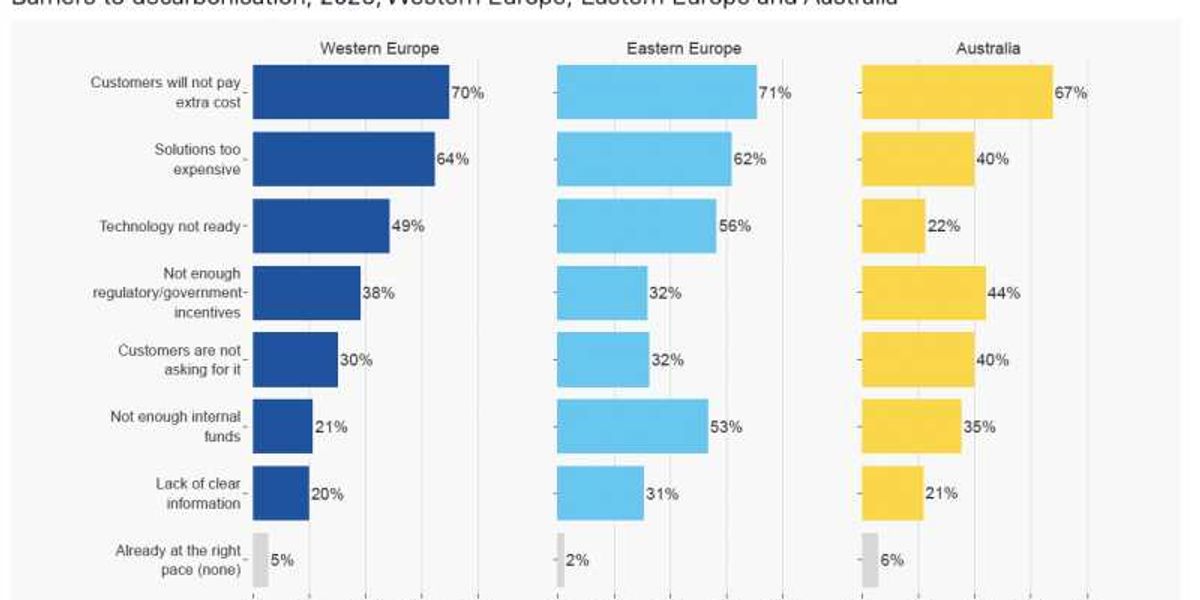
That change has come because around seven in ten operators in Western Europe (70%), Eastern Europe (71%), and Australia (67%) say their customers are unwilling to pay the additional cost of decarbonization. That’s a problem because the price of decarbonizing is high, but operators have no reliable way to pass it on. Solutions are seen as too expensive by 64% of Western European operators, 62% in Eastern Europe and 40% in Australia.
Taken together, expensive solutions and unwilling customers form a “cost wall,” researchers said. The shift is clearest in alternative fuels. Last year, the lack of charging and refueling infrastructure was the leading obstacle. But in 2026, vehicle prices have become the biggest barrier in both European regions. In Western Europe, 66% of operators cite vehicle prices, up from 49% in 2025. In Eastern Europe, the figure has risen from 52% to 78%.
And indeed, the gap is large. An electric truck costs two to three times as much as its diesel equivalent, far more than operators’ thin margins can absorb, the study said.
Still, nine in ten Western European operators (90%) take at least one measure to cut emissions, as do 87% in Eastern Europe and 55% in Australia. They start with measures that pay for themselves: routing optimization (53% in Western Europe, 62% in Eastern Europe) and eco-driving training (42% in both).
