


India’s engagement with OPEC is gaining significance at a time when the global oil market is undergoing a major transition, with changing producer dynamics, heightened energy-security concerns and growing demand from emerging economies.
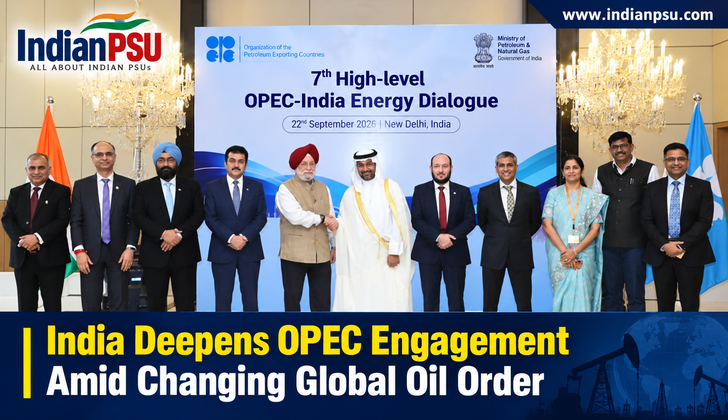
The backdrop was evident as India and the Organization of the Petroleum Exporting Countries held the 7th High-Level Meeting of the OPEC-India Energy Dialogue in New Delhi on Tuesday.
The meeting was co-chaired by Petroleum and Natural Gas Minister Hardeep Singh Puri and OPEC Secretary General Haitham Al Ghais, with discussions centred on oil market stability, energy security, investment and the short-, medium- and long-term outlook for the global energy sector.
The dialogue assumes added importance following the United Arab Emirates’ exit from OPEC with effect from May 1, 2026. The UAE was OPEC’s fourth-largest producer in 2025 and had an estimated effective crude production capacity of 4.2 million barrels per day. The US Energy Information Administration said the UAE’s departure reduced OPEC’s share of global crude production and production capacity.
The UAE’s exit, however, has not brought an end to the wider OPEC+ production framework. Saudi Arabia continues to remain a key participant, alongside Russia, Iraq, Kuwait, Kazakhstan, Algeria and Oman, in the group that has continued to review production levels and market conditions through 2026.
That changing landscape makes India’s sustained dialogue with OPEC particularly relevant.
India’s energy demand at the centre of the conversation
Puri underlined India’s position as one of the world’s fastest-growing major economies and said the country would remain an important driver of global energy demand in the decades ahead.
He stressed that sustained dialogue between producers and consumers was essential to support investment, strengthen energy resilience and ensure reliable energy supplies for global economic growth and development.
For India, the issue goes beyond crude oil prices alone. Supply security, shipping routes, refinery economics, investment in upstream production and the ability of major producers to respond to changing demand are all becoming increasingly important elements of the country’s energy strategy.
Puri also appreciated OPEC’s efforts to promote stability and transparency in global energy markets and called for closer cooperation between India and OPEC to advance a balanced, stable and predictable global energy market.
OPEC looks to India
For OPEC, India represents a market whose importance is expected to increase as the country’s economy and energy requirements expand.
Al Ghais said dialogue with India was a priority for OPEC because of India’s importance in the current global energy landscape and the fact that this importance would increase in the decades ahead.
He noted that the OPEC-India Energy Dialogue is now 11 years old, having been launched in New Delhi in 2015.
The Secretary General also described India’s approach to energy challenges as balanced, realistic and pragmatic, saying many of India’s energy priorities are aligned with those of OPEC.
The comments underline a central feature of the producer-consumer relationship: while OPEC’s principal role is associated with coordination among oil-producing countries, its long-term influence also depends on its engagement with major consuming economies.
Investment emerges as a common concern
Investment was another important theme at the meeting.
The global energy industry faces the simultaneous challenge of meeting rising demand while dealing with geopolitical risks, changing energy policies and the transition towards lower-carbon energy systems.
OPEC itself has argued that continued investment will be necessary to meet future oil demand. In its 2026 World Oil Outlook, the organisation projected global oil demand could reach 124 million barrels per day by 2050 and estimated that $17.7 trillion in oil-sector investment would be required between 2026 and 2050. These are OPEC’s projections and should be viewed in that context.
For India, adequate investment across the oil and gas value chain has direct implications for the availability, affordability and reliability of energy supplies.
A changing producer landscape
The UAE’s departure is significant because it was not a marginal producer within OPEC. According to the EIA, the UAE produced an average of 3.4 million barrels per day of crude oil in 2025 and held estimated effective production capacity of 4.2 million barrels per day. Saudi Arabia remained the largest producer and the most influential OPEC member, with an estimated 11.6 million barrels per day of effective production capacity in 2025.
At the same time, OPEC+ continues to operate as a broader production-coordination mechanism. In September, Saudi Arabia, Russia, Iraq, Kuwait, Kazakhstan, Algeria and Oman reaffirmed their commitment to market stability and agreed to maintain September 2026 required production for October.
The changing composition of the producer group therefore does not diminish the importance of India’s engagement with major oil-producing countries. If anything, it makes sustained producer-consumer dialogue more relevant.
India seeks predictability
For New Delhi, the immediate priority remains clear: energy security and predictability.
India’s rapidly expanding economy requires dependable energy supplies, while global oil markets remain exposed to geopolitical developments and disruptions to production and transportation.
The OPEC-India dialogue provides a structured platform for India to engage with one of the world’s principal oil-producing institutions while also communicating the concerns of a major and rapidly growing consumer.
The meeting concluded with both sides underlining the importance of deeper energy cooperation.
The 8th High-Level Meeting of the OPEC-India Energy Dialogue will be held in Vienna, Austria, at a mutually convenient date.
The location may change, but the underlying equation is becoming increasingly important: OPEC needs major consumers such as India, while India needs stable and reliable relationships with the world’s major energy producers.
